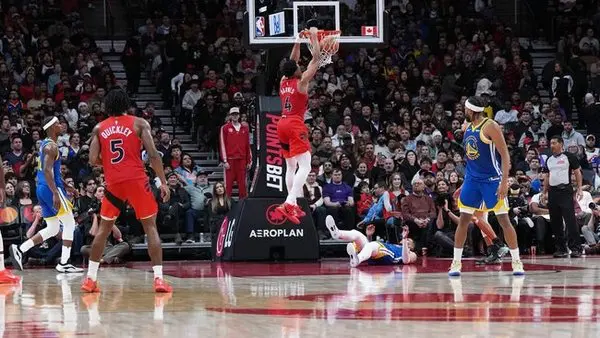
Can a shorthanded Magic squad survive the North, or will Scottie Barnes continue his historic tear? Bryan Bash breaks down the injury landscape and provides his top ATS pick for Monday’s Eastern Conference clash.
The Setup: Magic at Raptors
The Magic are laying 1.5 points (Bovada) on the road in Toronto, and on the surface, this number makes sense. Orlando sits 18-14 and fifth in the East, while Toronto checks in at 19-14 in fourth. These teams are separated by a single game in the standings, and the market is essentially calling this a pick’em with a slight lean toward the visitors.
Here’s the thing — that lean exists for a reason. Orlando has been one of the league’s more consistent road teams at 7-8 away from home, and they’re coming off a solid 110-106 win in Portland where Desmond Bane dropped 23 and Anthony Black added 22. Meanwhile, Toronto just survived Golden State in overtime at home, with Scottie Barnes putting up a monster 23-point, 25-rebound, 10-assist triple-double in that 141-127 win.
But let me walk you through why this line exists, and more importantly, why I think the injury situation tilts this matchup more than the spread suggests. Orlando is dealing with significant rotation questions — Jalen Suggs is out with a hip injury, Goga Bitadze is questionable with a knee issue, and Moritz Wagner remains sidelined. Toronto isn’t fully healthy either, with Jakob Poeltl out due to back problems, but the Magic’s backcourt depth takes a bigger hit here.
Game Info & Betting Lines
Game Time: December 29, 2025, 7:30 ET
Venue: Scotiabank Arena
Spread: Magic -1.5 (-110) | Raptors +1.5 (-110)
Total: 222.0 (Over -110 | Under -110)
Moneyline: Magic -125 | Raptors +102
Why This Line Exists
The market opened Orlando as a short road favorite, and that tells you everything about how these two teams match up on paper. The Magic bring a 18-14 record with legitimate two-way balance — Franz Wagner averaging 22.7 points per game, Paolo Banchero at 19.8 points and 8.2 rebounds, and Bane contributing 19.2 points with 4.6 assists. That’s three guys who can create offense in different ways.
Toronto counters with Brandon Ingram at 22.0 points per game, Barnes at 19.3 points with 8.4 rebounds and 5.2 assists, and RJ Barrett chipping in 18.9 points. The offensive firepower is nearly identical when you compare the top-end talent.
So why does Orlando get the nod? The answer comes down to recent form and road performance. The Magic have shown they can win away from home, posting that 7-8 road mark, and they just proved it again in Portland. Toronto is 9-7 at home, which is solid but not dominant. The Raptors needed overtime to put away a Warriors team that’s been inconsistent this season, and that game went to 141-127 — a pace and scoring output that suggests defensive issues.
The total sitting at 222.0 reflects two teams that can score but also have defensive identity. That’s not just a stat — it’s how this game tilts. The market expects a competitive game that stays within a possession or two throughout, with enough offensive talent to push toward the mid-220s if the pace cooperates.
Magic Breakdown: What You Need to Know
Orlando’s strength this season has been their ability to get contributions from multiple sources. Wagner leads the way at 22.7 points per game with 6.1 rebounds and 3.7 assists, providing both scoring punch and playmaking. Banchero gives them 19.8 points and 8.2 boards, operating as a versatile forward who can attack mismatches. Bane’s addition has been huge — 19.2 points with 4.6 assists means the Magic have a third legitimate creator.
The concern heading into Toronto is the backcourt depth. With Suggs out, Orlando loses a key perimeter defender and secondary ball-handler. That’s a real problem against a Raptors team that features Barnes as a point-forward who can exploit size advantages. If Bitadze can’t go, the Magic also lose interior depth behind their starting frontcourt, which matters when Poeltl is out for Toronto but they still have size to throw at you.
Orlando’s 11-5 home record versus 7-8 on the road shows a team that’s comfortable at home but has to grind out wins away. They proved in Portland they can do it, but that was against a Trail Blazers team that’s struggled all season. Toronto represents a significant step up in competition, especially with the Raptors coming off that emotional overtime win against Golden State.
Raptors Breakdown: The Other Side
Toronto’s offensive balance is what keeps them competitive every night. Ingram at 22.0 points, Barnes at 19.3 with elite rebounding and playmaking, and Barrett at 18.9 gives them three guys who can get their own shot. That Barnes triple-double against Golden State wasn’t a fluke — he’s averaging 8.4 rebounds and 5.2 assists, making him one of the more versatile forwards in the league.
The main risk here is what that overtime game takes out of them. Playing 53 minutes in a high-scoring, emotionally draining win over the Warriors could leave Toronto flat for this spot. They’re also missing Poeltl, who provides rim protection and interior presence. Without him, the Raptors have to play smaller or rely on less experienced bigs to handle Orlando’s size.
Toronto’s 9-7 home record isn’t intimidating, but it’s not a red flag either. They’ve been better on the road at 10-7, which suggests they’re comfortable playing in hostile environments and don’t necessarily need Scotiabank Arena to perform. That 141-127 overtime win shows they can score in bunches, but it also reveals defensive vulnerability when the pace gets loose.
The Matchup: Where This Game Gets Decided
Once you dig into the matchup data, this game comes down to which team can control pace and execute in the halfcourt. Orlando wants to slow things down and leverage their size advantage with Banchero and Wagner operating in the mid-range and around the basket. Toronto thrives when Barnes can push in transition and create advantages before the defense is set.
I keep coming back to this efficiency gap in the backcourt. Without Suggs, Orlando loses a key defender who would typically match up with Barrett or help contain Barnes on the perimeter. That forces the Magic to adjust their rotations, likely asking Wagner or Bane to take on tougher defensive assignments. Over 96 possessions, that extra wear on your primary scorers adds up.
The total at 222.0 feels about right when you factor in both teams’ ability to score and the likely pace. Toronto just put up 141 in overtime against Golden State, but that was in extra time with a frantic pace. In regulation, they scored 127 over what was essentially 48 minutes of basketball. Orlando scored 110 against Portland in a more controlled game. Split the difference, and you’re looking at a game that pushes toward 220-225 if both teams execute.
This matchup narrows the margin more than the line suggests because of the injury situations on both sides. Orlando is without key rotation pieces, but Toronto is also missing Poeltl and coming off an emotional overtime game. The question becomes whether the Magic’s road experience and balanced scoring can overcome their depth issues against a Raptors team that might be fatigued.
Bash’s Best Bet & The Play
I’ve accounted for the home court — and it still doesn’t get Orlando there. The Magic are laying 1.5 on the road without Suggs and potentially without Bitadze, facing a Raptors team that just proved they can score with anyone in that Warriors game. Toronto gets Barnes back after that monster performance, Ingram is rolling at 22.0 per game, and Barrett gives them a third option who can attack.
The main risk here is that Orlando’s superior road record and recent win in Portland carries over, and they simply execute better in crunch time. But I’m betting on Toronto’s depth advantage and home crowd to make the difference in a game that should come down to the final possession.
The Play: Raptors +1.5 (-110) for 2 units
This line should be closer to a pick’em given the injury situations, and getting 1.5 points with the home team that has comparable talent feels like value. I expect a tight game throughout, and in those spots, I want the points and the home crowd. Toronto covers in a game that finishes within a single possession.