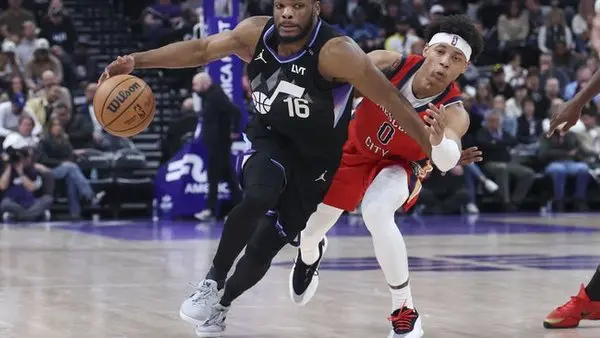
The public is rushing to the window to back the Pelicans after they hung 129 on Utah Thursday, but Bryan Bash is smelling a rat and grabbing the points with the home dog.
The Setup: New Orleans Pelicans at Utah Jazz
The Pelicans are laying 7 points on the road in Salt Lake City on Saturday night, and that number screams recency bias after Saddiq Bey’s 42-point explosion Thursday in this same building. New Orleans won 129-118 two nights ago, but the projection here sits at Utah +0.8 points when you account for season-long efficiency. That’s a 7.8-point edge against the spread favoring the home dog, and this line doesn’t add up once you run the efficiency math. The market’s disrespecting Utah here based on one game, but the possessions math tells a different story when you zoom out beyond Thursday’s highlight reel.
Both teams sit in the Western Conference basement at 18-42 and 18-41 respectively, but the underlying numbers reveal why this spread is too wide. New Orleans posts a -5.2 net rating compared to Utah’s -7.6, a gap of just 2.4 points per 100 possessions. Over the expected 102.2 possessions in this pace blend, that translates to barely a bucket separating these squads. Yet the Pelicans are getting nearly a full touchdown on the road against a team that’s 11-19 at home but covers at a respectable clip in close games. I’ve seen this movie before—the market overreacts to a blowout between bad teams, and the regression comes fast.
Game Info & Betting Lines
New Orleans Pelicans (18-42) at Utah Jazz (18-41)
Date: Saturday, February 28, 2026
Time: 9:30 ET
Venue: Delta Center
TV: Home: KJZZ-TV, Jazz+ | Away: GCSEN, Pelicans.com, NBA League Pass
Current Betting Lines (Bovada):
Spread: Pelicans -7.0 (-110) | Jazz +7.0 (-110)
Total: Over 245.0 (-110) | Under 245.0 (-110)
Moneyline: Pelicans -270 | Jazz +220
Why This Line Exists
The market hung 7 on New Orleans because Bey went nuclear Thursday and the Pelicans have won three straight. But when you strip away the narrative and focus on the season-long body of work, this spread collapses. The net rating differential of -2.4 per 100 possessions favoring New Orleans barely justifies a 2-point spread, let alone 7. Over 102.2 possessions—the pace blend between New Orleans’ 101.2 and Utah’s 103.1—that efficiency gap projects to roughly 2.5 points of separation before you even factor in home court.
The offensive and defensive mismatches actually favor New Orleans in both directions, but not by the margin this line suggests. When New Orleans’ offense faces Utah’s defense, you’re looking at 112.6 offensive rating against 120.8 defensive rating, a -8.2 gap. When Utah’s offense meets New Orleans’ defense, it’s 113.2 against 117.8, a -4.6 differential. Both teams struggle defensively, but Utah’s porous 120.8 defensive rating is the worst mark in this matchup. The problem for the spread is that New Orleans isn’t good enough offensively to exploit it consistently on the road without Trey Murphy III, who remains out with a right shoulder contusion.
The total at 245.0 reflects the pace and both teams’ offensive capabilities, but my model projects 237.3, creating a 7.7-point edge toward the under. This pace blend pushes possessions, but neither team shoots efficiently enough to consistently cash high totals against even weak defenses.
New Orleans Pelicans Breakdown: What You Need to Know
The Pelicans are 7-21 on the road and post a 112.6 offensive rating that ranks among the league’s worst. Zion Williamson remains the most efficient scorer at 58.5% from the field, averaging 21.9 points, but his lack of three-point shooting (25.0%) limits spacing. Saddiq Bey’s 42-point outburst Thursday was an outlier—he averages 17.2 points on 45.5% shooting with a 35.5% three-point mark. Expecting a repeat performance in a back-to-back situation is wishful thinking.
Dejounte Murray returned from a torn Achilles and played Thursday, contributing 17 points and nine assists, but he’s listed as out for Saturday’s first leg of this back-to-back. That removes a critical playmaker who posted 6.0 assists per game in limited action. Without Murray, the ball-handling responsibilities shift, and New Orleans’ 59.6% assist rate takes a hit. Jordan Poole and Bryce McGowens will absorb minutes, but neither offers Murray’s two-way impact.
The Pelicans’ clutch numbers reveal mediocrity: 11-21 record in clutch situations with a -1.9 plus/minus. They shoot just 42.5% in the clutch with a brutal 27.7% from three. This is exactly the spot where New Orleans burns you—they look competent in blowouts but can’t execute in tight games.
Utah Jazz Breakdown: The Other Side
Utah’s 18-41 record masks some competitiveness in close games. They’re 12-13 in clutch situations with a +1.0 clutch plus/minus, shooting 44.9% from the field and 35.4% from three when it matters. That’s a 13.6% clutch win rate gap over New Orleans, and it matters in a game projected to be competitive throughout.
The injury situation decimates Utah’s depth. Lauri Markkanen is out with an injury suffered in Wednesday’s practice, removing their leading scorer at 26.7 points per game on 47.7% shooting. Keyonte George remains questionable with a right ankle sprain after missing six straight, though he’s nearing a return. Walker Kessler, Jaren Jackson Jr., Jusuf Nurkic, and Vince Williams Jr. are all out for the season, gutting the frontcourt rotation.
Brice Sensabaugh (12.9 points, 45.6% shooting) and Ace Bailey (23 points Thursday) will carry the scoring load, but Utah’s 113.2 offensive rating barely edges New Orleans. The Jazz shoot 58.0% true shooting compared to New Orleans’ 56.5%, a 1.4-point edge, but that’s marginal. Their 53.8% effective field goal percentage versus New Orleans’ 52.5% tells the same story—slight shooting advantages that don’t justify a 7-point spread against them.
The Matchup: Where This Game Gets Decided
This game gets decided in the margins, and the efficiency gap is too wide to ignore here—except it’s not wide enough to support 7 points. Over 102.2 possessions, the 2.4 net rating gap projects to roughly 2.5 points of separation. Factor in a modest 2-point home court advantage for Utah, and you’re looking at a near pick’em based on season-long data.
The turnover battle slightly favors New Orleans, with Utah posting a 13.6% turnover rate compared to New Orleans’ 12.2%, a 1.3-point edge in ball security. But Utah’s 70.6% assist rate dwarfs New Orleans’ 59.6%, suggesting better ball movement when they do protect possession. The offensive rebounding rates are essentially identical—Utah at 26.4%, New Orleans at 27.0%—so second-chance opportunities won’t tilt the game.
The pace blend changes everything in this matchup. Both teams want to push tempo, and 102.2 possessions creates more variance. But variance cuts both ways, and New Orleans doesn’t have the offensive firepower on the road without Murphy to consistently pull away. Utah’s home splits show 11-19 straight up but better cover rates in competitive spots, and this projects as exactly that type of game.
The writing’s on the wall with this matchup: two bad teams separated by minimal efficiency differences, one coming off an emotional win, the other desperate for any positive result at home. New Orleans won’t shoot 50% from three again like Thursday, and Utah won’t allow 129 points in consecutive games. Regression favors the home dog in a significant way.
Bash’s Best Bet & The Play
I’m taking the points all day long with Utah +7.0. The 7.8-point edge against the spread is too substantial to ignore when the underlying numbers suggest a game decided by 3 points or fewer. New Orleans is 7-21 on the road, missing Murray for this leg of the back-to-back, and facing a Utah team that—despite catastrophic injuries—competes harder at home in clutch situations.
The main risk is Zion and Bey catching fire again, but Thursday’s shooting percentages aren’t sustainable in a back-to-back road spot. Utah’s depleted roster still features enough scoring from Sensabaugh and Bailey to keep this within a possession, and their 48% clutch win rate versus New Orleans’ 34.4% provides confidence in a tight finish.
The projected total of 237.3 versus the market’s 245.0 also creates value on the under, but the spread offers cleaner value. this number points to overreaction to one explosive performance, and the possessions math tells us this game should be decided in the final minutes.
BASH’S BEST BET: Utah Jazz +7.0 for 2 units.