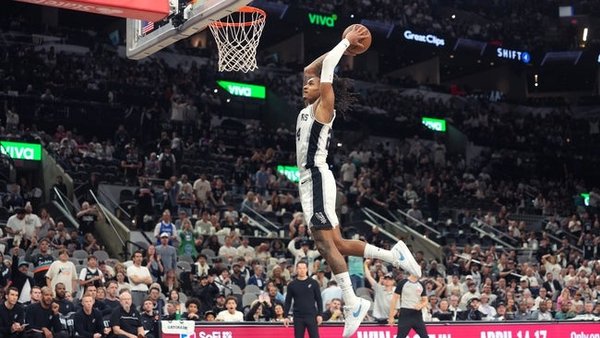
Bash finds value in a playoff opener where the market may be overestimating the gap between a resilient underdog and a vulnerable favorite in a matchup that projects tighter than the double-digit spread suggests.
The Setup: Trail Blazers at Spurs
San Antonio opens as an 11.5-point home favorite against Portland in Game 1 of their first-round Western Conference playoff series, and that number feels inflated given the matchup context. The Spurs finished 62-20 and earned the 2-seed, while the Blazers clawed through the play-in tournament with a gutsy comeback win in Phoenix. On paper, this looks like a mismatch. But the projection here sits at just 6.4 points in San Antonio’s favor—a full five points tighter than what the market is offering.
Portland brings playoff momentum after Deni Avdija’s 41-point heroics against the Suns, erasing an 11-point fourth-quarter deficit with clutch execution down the stretch. That’s the kind of mental edge that carries into a series opener. San Antonio, meanwhile, is coming off a loss to Denver where Victor Wembanyama sat with a rib contusion. His status looms large, but even with him healthy, this spread asks the Spurs to cover a number they haven’t consistently hit against quality opponents.
The efficiency gap is real—San Antonio’s +8.4 net rating dwarfs Portland’s -0.4 mark—but playoff basketball compresses possessions and tightens rotations. The Blazers aren’t a pushover at 42-40, and they’ve shown they can execute in crunch time. This line exists because the market respects San Antonio’s regular-season dominance. The question is whether that dominance translates to double-digit separation in a playoff environment where Portland has nothing to lose.
Game Info & Betting Lines
Matchup: Portland Trail Blazers at San Antonio Spurs
Date: Sunday, April 19, 2026
Time: 7:30 PM ET
TV: NBC, Peacock
Spread: Spurs -11.5 (-105) | Blazers +11.5 (-115)
Total: 221.0 (Over/Under -110)
Moneyline: Spurs -600 | Blazers +425
Why This Line Exists
The market is pricing San Antonio’s regular-season body of work—62 wins, a top-tier offense at 118.7 points per 100 possessions, and a stout defense that held opponents to 110.4. The Spurs shot 48.3% from the field, assisted on nearly 65% of their buckets, and protected the ball with just 13.5 turnovers per game. They went 32-8 at home, and the market assumes that dominance continues in the postseason.
But Portland just survived a playoff atmosphere in Phoenix and showed real poise when the game tightened. The Blazers hit 46.1% from the field in clutch situations this season and went 21-22 in games decided by five points or fewer in the final five minutes. That’s not a team that folds under pressure. The market sees a 2-seed against a 7-seed and defaults to double digits. The matchup tells a different story.
The projection accounts for pace—101.2 possessions in a blended model—and recognizes that San Antonio’s offensive edge over Portland’s defense sits at 5.2 points per 100 possessions, while Portland’s offense against San Antonio’s defense checks in at 2.7 points. Those aren’t blowout margins. My model projects a 6.4-point game, which means the Spurs would need to outperform their season-long efficiency profile by a significant margin to justify laying 11.5.
Trail Blazers Breakdown
Portland’s offense runs through Deni Avdija, who’s averaging 24.2 points, 6.9 rebounds, and 6.7 assists while carrying the playmaking load. His performance in Phoenix—41 points including the go-ahead and-one with 16 seconds left—wasn’t a fluke. He’s been Portland’s best player all season, shooting 46.2% from the field and creating advantages off the bounce.
Shaedon Sharpe adds 20.8 points per game with legitimate scoring punch, and Jerami Grant (18.6 PPG, 38.9% from three) provides spacing and defensive versatility. Jrue Holiday stabilizes the backcourt with 16.3 points and 6.1 assists, and his playoff experience matters in a series opener. The Blazers don’t have elite offensive firepower, but they generate 113.1 points per 100 possessions with a true shooting percentage of 57.1%. That’s good enough to stay in games.
Defensively, Portland allows 113.5 per 100, which isn’t lockdown but also isn’t exploitable. They force 17.3 turnovers per game and crash the offensive glass at a 31.3% rate—the second-chance opportunities could keep possessions alive against a Spurs team that rebounds at just 26.2% on the offensive end. Portland’s 18-23 road record isn’t inspiring, but playoff intensity changes the calculus.
Spurs Breakdown
Victor Wembanyama is the engine—25.0 points, 11.5 rebounds, and 3.1 blocks per game on 51.2% shooting. His rim protection alters everything, and his ability to stretch the floor (34.9% from three) creates impossible defensive matchups. If he’s compromised by the rib injury, this line loses its foundation. The recent game recap shows he sat against Denver, and there’s no confirmation he’s fully cleared.
De’Aaron Fox (18.6 PPG, 6.2 APG) and Stephon Castle (16.7 PPG, 7.4 APG) run the offense with pace and precision. Devin Vassell (13.9 PPG, 38.4% from three) and Keldon Johnson (13.2 PPG, 51.9% shooting) provide secondary scoring. San Antonio’s 28.1 assists per game reflect a ball-movement system that thrives on open looks and transition opportunities.
The Spurs’ 118.7 offensive rating is elite, but their 100.7 pace suggests they don’t run teams off the floor—they execute in the halfcourt. Their 59.5% true shooting and 55.9% effective field goal percentage are excellent, but those numbers come against regular-season defenses. Portland’s defensive rating of 113.5 isn’t elite, but it’s also not a sieve. The Spurs’ clutch record of 24-12 with a +1.4 plus-minus in tight games is solid, but Portland’s 21-22 clutch record shows they don’t buckle.
The Matchup
This game projects to 101.2 possessions, which favors a controlled tempo rather than a track meet. San Antonio’s offense against Portland’s defense creates a 5.2-point edge per 100 possessions, while Portland’s offense against San Antonio’s defense sits at 2.7 points. Those mismatches don’t scream blowout—they suggest a game that stays within single digits for long stretches.
The shooting gap matters. San Antonio’s 2.4-percentage-point edge in true shooting and effective field goal percentage translates to better shot quality, but Portland’s 31.3% offensive rebounding rate compared to San Antonio’s 26.2% means the Blazers will get extra possessions. That 5.0-percentage-point gap in offensive rebounding is the largest edge in this matchup, and it tilts toward the underdog.
Turnover differential also plays. San Antonio’s 11.8% turnover rate is excellent, while Portland sits at 14.6%. That 2.8-point gap gives the Spurs more clean possessions, but it’s not enough to justify an 11.5-point spread in a playoff game where both teams will tighten rotations and limit mistakes.
The clutch data tells the story: San Antonio wins 66.7% of clutch games compared to Portland’s 48.8%, but that 17.9% gap doesn’t translate to double-digit blowouts. It means close games tilt toward the Spurs, not that they run away from quality opponents. Portland just proved in Phoenix they can execute when the game tightens. This matchup projects to a 230.5 total, well above the 221.0 market number, which suggests both offenses will find success.
Bash’s Best Bet & The Play
The Play: Trail Blazers +11.5 (-115)
This spread overvalues San Antonio’s regular-season dominance and underestimates Portland’s ability to stay competitive in a playoff environment. The projection sits at 6.4 points, giving the Blazers a five-point cushion against the spread. That’s significant value on a team that just executed a fourth-quarter comeback in a must-win play-in game.
Portland’s offensive rebounding edge and Avdija’s current form keep this game closer than the market expects. San Antonio’s reliance on Wembanyama—who sat in their last game—adds uncertainty, and even if he plays, the Blazers have the personnel to make this a grind-it-out contest. Playoff basketball compresses margins, and 11.5 points is too many to lay on a Spurs team that hasn’t shown they can consistently blow out quality opponents.
The risk is straightforward: if Wembanyama dominates and San Antonio’s shooting efficiency spikes, the Spurs can pull away. But the projection, the matchup data, and Portland’s recent execution all point to a game that stays within single digits deep into the fourth quarter. Take the points.