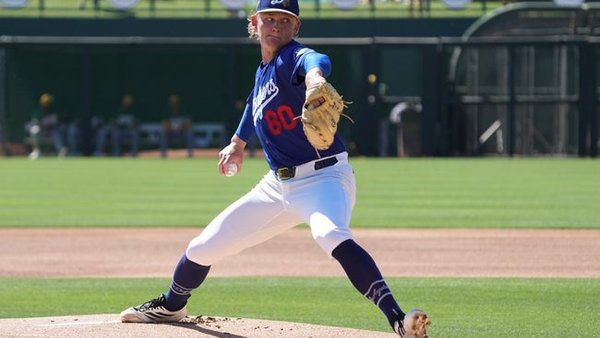
The market sees yesterday’s 8-2 blowout as noise, but I’m seeing a pitching mismatch that wasn’t a fluke — one that creates legitimate value on the run line despite the chalky price.
Ryne Nelson vs Emmet Sheehan: Arizona Diamondbacks at Los Angeles Dodgers Betting Preview
Opening Day brings the usual suspects: inflated lines, home cooking, and everyone trying to read too much into small samples. But when you strip away the pageantry, this comes down to a simple reality — **Emmet Sheehan** brings elite strikeout stuff that **Ryne Nelson** simply can’t match, and yesterday’s 8-2 result wasn’t lucky timing.
The Dodgers’ 5-run fifth inning explosion came with two strikes on three of their first four hits against Zac Gallen. That’s not random variance — that’s a disciplined lineup working counts and capitalizing on mistakes. Now they get a softer target in Nelson, while Arizona faces Sheehan’s 10.9 K/9 rate that dominated in limited action last season (2026).
The market has this priced as a moderate Dodgers victory, but the pitching gap suggests something closer to a comfortable win than a nail-biter.
Game Info & Betting Lines
- Date/Time: Friday, March 27, 10:10 PM ET
- Venue: Dodger Stadium (Park Factor: 0.98)
- Probable Starters: Ryne Nelson (ARI) vs Emmet Sheehan (LAD)
- Moneyline: Arizona +194 / Los Angeles -240
- Run Line: Los Angeles -1.5 (-115) / Arizona +1.5 (-105)
- Total: 8.5 (O -115 / U -105)
Why This Number Is Close
The market is balancing legitimate concerns about early-season variance against a clear talent gap. Arizona has enough pieces to hang around — **Ketel Marte** (.893 OPS in 2026) and **Corbin Carroll** (.883 OPS) can change any game with one swing, and Nelson did post a respectable 3.39 ERA with a 7-3 record last season.
The Dodgers’ -240 moneyline price also factors in typical home opener enthusiasm and the psychological impact of yesterday’s dominant performance. You’re paying premium for what looks like a sure thing.
But here’s where I think the market is slightly wrong — the run line at -1.5 (-115) doesn’t fully account for the strikeout differential and bullpen advantage. This isn’t just about the Dodgers winning; it’s about how they win. Sheehan’s ability to miss bats (10.9 K/9 vs Nelson’s 7.7 K/9) creates earlier pressure on Arizona’s lineup, while the Dodgers’ superior offensive depth (.768 OPS vs .757 OPS in 2026) provides multiple ways to extend leads.
What Separates the Pitching
The numbers tell a clear story: **Sheehan’s 2.82 ERA and 0.97 WHIP** from 2026 dwarf **Nelson’s 3.39 ERA and 1.07 WHIP**. But it’s the strikeout gap that creates the real betting edge here.
Sheehan’s 10.9 K/9 rate means he’s getting swings and misses at an elite level, limiting Arizona’s ability to string together rallies through contact. Nelson’s 7.7 K/9 is perfectly adequate, but it puts more balls in play against a Dodgers lineup that proved yesterday they can work counts and capitalize on mistakes. When **Shohei Ohtani** (1.014 OPS in 2026) and **Will Smith** (.901 OPS) are fouling off two-strike pitches and staying alive, that’s where Nelson’s margin for error shrinks.
The bullpen comparison amplifies this edge. The Dodgers’ 3.95 ERA from their relief corps (2026) gives them late-game protection that Arizona’s 4.49 bullpen ERA can’t match. In tight run line scenarios, that seventh-inning separation often comes from superior depth pieces, not just the starters.
Sheehan creates low-contact innings that preserve leads, while Nelson allows enough baserunners (1.07 WHIP) to keep Arizona vulnerable to multi-run frames. Yesterday’s fifth-inning explosion wasn’t an outlier — it was the natural result of a deep lineup working a contact pitcher.
The Pushback
The concern is more significant than the raw numbers suggest — we’re dealing with Opening Week rust, limited recent data on both arms, and the very real possibility that early-season variance overwhelms any pitching edge. Nelson’s ability to limit hard contact when he commands the zone creates legitimate doubt about this spread. His 7-3 record from 2026 wasn’t built on lucky sequencing; it came from attacking strikes and trusting his defense.
The real friction here is sample size versus skill. Sheehan’s 10.9 K/9 comes from just 73.1 innings pitched in 2026, while Nelson logged 154 innings of proven durability. In a sport where veteran execution often trumps raw stuff, Nelson’s track record of limiting big innings (1.07 WHIP) suggests he won’t crumble against this Dodgers lineup like Gallen did yesterday.
Arizona’s offense also presents more danger than yesterday’s result indicates. Marte and Carroll combined for 59 home runs last season, and both possess the plate discipline to work deeper counts against Sheehan’s power arsenal. If Nelson can keep this game within 1-2 runs through six innings, Arizona’s offensive ceiling creates legitimate backdoor cover scenarios.
The Dodgers are also managing early-season pitch counts carefully, meaning Sheehan might not work deep enough for his strikeout advantage to fully manifest. If both starters exit after five innings, we’re looking at a bullpen game where Arizona’s depth has proven adequate in past playoff runs.
Rejected Angles: Total and First Five Considerations
I considered backing the under 8.5, particularly given Dodger Stadium’s pitcher-friendly environment and both teams working through early-season timing issues. The combination of Sheehan’s strikeout upside and potential limited pitch counts could create a lower-scoring affair than the market anticipates.
The First Five innings under also presents value, as both starters should be on restricted pitch counts and working carefully through opposing lineups. Nelson’s demonstrated ability to navigate trouble early, combined with Sheehan’s swing-and-miss stuff, could keep this game scoreless or 1-0 through the initial five frames.
However, yesterday’s offensive explosion demonstrates this Dodgers lineup’s ability to break games open quickly, even against quality pitching. The total feels properly calibrated around 8.5, while the F5 market doesn’t offer enough edge over the full-game run line to warrant splitting the difference.
Run Environment & Game Shape
Dodger Stadium’s 0.98 park factor creates a slightly pitcher-friendly environment that should keep this game in the 8-9 run range the market expects. This isn’t Coors Field where one swing changes everything — it’s a park where sustained offensive pressure matters more than individual explosive moments.
The projected game shape favors methodical scoring over sudden eruptions. Sheehan’s strikeout ability creates early leads through quick innings, while the Dodgers’ offensive depth allows them to add insurance runs in the middle frames. This environment amplifies the pitching edge rather than neutralizing it.
With the total set at 8.5, we’re looking at a moderate-scoring game where a 6-3 or 5-2 Dodgers victory covers the run line comfortably. The park factor supports the under on the total while creating the perfect environment for a Dodgers spread cover.
The Bet
**Los Angeles Dodgers -1.5 (-115)**
The strikeout differential creates the foundation, but it’s the secondary edges — bullpen depth, offensive consistency, and home field timing — that push this over the finish line. Nelson can pitch respectably and keep Arizona competitive, but Sheehan’s upside combined with yesterday’s demonstrated offensive capability suggests a multi-run Dodgers victory is more likely than the current price implies.
This isn’t about expecting a blowout. It’s about recognizing when the market undervalues a skill-based edge in favor of broad competitive balance. The Dodgers have multiple ways to win by two or more runs, while Arizona needs everything to break right just to keep it close.