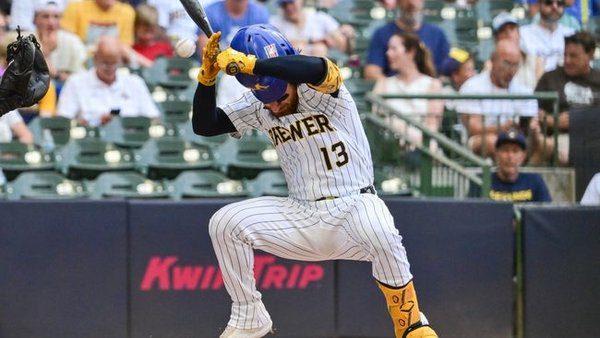
The market favors the home team, but the starting pitching matchup tells a different story. Kyle Harrison’s elite strikeout rate gives him the edge to shut down a Kansas City lineup that struggled for consistency during yesterday’s doubleheader.
Kyle Harrison vs Kris Bubic: Milwaukee Brewers at Kansas City Royals Betting Preview
The market sees a tight Sunday finale between two 1-0 pitchers with microscopic ERAs, making Kansas City a moderate home favorite at -126. But beneath those glossy early-season numbers lies a significant gap in strikeout ability and command that the pricing doesn’t fully capture.
Harrison‘s 14.4 K/9 rate through five innings represents legitimate swing-and-miss stuff, while Bubic‘s 6.0 K/9 suggests he’s living on weaker contact and defensive execution. When you factor in Milwaukee’s explosive five-run outburst in the doubleheader opener — showing they can attack Kansas City pitching when the offense clicks — getting the Brewers at +104 feels like the market undervaluing the superior arm.
Game Info & Betting Lines
- Date/Time: Sunday, April 5, 2026, 2:10 PM ET
- Venue: Kauffman Stadium (0.95 park factor — slightly pitcher-friendly)
- Probable Starters: Kyle Harrison (0-0, 1.80 ERA) vs Kris Bubic (1-0, 1.50 ERA)
- Moneyline: Milwaukee +104 / Kansas City -126
- Run Line: Kansas City -1.5 (+163) / Milwaukee +1.5 (-199)
- Total: 7.5 (Over -117 / Under -103)
Why This Number Is Close
Kansas City’s -126 price reflects legitimate home field value and Bubic‘s perfect 1-0 record with a 1.50 ERA. The market also weights the Royals splitting Saturday’s doubleheader, proving they can score runs against Milwaukee pitching when they get their offense rolling — as evidenced by their six-run sixth inning in the nightcap.
The line also accounts for early-season variance, where small samples can make mediocre pitchers look dominant. With both starters working with fewer than 10 innings of data, the market is pricing in significant uncertainty about true talent levels.
However, the market appears to be overvaluing superficial ERA comparisons while underweighting the massive gap in strikeout ability. Harrison‘s 14.4 K/9 rate paired with superior command (1 BB in 5 IP vs 3 BB in 6 IP) suggests a pitcher who controls the strike zone and generates consistent outs. Getting Milwaukee at plus money with that kind of pitching edge feels like the market is still reacting to Kansas City’s game two explosion rather than properly handicapping the Sunday matchup.
What Separates the Pitching
The core difference between these starters lies in their approach to generating outs. Harrison dominates through raw stuff — his 14.4 K/9 rate indicates hitters are consistently late or fooled by his arsenal. That strikeout ability creates shorter innings and limits damage when runners do reach base, while his excellent 1.00 WHIP shows he’s not creating extra baserunners through walks or weak contact.
Bubic, by contrast, profiles as more of a pitch-to-contact starter whose 6.0 K/9 rate suggests he relies heavily on his defense and location to succeed. While his 0.83 WHIP looks impressive, that number becomes more fragile when you can’t miss bats consistently. His three walks in six innings also indicate shakier command, which could be exploited by Milwaukee hitters who showed patience and power in Saturday’s opener.
The concerning element for Kansas City is that Bubic‘s approach creates longer at-bats and higher pitch counts, potentially shortening his outing and forcing earlier reliance on a bullpen that got tagged for five runs in game one. Harrison‘s strikeout ability should allow him to work deeper into the game with more efficient innings, giving Milwaukee a better chance to avoid their own bullpen vulnerabilities.
The Pushback
The strongest case against Milwaukee centers on sample size concerns — we’re essentially betting on five innings of data from Harrison while Bubic has already proven he can win at this level with a complete game performance. Kansas City’s offense showed legitimate pop in the nightcap, scoring eight runs and proving they can adjust after getting shut down early in the doubleheader.
The Royals also benefit from last at-bat advantage in what projects as a tight, low-scoring environment. With both teams dealing with key injury absences — Milwaukee missing Jackson Chourio and Kansas City without Michael Massey — the offensive edges become harder to identify, potentially making home field the deciding factor.
But I keep coming back to the pitching matchup as the primary driver in MLB handicapping. Harrison‘s ability to miss bats and limit baserunners gives Milwaukee the cleaner path to a quality start, while Bubic‘s contact-dependent approach feels more vulnerable to variance. When you’re getting plus money on the team with the superior starter, that edge outweighs the legitimate concerns about small sample sizes.
Run Environment & Game Shape
Kauffman Stadium’s 0.95 park factor creates a slightly pitcher-friendly environment, which should amplify the advantage of having the better starter. The 7.5 total suggests the market expects a tight, low-scoring game where each team scratches across 3-4 runs — exactly the type of environment where strikeout ability becomes most valuable.
This setup favors Milwaukee’s approach with Harrison likely to work deeper into the game and create fewer high-leverage situations for Kansas City. In a game where both teams might struggle to string together rallies, having the pitcher who can escape jams with strikeouts becomes the decisive edge.
The projected scoring range of 3-5 runs per team means this game likely gets decided by one or two key sequences, making starting pitcher performance the primary factor rather than deeper lineup construction or bullpen matchups.
Joe Jensen’s Pick
JENSEN’S PICK: Milwaukee Brewers Moneyline +104 — 2 Units
I looked at the run line here, but Bubic‘s 1.50 ERA suggests he’s been effective enough to keep this competitive, and Kansas City showed they can score runs in bunches during Saturday’s nightcap. This projects as too tight an environment to risk needing Milwaukee to win by multiple runs.
The moneyline captures the core thesis — getting plus money on the superior pitcher in a tight, low-total environment. Harrison‘s strikeout dominance and command advantage give Milwaukee the cleaner path to a quality start, while the Brewers’ offensive showing in game one proves they can attack Kansas City pitching when they get their timing right.
Two units reflects moderate confidence in an early-season edge where small samples create uncertainty, but the fundamental pitching gap feels legitimate enough to warrant the investment at this price. I’m not going heavier because both ERAs could regress quickly, but getting Milwaukee as an underdog with the better starter is the type of market inefficiency that drives long-term profits.