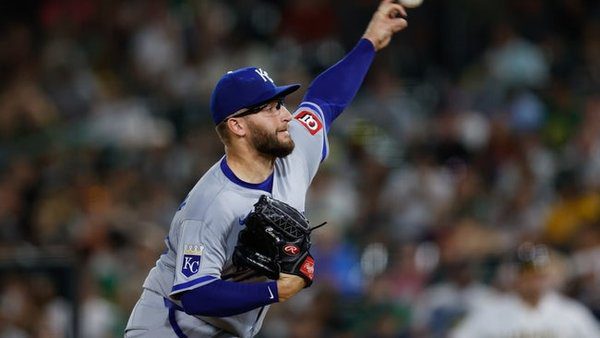
Cleveland’s bullpen depth creates a late-inning edge that the moneyline hasn’t priced in — the odds still treat this as an even matchup despite a relief disparity that could decide a tight game.
Noah Cameron vs Gavin Williams: Kansas City at Cleveland Betting Preview
The market sees two young arms in a pitcher-friendly environment and sets this game close to even money. That surface reading misses the offensive chasm that’s developed between these clubs. Kansas City enters with a .728 OPS that dwarfs Cleveland’s .627 mark, and Monday night’s 4-2 result demonstrated exactly how that production gap translates on the field.
Cleveland gets slight home favoritism at -118, but that price doesn’t properly account for their offensive struggles. When a team is hitting .193 as a unit — 63 points below Kansas City — the pitching matchup needs to heavily favor the home side to justify that line. It doesn’t.
Game Info & Betting Lines
- Date/Time: Tuesday, April 7, 2026, 1:10 PM ET
- Venue: Progressive Field (Park Factor: 0.98 — slightly pitcher-friendly)
- Probable Starters: Noah Cameron (KC) vs Gavin Williams (CLE)
- Moneyline: Kansas City -102 / Cleveland -118
- Run Line: Cleveland +1.5 (-201) / Kansas City -1.5 (+165)
- Total: 6.5 (Over -125 / Under +104)
Why This Number Is Close
The market respects Cleveland’s home field advantage and Gavin Williams’ strikeout upside — he’s punching out batters at a 12.75 K/9 clip through 12 innings. That’s legitimate swing-and-miss stuff that can neutralize any lineup on a given day. Cleveland also carries the psychological edge of being the home team in a divisional matchup.
The line also factors in early-season variance and small sample concerns. Both teams sit at 5-5 and 6-5 respectively, suggesting the market views them as relatively equal competitors. But that equality assumption breaks down when you examine the underlying offensive production. Looking at their season totals, Kansas City is averaging 4.2 runs per game (42 runs in 10 games) while Cleveland sits at just 3.1 runs per game (34 runs in 11 games) — that’s not noise, that’s a significant production gap.
The market is giving Cleveland too much credit for home field in a matchup where the visiting team has shown superior offensive consistency. Kansas City at -102 represents value against a Cleveland lineup that’s shown little ability to string together productive at-bats.
What Separates the Pitching
Noah Cameron brings pristine early-season numbers — 1.80 ERA, 1.00 WHIP, zero home runs allowed through five innings — but it’s the contrast with Gavin Williams that matters for handicapping purposes. While Williams posts superior strikeout numbers (12.75 K/9 vs Cameron’s 9.0 K/9), he’s also issued nine walks in 12 innings compared to Cameron’s single free pass in five frames.
That walk differential becomes crucial against Kansas City’s patient approach — they’ve drawn 37 walks as a team, suggesting they’ll work counts and capitalize on Williams’ command issues. Cleveland’s lineup, hitting just .193, can’t afford to give away baserunners to a Kansas City offense that’s already shown the ability to cash in runners.
Williams’ velocity and swing-and-miss stuff give him a higher ceiling, but Cameron’s precision creates a more predictable floor. In a tight, low-scoring environment where each mistake gets magnified, Cameron’s control advantage becomes the separator. Williams can dominate for six innings or implode in the third — Cameron projects to give Kansas City consistent innings without the dramatic variance.
The underlying metrics support Cameron’s edge: his 0.2 WAR through one start matches Williams’ 0.56 WAR despite significantly fewer innings, suggesting similar impact per inning pitched.
The Pushback
Here’s what keeps me from going heavier on Kansas City — Williams’ strikeout rate could completely overwhelm any offensive advantages the Royals bring. Twelve-plus strikeouts per nine innings represents elite swing-and-miss ability that can make lineup quality irrelevant. If Williams locates his secondary stuff and Kansas City’s hitters get impatient against premium velocity, this game flips to being about one man’s arm rather than team-wide offensive production.
The sample size concern with Cameron also gnaws at me. Five innings of dominance looks impressive on paper, but one rough sequence can crater that 1.80 ERA and shift this game’s entire dynamic. Williams has nearly 2.5 times the innings pitched, giving his metrics more stability and credibility. Cleveland’s home environment, even with a 0.98 park factor, has historically provided enough edge to matter in games projected this tightly.
The bigger worry is Cleveland’s offense finally showing life at Progressive Field after struggling for two weeks. Sometimes teams break out of collective slumps in explosive fashion, and facing Kansas City’s 4.28 ERA staff could provide exactly the catalyst Cleveland needs. If their .193 average represents bad luck more than true talent, we could see significant regression to the mean in this spot.
Run Environment & Game Shape
The 6.5 total suggests the market expects a pitcher-driven affair, exactly the environment where offensive quality gets amplified. Progressive Field’s 0.98 park factor supports low-scoring outcomes, meaning the team that can scratch across 3-4 runs likely wins.
This setup favors Kansas City’s more consistent offensive approach. While Cleveland needs everything to click perfectly — Williams dominates, the lineup breaks through, the bullpen holds — Kansas City can win with their established pattern of steady production. The Royals have shown they can manufacture runs against quality pitching, as evidenced in Monday night’s 4-2 victory.
The Pick: Kansas City Royals -102
The market is offering near pick ’em odds on a team with demonstrably superior offensive production. While Williams’ strikeout ability creates genuine risk, Cameron’s control and Kansas City’s patient approach provide the more reliable path to victory in a low-scoring environment. Take the Royals and trust the numbers over the noise.