Bash sees a playoff game shaped more by shooting quality and second chances than the current number suggests, with the market missing a key gap in how these teams generate offense.
The Setup: Rockets at Lakers
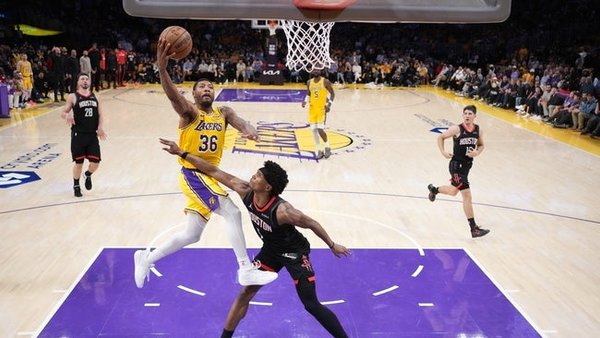
The Lakers are catching five points at home Tuesday night in Game 2 of this first-round series, and the projection has this game essentially dead even. Los Angeles stole Game 1 despite missing Luka Doncic and Austin Reaves, riding Luke Kennard’s 27-point explosion and 60.6% shooting to a 107-98 win. Houston shot just 37.6% in that opener and may have been without Kevin Durant again—he’s questionable with a right knee contusion and was only a partial participant in Monday’s practice.
The market is giving the Lakers five points at home in a game my model projects as a virtual pick’em. That’s significant separation, and it creates real value on the home side. The total sits at 207.5, which feels like the market is pricing in the defensive grind we saw in Game 1. But the underlying numbers tell a different story about how this game should play out.
This is a matchup where shooting efficiency and second-chance opportunities create more separation than the current spread suggests. The Lakers aren’t getting their top two scorers back, but they’ve got the shooting edge and the clutch execution to stay competitive in a game that should be tighter than five points.
Game Info & Betting Lines
Houston Rockets at Los Angeles Lakers
When: Tuesday, April 21, 2026 | 7:30 PM ET
Where: TBD
Watch: NBC, Peacock
Current Betting Lines (MyBookie.ag):
- Spread: Lakers +5.0 (-110) | Rockets -5.0 (-110)
- Total: 207.5 (Over -110 | Under -110)
- Moneyline: Lakers +161 | Rockets -200
Why This Line Exists
The market is giving Houston five points on the road because the Rockets are supposed to be the better team here. Their net rating sits at +5.4 compared to the Lakers’ +1.5—a nearly four-point gap per 100 possessions. Houston has Kevin Durant, or at least they’re supposed to. They’ve got Alperen Sengun controlling the paint and generating 15.0 offensive rebounds per game, which is elite. The Rockets’ 117.5 offensive rating edges the Lakers’ 117.0, and they’ve been the more consistent team all season.
But this line also reflects what happened in Game 1. The Lakers just won by nine without their two best scorers. Kennard went nuclear, LeBron James orchestrated the offense with 13 assists, and Deandre Ayton controlled the paint with 19 points and 11 rebounds. The market saw that performance and adjusted, but it may have overreacted to Houston’s shooting struggles.
The total at 207.5 is pricing in the defensive intensity and the slower pace we saw Saturday. Both teams attempted just 66 and 70 shots respectively, and the game never found an offensive rhythm. The market expects more of the same—a playoff grind with possessions mattering more than volume. At a projected pace of 98.1 possessions, this should be a deliberate game, but the shooting quality on both sides suggests more scoring than this number anticipates.
Rockets Breakdown
Houston’s identity is built on offensive rebounding and efficient scoring around the rim. Sengun is the engine, averaging 20.4 points, 8.9 rebounds, and 6.2 assists while shooting 51.9% from the floor. Amen Thompson provides secondary creation at 18.3 points and 7.8 rebounds, and Jabari Smith Jr. spaces the floor at 36.3% from three. Reed Sheppard has been a steady contributor at 13.5 points and 39.4% from deep.
The problem is Durant’s status. He missed Game 1 with that right knee contusion and was only a partial participant in practice Monday. If he sits again, Houston loses 26.0 points per game and their best isolation scorer. That’s a massive hole in the playoff setting where half-court execution matters most. Even if Durant plays, there’s no guarantee he’s moving at full speed or comfortable attacking off the dribble.
Houston’s offensive rebounding is a real weapon—they grab 34.7% of their misses compared to the Lakers’ 23.8%. That’s an 10.9-percentage-point gap, which is substantial. But in Game 1, the Rockets grabbed 21 offensive boards and still lost by nine because they couldn’t convert those second chances into efficient scoring. Shooting 37.6% will kill you in the playoffs, no matter how many extra possessions you create.
Lakers Breakdown
The Lakers are playing without Doncic and Reaves, which removes 56.8 combined points per game from their offense. That’s not a small adjustment—that’s asking role players to become primary options. But Kennard showed in Game 1 that he can fill that void, at least in spurts. His 27 points on elite efficiency gave Los Angeles the spacing and perimeter punch they needed.
LeBron at 41 years old is still orchestrating at a high level. He had 19 points and 13 assists in the opener, and his 7.2 assists per game during the regular season show he’s comfortable running the offense through others. Ayton has been solid in the paint, averaging 12.5 points and 8.0 rebounds while shooting 67.1% from the floor. Rui Hachimura provides floor spacing at 44.3% from three, which is critical when the offense lacks primary creation.
The Lakers’ shooting efficiency is the real edge here. They posted a 60.9% true shooting percentage during the season compared to Houston’s 57.5%—a 3.4-percentage-point gap. Their 57.3% effective field goal percentage also edges the Rockets’ 54.3% by 2.9 points. That’s medium-level separation, but it matters in a playoff game where every possession tightens up. Los Angeles proved in Game 1 they can shoot their way to victory even without their top scorers.
The Matchup
This game comes down to shooting quality versus second-chance opportunities. Houston will dominate the offensive glass—that’s not in question. But if they can’t convert those extra possessions into efficient scoring, it doesn’t matter. The Lakers proved Saturday they can defend at a high level when locked in, holding the Rockets to 37.6% shooting despite giving up 21 offensive rebounds.
The pace projects at 98.1 possessions, which favors the team that can execute in the half-court. That’s typically Houston with Durant, but if he’s compromised or out again, the Lakers have the advantage. LeBron’s playmaking and Kennard’s shooting create more half-court scoring options than Houston has without Durant. Sengun is excellent, but he can’t carry an entire playoff offense by himself.
The clutch numbers favor the Lakers significantly. Los Angeles went 22-8 in clutch situations during the regular season with a +2.3 plus-minus. Houston was 22-23 with a -0.4 mark. That’s a 24.4-percentage-point gap in win rate, which tells you the Lakers are more comfortable in tight games. If this comes down to the final five minutes—and at a projected margin of 0.1 points, it likely will—the Lakers have the execution advantage.
The total at 207.5 feels low given the shooting quality on both sides. The projection sits at 226.7, which creates a 19.2-point edge to the over. Even accounting for playoff defense and a slower pace, both teams have enough offensive firepower to push this number higher. The Lakers shot 60.6% in Game 1, and while that’s unsustainable, it shows the ceiling. Houston won’t shoot 37.6% again either—regression suggests better offensive efficiency from both sides.
Bash’s Best Bet & The Play
I’m taking the Lakers +5.0. The projection has this game essentially even with Los Angeles up by 0.1 points, which means five points of cushion is legitimate value. The Lakers just proved they can win this matchup without their top two scorers, and the shooting efficiency edge gives them a real path to staying competitive. Houston’s offensive rebounding advantage is real, but it didn’t translate to victory in Game 1, and there’s no reason to think it will in Game 2 if the Rockets can’t shoot better.
If Durant sits again, this line should be closer to three. If he plays but isn’t fully healthy, the Lakers still have the shooting and clutch execution to keep this tight. Five points is too many for a home team that just won by nine and has the efficiency metrics to suggest they’re not as outmatched as the market thinks.
The risk is Houston’s offensive rebounding finally translates to second-chance points, or Durant returns at full strength and takes over in isolation. But even with those concerns, five points is enough cushion to absorb a Rockets run. This is a playoff game that should come down to the final possessions, and the Lakers have shown they can execute when it matters.
The Play: Lakers +5.0 | Risk: Medium