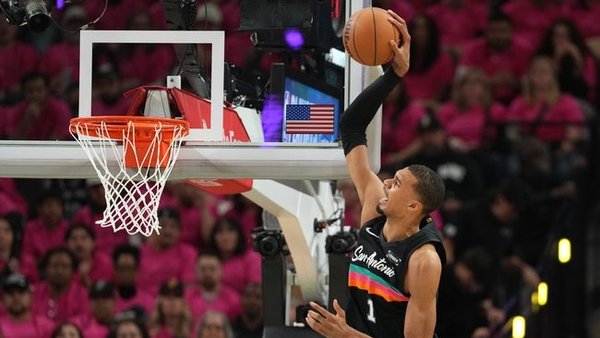
Bash sees a market overreaction in Game 2 and finds value in a playoff total that’s priced for caution rather than execution.
The Setup: Trail Blazers at Spurs
San Antonio sits as 11.5-point home chalk for Game 2 after dismantling Portland 111-98 in the series opener. Victor Wembanyama’s 35-point playoff debut set the tone, and the market responded by inflating this number past two possessions. But here’s the thing—the Spurs won that game by 13, and now the spread asks them to cover nearly 12. That’s not a gimme in playoff basketball, even with home court and momentum.
The total sits at 220.5, down from what these teams produced Sunday night. That’s where my attention lands. The projection sees 230.5 points in this matchup, a full 10 points above what the market is pricing. That’s not a small gap—that’s a fundamental disagreement about how this game plays out. Portland’s not rolling over after one loss, and San Antonio’s not slowing down after Wembanyama’s breakout. This total feels like the market overcompensating for playoff defense when the real story is two teams built to score.
Game Info & Betting Lines
Portland Trail Blazers at San Antonio Spurs
When: Tuesday, April 21, 2026 | 7:30 PM ET
Where: TBD
Watch: NBC, Peacock
Current Odds (MyBookie.ag):
- Spread: Spurs -11.5 (-110) | Trail Blazers +11.5 (-110)
- Total: Over 220.5 (-110) | Under 220.5 (-110)
- Moneyline: Spurs -714 | Trail Blazers +472
Why This Line Exists
The market saw Wembanyama’s 35 points and 21 first-half points—both franchise records for a playoff debut—and decided Portland can’t hang. Fair enough. The Spurs shot 48.3% for the season and posted a net rating of +8.4, good for 62 wins and the second seed. They’re the better team by every metric that matters. The spread reflects that dominance, and the moneyline at -714 tells you the market doesn’t think this is competitive.
But the total at 220.5? That’s the market pricing in playoff grind-it-out basketball. The thinking goes like this: first-round games tighten up, defenses lock in, possessions get slower. Except these two teams combined for 209 points in Game 1, and that was with Portland shooting just 45.3% and turning it over 17 times. The Spurs didn’t win that game by strangling possessions—they won it by executing at 118.7 offensive rating and getting quality looks.
San Antonio’s pace sits at 100.7, Portland’s at 101.6. The blended pace projection lands at 101.2 possessions, which is up-tempo enough to generate scoring opportunities. Add in true shooting percentages of 59.5% for the Spurs and 57.0% for the Blazers, and you’ve got two teams capable of putting points on the board in volume. The market’s pricing caution. My model projects execution.
Trail Blazers Breakdown
Portland’s 42-40 record and 18-23 road mark don’t inspire confidence, but this roster has more offensive firepower than Game 1 showed. Deni Avdija led the team with 24.2 points per game during the regular season, and Shaedon Sharpe added 20.8. Jerami Grant’s 38.9% from three and Jrue Holiday’s 37.8% give them legitimate spacing threats. The problem in Game 1 wasn’t talent—it was execution under playoff pressure.
The Blazers posted a 113.1 offensive rating for the season, which isn’t elite but it’s functional. Their 31.3% offensive rebounding rate trails San Antonio’s 26.2%, giving them a real edge on the glass for second-chance points. That’s a 5.0 percentage point gap that matters in a playoff setting where possessions tighten. Portland also turned it over at 14.6% compared to the Spurs’ 11.8%, which cost them in Game 1 and will cost them again if they don’t clean it up.
But here’s what the market’s missing: Portland’s not going to shoot 45.3% again. Regression exists, and this team shot 46.1% in clutch situations during the regular season. They’re capable of better offensive nights, and Game 2 at home in a must-respond spot is exactly when you’d expect that improvement. The Blazers know they can’t go down 0-2 heading to Portland. That urgency shows up in effort and execution.
Spurs Breakdown
San Antonio’s 62-20 record and 32-8 home mark tell you everything about their regular season dominance. Wembanyama’s 25.0 points and 11.5 rebounds anchor everything, but this isn’t a one-man show. De’Aaron Fox added 18.6 points and 6.2 assists, Stephon Castle contributed 16.7 points and 7.4 assists, and the depth chart runs deep with Devin Vassell and Keldon Johnson providing secondary scoring.
The Spurs’ 118.7 offensive rating ranked among the league’s best, and their 110.4 defensive rating gave them an 8.4 net rating edge. They shot 59.5% true shooting and 55.8% effective field goal percentage, both marks that show elite shot quality. The 11.8% turnover rate is the lowest in this matchup, and it’s a major reason they controlled Game 1. When you don’t give the ball away and you shoot efficiently, you win games.
Jordan McLaughlin remains out with a left ankle sprain, but he averaged just 6.4 minutes across 44 regular-season appearances. His absence doesn’t move the needle. David Jones is out for the season, but he played 11 games and averaged 2.9 points. This roster is healthy where it counts, and Wembanyama’s playoff debut showed he’s ready for this stage. The question isn’t whether San Antonio can score—it’s whether they’ll push pace enough to get this total over the number.
The Matchup
The net rating gap sits at 8.8 points per 100 possessions in San Antonio’s favor, which is significant but not insurmountable for a total. The Spurs’ offense against Portland’s defense projects at 5.2 points per 100 possessions in San Antonio’s favor, a medium-level mismatch. Portland’s offense against San Antonio’s defense projects at 2.7 points per 100 possessions in Portland’s favor, a smaller edge but still present.
Here’s what matters for the total: both teams can score. The Spurs averaged 119.8 points per game, the Blazers 115.5. That’s 235.3 combined points per game during the regular season, well above the 220.5 total posted here. Even accounting for playoff adjustments, this number feels too low. The pace blend at 101.2 possessions gives both teams enough opportunities to execute their offenses, and the true shooting gap of 2.4 percentage points favors San Antonio but doesn’t suggest a defensive slog.
Portland’s offensive rebounding edge at 31.3% compared to San Antonio’s 26.2% creates extra possessions, which directly impacts scoring volume. The Blazers grabbed 14.1 offensive rebounds per game during the season, and those second-chance points add up. San Antonio’s ball security at 11.8% turnover rate limits Portland’s transition opportunities, but the halfcourt execution from both sides should be enough to push this total over.
The clutch stats show San Antonio at 66.7% win rate in close games compared to Portland’s 48.8%, a 17.9% gap that matters for side decisions but doesn’t change the scoring environment. Both teams shot above 45% in clutch situations, and both teams have proven they can score when games tighten. This isn’t a defensive battle—it’s a playoff game between two teams that know how to put the ball in the basket.
Bash’s Best Bet & The Play
The market’s pricing this total for playoff caution, but the matchup says otherwise. San Antonio’s 118.7 offensive rating and Portland’s desperation to avoid an 0-2 hole create a scoring environment that should clear 221 points without much stress. The projection sees 230.5, and even if we discount that for playoff intensity, 225-228 feels like the realistic landing spot.
I’m taking Over 220.5. The pace blend at 101.2 possessions gives both teams enough chances, the shooting quality from San Antonio is elite, and Portland’s offensive rebounding edge creates extra opportunities. Wembanyama’s not slowing down after a 35-point debut, and the Blazers have too much offensive talent to lay down in a must-win spot. This total’s too low by at least a bucket per team, and that’s enough edge to bet it.
The risk is obvious—playoff games can grind, and if Portland’s turnovers spike again, possessions shrink. But the math says score, and I’m trusting the efficiency over the market’s fear. Lock in the over and watch these teams execute.