Bash identifies a playoff spread that’s tighter than the matchup efficiency suggests, with Denver’s offensive firepower creating more separation potential than the market is pricing in this first-round series.
The Setup: Nuggets at Timberwolves
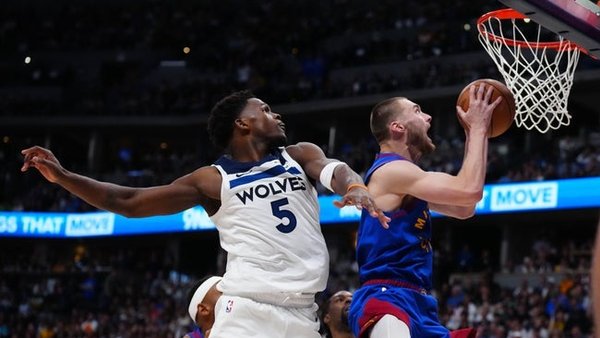
Minnesota comes home with the series knotted at 1-1 after staging another signature comeback in Denver, erasing a 19-point deficit to steal Game 2. The Wolves are catching +2.0 at home Thursday night, and the market is essentially calling this a pick’em with home court. That’s the part that doesn’t sit right with me.
Denver’s offensive rating sits at 121.2 compared to Minnesota’s 115.6—a massive gap that doesn’t just disappear because the Wolves rallied from 19 down. The Nuggets are the better team by the numbers, and while Minnesota’s home crowd will be electric, two points feels light for a Denver squad that creates offense at an elite level. The projection has this game at essentially a one-point margin, which means we’re getting value on the road favorite in a playoff environment where the better offense typically wins out.
Aaron Gordon is probable with left calf tightness but expected to play. Peyton Watson remains out for Denver’s eighth consecutive game. Anthony Edwards is questionable for Minnesota but has played through this designation in Games 1 and 2, averaging 26.0 points across those contests.
Game Info & Betting Lines
When: Thursday, April 23, 2026 | 7:30 PM ET
Where: TBD
Watch: Prime Video
Spread: Timberwolves +2.0 (-110) | Nuggets -2.0 (-110)
Total: 234.0 (Over -110 / Under -110)
Moneyline: Timberwolves +109 | Nuggets -134
Why This Line Exists
The market is giving Minnesota full credit for that Game 2 comeback and the home-court advantage in a hostile building. Fair enough—the Wolves have proven they can erase deficits against this Denver team, and Target Center will be rocking for a pivotal Game 3. But here’s what the market might be overweighting: recency bias from one game.
Denver led by 19 in that game because they’re the superior offensive team. They scored 39 points in the first quarter because Nikola Jokic and Jamal Murray can pick apart Minnesota’s defense in ways most teams can’t. The collapse was real, but it doesn’t erase the fundamental efficiency gap between these rosters. Denver’s 121.2 offensive rating dwarfs Minnesota’s 115.6, and that 5.6-point difference per 100 possessions is substantial.
The Wolves are getting two points at home because the market respects their ability to grind in close games and their 26-15 home record. But when you’re facing a team with Denver’s offensive firepower—a squad shooting 61.6% true shooting compared to Minnesota’s 59.2%—that two-point cushion starts looking thin. The market is pricing this as a coin flip with home court breaking the tie. The efficiency numbers suggest Denver should be favored by more.
Nuggets Breakdown
Denver’s offense is the story here, and it starts with Jokic orchestrating at a historic level. He’s averaging 27.7 points, 12.9 rebounds, and 10.7 assists while shooting 56.9% from the floor. When he’s running pick-and-roll with Murray—who’s putting up 25.4 points per game on 48.3% shooting and 43.5% from three—this offense becomes nearly impossible to contain for extended stretches.
The Nuggets rank third in the West at 54-28, and their 26-15 road record shows they don’t need home cooking to win games. They’re averaging 122.1 points per game with an assist rate of 66.5%, meaning they’re generating quality looks through ball movement. Aaron Gordon adds 16.2 points and provides defensive versatility, and even with Peyton Watson sidelined, this rotation has enough depth to weather Minnesota’s defensive pressure.
The concern is that 19-point blown lead from Game 2, which raises questions about their ability to close. But Denver’s clutch record of 23-19 isn’t terrible, and in a playoff series where they’ve already shown they can build massive leads against this defense, I’m not panicking over one collapse.
Timberwolves Breakdown
Minnesota’s identity is built on Anthony Edwards and Julius Randle creating offense while their defense creates chaos. Edwards is averaging 28.8 points on 48.9% shooting and 39.9% from three, and Randle chips in 21.1 points with 6.7 rebounds. When those two are rolling, the Wolves can hang with anyone.
The problem is consistency against elite offenses. Minnesota’s 112.5 defensive rating is solid, but Denver’s offensive rating of 121.2 means the Nuggets are scoring 8.7 points per 100 possessions more than what Minnesota typically allows. That’s a strong mismatch favoring Denver’s offense, and it’s hard to ignore that kind of gap in a playoff setting.
Minnesota’s 26-15 home record is legit, and their ability to come back from 19 down shows mental toughness. But their 115.6 offensive rating trails Denver’s significantly, and their 59.2% true shooting percentage gives them less margin for error when the game tightens up. The Wolves live and die by Edwards’ shot-making, and while he’s been excellent, relying on one guy to match Denver’s balanced attack is a tough ask.
The Matchup
This game projects to play at a pace of 100.5 possessions, which is slightly above Minnesota’s season average and right in Denver’s comfort zone. More possessions favor the team with better offensive efficiency, and that’s Denver by a wide margin. The Nuggets’ 121.2 offensive rating against Minnesota’s 112.5 defensive rating creates an 8.7-point mismatch per 100 possessions—that’s the biggest edge in this game.
Minnesota does hold a 2.1 percentage point advantage in offensive rebounding rate, which could create some second-chance opportunities. But Denver’s 2.4 percentage point edge in true shooting means they’re converting at a higher rate on their initial looks, which matters more over the course of 100 possessions. The shooting quality gap is real, and in a playoff game where both teams are locked in defensively, the team that generates better shots typically wins.
The clutch numbers are basically even—Denver at 54.8% in close games, Minnesota at 57.6%—so there’s no real edge there if this comes down to the final minutes. But my model projects Denver winning by 0.9 points in a game totaling 233.8, which is basically in line with the market on the total but suggests the spread is slightly off. Getting Denver at -2.0 when the projection is less than a point feels like the market is giving us a small window.
Bash’s Best Bet & The Play
The Play: Nuggets -2.0 (-110)
I’m laying the short number with Denver on the road. The efficiency gap is too significant to ignore, and while Minnesota showed heart in Game 2, that comeback doesn’t change the fundamental matchup. Denver’s offense is elite, Jokic and Murray are playing at a high level, and the Nuggets have the shooting quality advantage across the board.
Minnesota will make this competitive—they always do at home—but in a playoff series where the better team typically asserts itself, I’m trusting Denver’s offensive firepower to create enough separation. The market is pricing this as a pick’em with home court, but the numbers suggest Denver should be favored by more. Two points is a gift.
The risk is obvious: Minnesota just came back from 19 down against this exact team, and Edwards is capable of taking over in a hostile environment. If the Wolves shoot the ball well and Denver has another defensive lapse, this could go the other way. But I’m betting on the team with the better offense and the better overall efficiency to cover a short road number in a playoff spot where they need to respond.