Bash examines a playoff series shifted by injury uncertainty and a market that’s priced tighter than the matchup fundamentals suggest, finding value in a total that doesn’t account for the expected game shape.
The Setup: Spurs at Trail Blazers
The spread sits at Portland +2.5, and the total at 220.5. That number tells you everything about how the market is hedging Victor Wembanyama’s status. The projection has San Antonio by 2.4 points with the Blazers getting 2.0 points of home-court advantage baked in—basically in line with the market on the side. But the total? That’s where the gap opens up. The projected total sits at 230.5, a full 10 points north of the posted number, and that’s accounting for the pace blend of 101.2 possessions and the efficiency profiles of both sides.
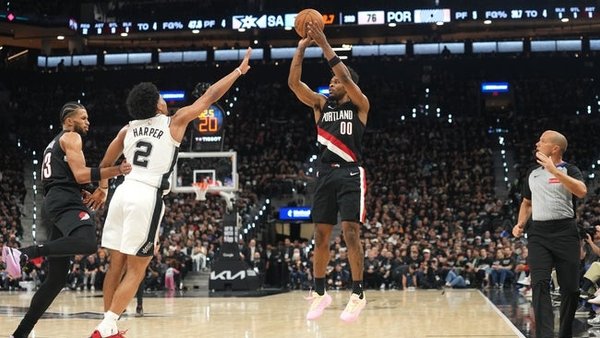
Portland just stole Game 2 in San Antonio after Wembanyama went down with a concussion in the second quarter. Scoot Henderson dropped 31, Robert Williams III finished the comeback with an alley-oop, and the Blazers closed on an 11-2 run to even this series at one game apiece. Now we’re headed to Portland for Game 3, and the big question is whether Wemby clears protocol. He’s listed as questionable, traveled with the team, but there’s no guarantee he suits up. That uncertainty is suppressing this total in a way that doesn’t match the offensive firepower on both sides.
Game Info & Betting Lines
- Game Time: 7:30 PM ET, Friday, April 24, 2026
- Location: TBD
- TV: Prime Video
- Spread: Portland Trail Blazers +2.5 (-110) | San Antonio Spurs -2.5 (-110)
- Total: Over 220.5 (-110) | Under 220.5 (-110)
- Moneyline: Portland Trail Blazers +115 | San Antonio Spurs -141
Why This Line Exists
The market is pricing Wembanyama’s absence as a coin flip, and that’s creating a tight spread that reflects maximum uncertainty. San Antonio went 62-20 this season with a +8.4 net rating, second in the West. Portland went 42-40 with a -0.4 net rating as the eighth seed. The season-long efficiency differential sits at -8.8 per 100 possessions in favor of the Spurs, and that’s a strong gap. But the Blazers just proved they can win without Wemby on the floor, building a 14-point lead in the fourth quarter of Game 2 before San Antonio’s offense went cold.
The total at 220.5 is where the real tension lives. The Spurs averaged 119.8 points per game this season with an offensive rating of 118.7. Portland put up 115.5 per game with a 113.1 offensive rating. Both teams play at a similar tempo—San Antonio at 100.7 pace, Portland at 101.6—and the expected pace blend of 101.2 possessions suggests an up-tempo playoff game. The true shooting gap sits at -2.4 percentage points in San Antonio’s favor, and the effective field goal percentage gap mirrors that at -2.4 points. Those are medium-sized edges that point to scoring efficiency, not a grind-it-out defensive battle.
Portland’s offensive rebounding edge is significant at +5.0 percentage points, which means more second-chance opportunities and extended possessions. That’s a strong gap that drives scoring volume, especially in a playoff setting where half-court execution tightens up. The market is pricing this total as if both teams will play conservative, low-possession basketball, but the pace and rebounding profiles don’t support that read.
Spurs Breakdown
San Antonio’s offense runs through Wembanyama, who averaged 25.0 points, 11.5 rebounds, and 3.1 blocks per game this season on 51.2% shooting. If he clears protocol, the Spurs have their full arsenal. If he doesn’t, they still have De’Aaron Fox (18.6 points, 6.2 assists), Stephon Castle (16.7 points, 7.4 assists), and a deep rotation that can score in transition. The Spurs shot 48.3% from the field and 35.9% from three this season, with a true shooting percentage of 59.5% that ranks among the league’s best.
The clutch stats tell you San Antonio knows how to finish. They went 24-12 in clutch situations this season with a 66.7% win rate, significantly better than Portland’s 48.8% mark. The Spurs shot 45.6% from the field and 34.7% from three in clutch time, and that’s a real edge when games tighten up. Even without Wembanyama in Game 2, they built a 14-point lead in the fourth quarter before the offense stalled. That’s not a team that forgets how to score—it’s a team that hit a cold stretch at the worst possible time.
Jordan McLaughlin remains out with a left ankle sprain, missing his third straight game. David Jones is out for the season. Neither absence changes the rotation in a meaningful way, but the Wembanyama question is the elephant in the room. If he plays, San Antonio’s offensive rating jumps. If he doesn’t, they’re still capable of pushing pace and generating quality looks.
Trail Blazers Breakdown
Portland’s offense is built around Deni Avdija (24.2 points, 6.9 rebounds, 6.7 assists), Shaedon Sharpe (20.8 points), and Jerami Grant (18.6 points). Jrue Holiday adds 16.3 points and 6.1 assists, and Scoot Henderson just showed in Game 2 that he can take over when the moment demands it. The Blazers shot 45.3% from the field and 34.3% from three this season, with a true shooting percentage of 57.0%. That’s not elite, but it’s efficient enough to score in bunches when the pace picks up.
The offensive rebounding edge at +5.0 percentage points is a real weapon for Portland. They averaged 14.1 offensive rebounds per game this season, compared to San Antonio’s 11.4. That’s extra possessions, extra points, and extra pressure on the Spurs’ defense. Robert Williams III is a presence on the glass, and his alley-oop finish in Game 2 showed how Portland can exploit second-chance opportunities in crunch time.
The Blazers went 21-22 in clutch situations this season, and their -0.9 clutch plus/minus suggests they struggle to close tight games. But Game 2 flipped that script. They held San Antonio without a field goal for the final 3:37 and closed on an 11-2 run. That’s a confidence boost heading into a home game where they went 24-17 this season. Portland’s defensive rating of 113.5 isn’t elite, but they’ve shown they can get stops when it matters.
The Matchup
The offensive mismatch favors Portland at +2.7 points per 100 possessions when you match their offense against San Antonio’s defense. The defensive mismatch favors the Spurs at +5.2 points per 100 possessions when you match their offense against Portland’s defense. That’s a medium-sized gap that suggests San Antonio should score more efficiently, but the Blazers have enough firepower to keep pace. The net rating edge of -8.8 per 100 possessions tilts toward the Spurs, but that’s a season-long number that doesn’t account for Wembanyama’s uncertain status.
The pace blend of 101.2 possessions is the key to unlocking this total. Both teams want to run, both teams have the personnel to push tempo, and playoff games at this pace historically produce scoring volume. The turnover edge sits at -2.8 percentage points in San Antonio’s favor, which means Portland is more careless with the ball. That should lead to transition opportunities for the Spurs, and transition buckets inflate scoring totals.
My model projects 230.5 total points, and that’s a 10-point gap from the posted number of 220.5. The shooting efficiency gap at -2.4 percentage points in true shooting and effective field goal percentage points to San Antonio’s ability to score at a higher rate, but Portland’s offensive rebounding edge keeps possessions alive and extends scoring opportunities. The expected game shape—up-tempo, transition-heavy, with second-chance points—doesn’t support a low-scoring grind.
Bash’s Best Bet & The Play
The play is Over 220.5 (-110). The market is pricing this total as if Wembanyama’s absence tanks the scoring environment, but the math doesn’t support that read. The projected total sits at 230.5, a full 10 points north of the posted number, and that gap is built on pace, efficiency, and rebounding edges that point to scoring volume. San Antonio’s offensive rating of 118.7 and Portland’s offensive rebounding edge at +5.0 percentage points create a game shape where both teams generate quality looks and extended possessions.
Even if Wembanyama sits, the Spurs have De’Aaron Fox, Stephon Castle, and a rotation that can score in transition. Portland just proved in Game 2 that they can push pace and finish in crunch time, and Scoot Henderson’s 31-point performance showed the Blazers have the firepower to keep up. The pace blend of 101.2 possessions drives the total projection, and both teams want to run. This number at 220.5 is too low for the expected game environment.
The risk is obvious: if Wembanyama sits and San Antonio plays conservative, half-court basketball, the scoring volume could drop. But the Spurs went 62-20 this season by playing fast and efficient, and Portland’s home crowd will push the tempo. The over has a strong edge here, and I’m backing it with confidence. This total should clear 220.5 without much drama.