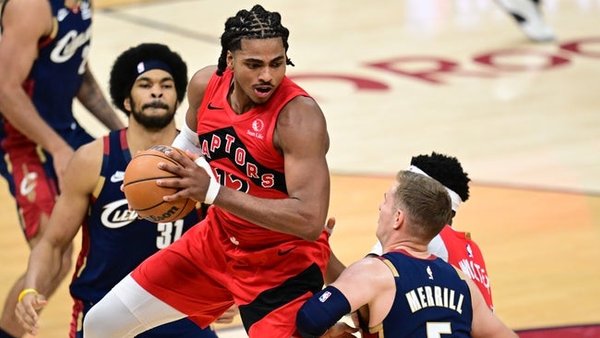
Bash sees a playoff series shifting home with Toronto facing elimination pressure, but questions whether desperation can overcome Cleveland’s two-way dominance and historical stranglehold in this matchup.
The Setup: Cavaliers at Raptors
Cleveland comes into Scotiabank Arena up 2-0 in this first-round series, and the market has Toronto getting 3 points at home in what amounts to a must-win spot. The Cavaliers just put up 115 points in Game 2 with three guys scoring 25-plus, and they’ve now won 12 straight playoff games against Toronto — tying an NBA record for postseason dominance against a single opponent. That’s not a typo. Twelve straight.
The projection here sees a tight game, with Toronto catching 3 points at home in a spot where elimination looms. Cleveland’s been the better team all season — better net rating, better offense, better defense — but this is where the market asks whether home court and desperation can flip the script. I’m not buying it, and here’s why the math doesn’t support the Raptors keeping this inside the number.
Game Info & Betting Lines
When: Thursday, April 23, 2026 | 7:30 PM ET
Where: TBD
Watch: Prime Video
Spread: Toronto Raptors +3.0 (-110) | Cleveland Cavaliers -3.0 (-110)
Total: 219.5 (Over/Under -110)
Moneyline: Raptors +126 | Cavaliers -155
Why This Line Exists
The market is giving Toronto every benefit here. You’ve got a home team facing a 3-0 deficit, and historically, desperation spots get respect. The Raptors went 24-17 at home during the regular season, and the thinking is that playoff survival mode might squeeze out enough execution to stay competitive. Plus, Cleveland’s road splits weren’t perfect — 25-16 away from home is solid, but not unbeatable.
But here’s what the market isn’t pricing correctly: Cleveland’s offensive rating sits at 118.3 per 100 possessions against Toronto’s 112.1 defensive rating. That’s a 6.2-point mismatch when the Cavaliers have the ball, and that’s not noise — that’s a structural advantage. The Raptors’ offense against Cleveland’s defense shows a 0.9-point gap, which is basically priced correctly and doesn’t move the needle. The real story is Cleveland’s ability to generate quality looks against a Toronto defense that’s been getting cooked all series.
My model projects Cleveland by 1.4 points in this spot, which means the Cavaliers getting 3 points of cushion creates real separation. The season-long efficiency differential favors Cleveland by 1.2 points per 100 possessions, and when you layer in the offensive mismatch, this number feels inflated for a Toronto team that’s shown no answers through two games.
Cavaliers Breakdown
Donovan Mitchell and James Harden just dropped 30 and 28 respectively in Game 2, and Evan Mobley added 25 with eight boards. That’s three guys scoring 25-plus in a playoff game — the Cavaliers have done that four times in franchise history, and twice this postseason already. This isn’t a one-dimensional offense. Cleveland’s shooting 48.2 percent from the field and 36.0 percent from three during the regular season, with a true shooting percentage of 59.5 percent that ranks among the league’s best.
The Cavs play at a 100.7 pace, which is deliberate but not sluggish. They control tempo, they don’t turn the ball over (14.0 per game), and they’ve got Jarrett Allen cleaning up misses with 8.5 rebounds per night. Thomas Bryant is questionable for this one, but he’s been out six straight games and wouldn’t shift the rotation much if he returns. The core is healthy, the execution has been crisp, and Cleveland’s 24-18 clutch record shows they can close games when it tightens up.
Raptors Breakdown
Toronto’s season-long numbers show a competent team — 115.0 offensive rating, 112.1 defensive rating, 46-36 overall record. Brandon Ingram led the way at 21.5 points per game, RJ Barrett chipped in 19.3, and Scottie Barnes provided 18.1 with playmaking versatility. But in this series, none of that has mattered. Cleveland’s forcing Toronto into uncomfortable offensive sets, and the Raptors haven’t found an answer for Mitchell, Harden, or Mobley.
Immanuel Quickley is questionable with a right hamstring strain after missing three straight games, and Ja’Kobe Walter is also questionable with an illness. If Quickley sits again, Toronto loses another ball-handler who averaged 16.4 points and 5.9 assists during the regular season. The Raptors shot 35.4 percent from three this year and 48.2 percent overall, but their clutch numbers are shaky — 41.5 percent shooting and just 27.2 percent from three in close games. That’s a problem when you’re staring down elimination.
The Matchup
This comes down to Cleveland’s ability to score on Toronto’s defense, and the math is clear. The Cavaliers generate 118.3 points per 100 possessions, and Toronto allows 112.1. That 6.2-point gap is the foundation of this game, and it’s not something Toronto can scheme away. Cleveland’s effective field goal percentage sits at 56.1 percent compared to Toronto’s 54.6 percent — a 1.4-point edge that reflects better shot quality across the board.
The pace blend projects around 100 possessions, which is right in Cleveland’s comfort zone. The Cavaliers don’t need to speed this game up or slow it down — they just need to execute in the half-court, and they’ve done that all series. Toronto’s offensive rebounding rate trails by 1.4 percentage points, which means fewer second-chance opportunities in a game where every possession matters. The turnover rates are identical at 12.2 percent, so there’s no edge to exploit there.
Cleveland’s also 12-0 against Toronto in playoff games dating back to 2016. That’s not just a fun stat — it’s a mental hurdle. The Raptors know they’ve never solved this matchup when it counts, and desperation doesn’t always translate to execution. Toronto’s 21-14 clutch record during the regular season looks fine on paper, but their clutch plus-minus of 0.9 shows they’ve been squeaking out tight games rather than dominating them. Cleveland’s clutch plus-minus sits at 1.4, and they’ve got two All-Star closers in Mitchell and Harden who’ve been here before.
Bash’s Best Bet & The Play
The Play: Cleveland Cavaliers -3.0 (-110)
I’m laying the points with Cleveland in a spot where the market is overvaluing Toronto’s desperation and home court. The Cavaliers have been the better team all season, they’ve dominated this series through two games, and the offensive mismatch creates a structural edge that Toronto can’t overcome. The projection sees Cleveland by 1.4 points, which means getting 3 points of cushion gives us real separation if this game stays close.
The Raptors might fight harder at home, and elimination pressure could spark some urgency, but urgency doesn’t fix defensive breakdowns or create better shot quality. Cleveland’s got three guys who can get 25 on any given night, and Toronto’s shown no ability to slow down Mitchell or Harden when the game tightens up. The 12-game playoff winning streak against Toronto isn’t just historical trivia — it’s a reflection of Cleveland’s ability to execute in this exact matchup when it matters most.
The risk here is obvious: home teams facing elimination can pull out inspired performances, and if Quickley returns and provides a spark, Toronto could keep this competitive. But the math says Cleveland’s offense against Toronto’s defense creates enough separation to cover 3 points, and I trust the Cavaliers’ two-way execution more than I trust the Raptors’ desperation. Lay the points and expect Cleveland to take a commanding 3-0 series lead.