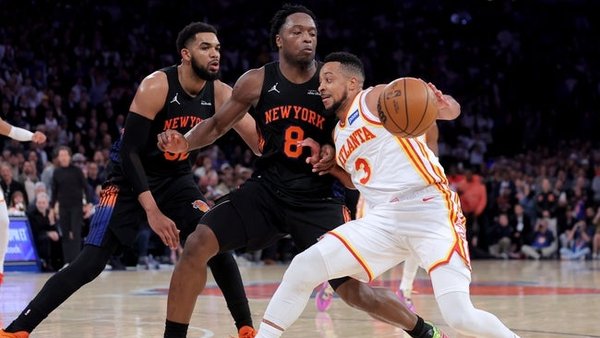
Bash sees a playoff series tied 1-1 heading back to Atlanta, where the market has installed the Hawks as near pick’em home favorites — but the efficiency gap and matchup math tell a different story than that tight number suggests.
The Setup: Knicks at Hawks
The market opened this Game 3 with Atlanta as a 1-point home favorite at -105, essentially a pick’em after the Hawks stole Game 2 in New York on Monday night. CJ McCollum’s 32-point heroics and a clutch rally erased a 12-point fourth-quarter deficit, tying this first-round series at one game apiece. Now we shift to State Farm Arena on Thursday night, where the 6-seed Hawks will try to protect home court against a Knicks squad that went 22-19 on the road during the regular season.
Here’s the tension: Atlanta just proved they can win a tight one in a hostile building, and the market is pricing this like a coin flip. But the projection sees this differently. The expected margin sits at just 0.1 points in New York’s favor even with the 2.0-point home-court adjustment baked in, which means we’re looking at a true toss-up on paper. The question is whether that one-point cushion for Atlanta properly accounts for the efficiency gap that existed all season long.
The Knicks posted a +6.4 net rating during the regular season compared to Atlanta’s +2.2 mark — a 4.2-point differential per 100 possessions that favors the visitors. That’s not noise. That’s a medium-grade edge that suggests New York has been the better team when we zoom out beyond a single playoff game. The offense-defense mismatch also leans toward the Knicks, who should generate 5.8 points per 100 possessions more than expected when their 118.7 offensive rating attacks Atlanta’s 112.9 defensive rating.
Game Info & Betting Lines
Matchup: New York Knicks (53-29, 22-19 road) at Atlanta Hawks (46-36, 24-17 home)
Date: Thursday, April 23, 2026
Time: 7:30 PM ET
TV: Prime Video
Venue: TBD
Current Betting Lines (MyBookie.ag):
Spread: Atlanta Hawks +1.0 (-110) | New York Knicks -1.0 (-110)
Moneyline: Atlanta Hawks -105 | New York Knicks -116
Total: Over 216.0 (-110) | Under 216.0 (-110)
Why This Line Exists
The market is giving Atlanta the slightest of edges here because they’re at home and just delivered a gutsy road win that proved they can execute in crunch time. McCollum hit big shot after big shot down the stretch, Jonathan Kuminga added 19 off the bench, and Jalen Johnson chipped in 17 including a dagger with 10 seconds left. That’s the kind of performance that shifts perception, especially when it happens on the road in a playoff environment.
But context matters. The Hawks trailed the entire second half and were down 12 entering the fourth quarter. They needed everything to break right in the final two minutes, and even then McCollum missed two free throws with 5.6 seconds left that nearly cost them the game. Mikal Bridges got a clean look at the buzzer that just didn’t fall. This wasn’t a dominant win — it was a survive-and-advance grinder that easily could’ve gone the other way.
The market is also respecting Atlanta’s 24-17 home record, which is solid but not overwhelming. The Knicks went 30-10 at Madison Square Garden, so both teams protected their building reasonably well during the regular season. The difference is that New York’s overall profile — the net rating, the offensive firepower, the clutch execution — suggests they’re built to win tight games more consistently. The Knicks went 21-13 in clutch situations with a +1.4 net rating in those spots, while Atlanta finished 17-18 with a -0.3 clutch net rating. That 13.2 percentage-point gap in clutch win rate isn’t something to ignore when we’re staring at a one-point spread.
The total sitting at 216.0 is the other piece of this puzzle, and it’s way too low based on how these teams actually play. The pace blend projects at 100.1 possessions, which is up-tempo territory when you split the difference between Atlanta’s 102.5 pace and New York’s 97.7 figure. More possessions mean more scoring opportunities, and both offenses have the efficiency to capitalize. The projection sees 229.7 combined points, which creates a 13.7-point edge to the over. That’s a strong gap that suggests the market is underpricing the scoring environment we’re likely to see.
Knicks Breakdown
New York runs through Jalen Brunson, who averaged 26.0 points and 6.8 assists during the regular season while shooting 46.7% from the floor and 36.9% from three. He’s the engine that makes this offense hum, and he showed up in Game 2 with a clutch three-pointer late that briefly tied the game at 103. The problem is that the supporting cast didn’t finish the job. Bridges got the look at the buzzer but couldn’t convert, and the Knicks went cold at the wrong time after controlling the game for three quarters.
Karl-Anthony Towns gives them a legitimate post presence at 20.1 points and 11.9 rebounds per game, and his ability to stretch the floor at 36.8% from three creates spacing issues for Atlanta’s defense. OG Anunoby (16.7 PPG, 38.6% 3PT) and Mikal Bridges (14.4 PPG, 37.1% 3PT) provide two-way versatility, while Josh Hart chips in 12.0 points and 7.4 rebounds as a glue guy who does the dirty work.
The Knicks’ 118.7 offensive rating ranked among the league’s best, and their 112.3 defensive rating shows they can get stops when it matters. The 5.8-point offensive-defensive mismatch edge when their offense faces Atlanta’s defense is real, and it’s built on superior shooting quality and ball movement. New York posted a 59.0% true shooting percentage and a 55.7% effective field goal mark, both of which are in line with Atlanta’s numbers but backed by better overall execution.
The one area where New York has a clear advantage is on the offensive glass. They grabbed 29.4% of available offensive rebounds during the regular season compared to Atlanta’s 24.4% mark — a 5.0 percentage-point gap that creates extra possessions and second-chance points. In a playoff game that’s likely to be decided by a single possession, those extra opportunities matter.
Hawks Breakdown
Atlanta’s identity is built around Jalen Johnson’s versatility and CJ McCollum’s shot-making. Johnson averaged 22.5 points, 10.3 rebounds, and 7.9 assists during the regular season, giving the Hawks a do-everything forward who can initiate offense and defend multiple positions. McCollum’s 18.7 points per game don’t jump off the page, but his 32-point explosion in Game 2 reminded everyone that he’s capable of taking over when the lights are brightest.
Nickeil Alexander-Walker (20.8 PPG, 39.9% 3PT) provides perimeter scoring, while Onyeka Okongwu (15.2 PPG, 7.6 RPG) anchors the paint. Jonathan Kuminga’s 19 points off the bench in Game 2 showed that Atlanta has legitimate scoring depth, which will be critical in a series where rotations tighten and every minute matters.
The Hawks are dealing with two injuries that could impact their depth. Jock Landale remains out and continues to progress slowly, which means Mouhamed Gueye will operate as the primary backup center. Keshon Gilbert is also out, though his absence is less impactful given his limited role. The bigger concern for Atlanta is whether their defense can consistently contain New York’s offensive weapons. The Hawks posted a 112.9 defensive rating during the regular season, which is respectable but not elite, and they allowed 115.0 points per 100 possessions when adjusted for pace.
Atlanta’s pace of 102.5 possessions per game is faster than New York’s 97.7 figure, which means the Hawks will try to push tempo and create transition opportunities. That’s where their 30.1 assists per game and 69.1% assist rate come into play — they move the ball well and generate open looks through ball movement. The question is whether that style holds up against a Knicks defense that ranked 112.3 in defensive rating and knows how to slow games down when necessary.
The Matchup
This game will be decided by which team controls the pace and executes in the half-court. Atlanta wants to run and generate easy baskets in transition, while New York prefers a slower, more methodical approach that leans on Brunson’s pick-and-roll mastery and Towns’ post touches. The pace blend of 100.1 possessions suggests we’ll land somewhere in the middle, which slightly favors the Knicks’ ability to dictate tempo.
The offensive rebounding gap is a legitimate edge for New York. That 5.0 percentage-point advantage on the offensive glass translates to extra possessions that Atlanta can’t afford to give up in a tight game. When you combine that with the Knicks’ superior net rating and clutch execution, the matchup math points toward New York being the sharper team over the course of 48 minutes.
The total is where the real value sits. My model projects 229.7 combined points, which is 13.7 points above the posted number of 216.0. That’s a strong edge driven by the pace blend and the offensive firepower both teams bring to the table. New York’s 118.7 offensive rating and Atlanta’s 115.0 mark suggest we’re looking at two offenses capable of scoring in bunches, especially when the game speeds up. The projection sees the Knicks at 115.9 points and the Hawks at 113.8 points, both of which are well above what the market is pricing in.
The spread is trickier. The market has this at Hawks +1.0, and the projection sees a margin of just 0.1 points in New York’s favor. That’s essentially a push, which means the spread is in line with the market and doesn’t offer clear value either way. The clutch edge favors the Knicks with their 61.8% win rate in tight games compared to Atlanta’s 48.6% mark, but that’s more of a confidence adjustment than a reason to lay the short number on the road.
Bash’s Best Bet & The Play
The Play: Over 216.0 (-110)
I’m passing on the spread and targeting the total. The 13.7-point edge to the over is too significant to ignore, especially when you consider the pace blend and the offensive efficiency both teams showed all season long. This game should produce 100-plus possessions, and both offenses have the weapons to score in that environment. The market is pricing this like a defensive slugfest, but the matchup math says otherwise.
New York’s 118.7 offensive rating attacking Atlanta’s 112.9 defensive rating creates scoring opportunities, and the Hawks’ ability to push pace will generate transition looks that inflate the total. The projection sees 229.7 combined points, which means we need these teams to hit around 115 points each. That’s well within range for two playoff squads playing with urgency in a tied series.
The risk is that playoff intensity tightens rotations and slows possessions in crunch time, which could drag the scoring down in the fourth quarter. But even accounting for that, the gap between 216.0 and 229.7 is wide enough to absorb some variance. This is a pace-up game with two capable offenses, and the market hasn’t adjusted properly for the scoring environment we’re likely to see. I’ll take the over and trust the math.