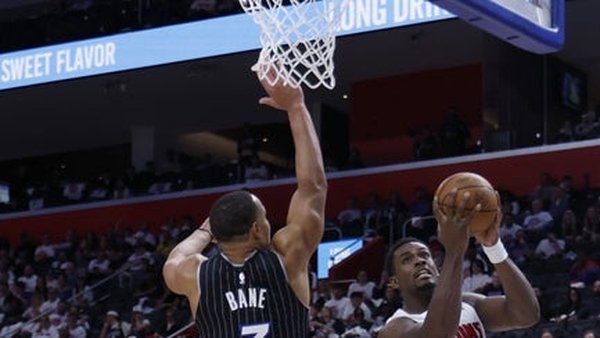
Bash sees a playoff series tied 1-1 heading back to Orlando, where the market expects a tight game but the matchup dynamics may tell a different story than the number suggests.
The Setup: Pistons at Magic
Detroit rolls into Orlando on Saturday night with momentum after evening this first-round series at one game apiece. The Pistons dismantled the Magic 98-83 in Game 2, turning a tied game into a rout with a dominant 38-16 third quarter. Now the series shifts to Orlando, where the Magic are catching 2.5 points at home with a total sitting at 213.5.
Here’s the tension: Detroit enters as the top seed with a 60-22 record and a net rating advantage of 7.8 points per 100 possessions over Orlando. The Pistons have been the superior team all season long, posting an offensive rating of 117.3 compared to Orlando’s 114.2. But the market is pricing this as essentially a pick’em with home court factored in, and that creates a real question about whether this line properly reflects the gap between these teams.
The projection has Detroit by 1.9 points, which puts the spread roughly in line with the market. But the total at 213.5 looks notably low given the pace profile and offensive firepower on both sides. Both teams play in the 100-possession range, and the expected pace blend comes in at 100.2 possessions—an up-tempo environment that should create more scoring opportunities than this number suggests.
Game Info & Betting Lines
When: Saturday, April 25, 2026 | 7:30 PM ET
Where: TBD
Watch: Peacock, NBCSN
Spread: Orlando Magic +2.5 (-110) | Detroit Pistons -2.5 (-110)
Total: 213.5 (Over -110 / Under -110)
Moneyline: Magic +117 | Pistons -143
Why This Line Exists
The market is giving Orlando respect for playing at home in a playoff environment where the Magic went 25-15 during the regular season. Home court matters in the postseason, and Orlando showed in Game 1 that they can compete with Detroit when the Pistons don’t get secondary scoring behind Cade Cunningham’s 39 points.
But Game 2 exposed a real problem for Orlando: when Detroit gets balanced contributions, the efficiency gap becomes glaring. The Pistons had five players in double figures in that 98-83 win, and they dominated the glass with an offensive rebounding edge that shows up in the season-long numbers. Detroit holds a 5.8 percentage point advantage in offensive rebounding rate, which translates to second-chance opportunities that can swing playoff possessions.
The total at 213.5 reflects the defensive intensity we saw in Game 2, where Orlando managed just 83 points. But that was in Detroit, where the Pistons’ defensive rating of 108.9 plays up even more. Orlando’s home environment typically allows for more offensive rhythm, and with both teams averaging north of 115 points per game during the regular season, this number feels like an overreaction to one low-scoring playoff game.
Pistons Breakdown
Cade Cunningham is operating at an elite level in this series, averaging 33 points across the first two games with the kind of playmaking that opens up Detroit’s offense. His 9.9 assists per game during the regular season showed his ability to create for others, and in Game 2 he had 11 dimes while still getting his 27 points. When Cunningham is both scoring and facilitating, the Pistons become extremely difficult to contain.
Jalen Duren gives Detroit an interior presence that Orlando struggles to match, averaging 19.5 points and 10.5 rebounds during the season while shooting 65.0% from the field. His offensive rebounding creates extra possessions, and his ability to finish around the rim forces Orlando to commit help defense, which opens up shooters like Duncan Robinson (41.0% from three) and Tobias Harris (36.8% from deep).
Detroit’s offensive rating of 117.3 ranks among the league’s best, and their true shooting percentage of 58.3% reflects genuine shot quality. The Pistons don’t just take good shots—they convert them at an efficient rate that puts constant pressure on opposing defenses. Their 28-13 road record during the regular season shows they can win away from home, and they’re coming off a Game 2 performance that re-established their identity as the superior team in this series.
Magic Breakdown
Orlando’s offense runs through Paolo Banchero and Franz Wagner, who combined for 42.8 points per game during the regular season. Banchero’s 22.2 points and 8.4 rebounds give the Magic a versatile weapon who can score inside and create off the dribble, while Wagner’s 20.6 points on 48.1% shooting provides a secondary scoring punch. Desmond Bane adds another 20.1 points per game with 39.1% three-point shooting, giving Orlando three legitimate offensive threats.
The problem for Orlando is defensive consistency. Their defensive rating of 113.6 ranks well below Detroit’s 108.9, and that gap showed up in Game 2 when the Pistons shot 48.5% from the field and controlled the paint. The Magic don’t have the rim protection or perimeter defense to consistently slow down Detroit’s balanced attack, especially when Cunningham is orchestrating the offense.
Jonathan Isaac remains doubtful with a left knee sprain, continuing a month-long absence that removes a key defensive piece from Orlando’s rotation. Without Isaac’s length and versatility, the Magic lack the defensive flexibility to switch across multiple positions, which becomes critical against a Pistons team that moves the ball and finds open shooters.
Orlando’s 25-15 home record provides some comfort, but their net rating of just 0.6 suggests they’re essentially a break-even team over the full season. In a playoff series against a top seed, that margin for error disappears quickly.
The Matchup
The pace environment sets up for more possessions than this total suggests. Both teams play in the 100-possession range, and my model projects 100.2 possessions in this game—an up-tempo environment that should create scoring opportunities. When you combine that pace with Detroit’s offensive rating of 117.3 and Orlando’s ability to score at home, the math points toward a higher-scoring game than 213.5.
Detroit’s offensive rebounding edge of 5.8 percentage points creates real separation in playoff basketball where every possession matters. The Pistons grabbed 30.9% of available offensive rebounds during the season compared to Orlando’s 25.1%, and those second-chance opportunities extend possessions and wear down defenses. In a playoff setting where halfcourt execution becomes more important, offensive rebounds can be the difference between winning and losing close games.
The effective field goal percentage gap of 1.6 percentage points favors Detroit, which reflects better shot quality and finishing ability. The Pistons get cleaner looks and convert them at a higher rate, which compounds over the course of a full game. Orlando’s defense simply doesn’t have the personnel to consistently contest Detroit’s shooters or protect the rim against Duren’s interior presence.
The clutch numbers show both teams are competent in close games—Detroit went 27-15 in clutch situations during the regular season while Orlando went 27-16. But in a playoff environment where the game tightens up in the fourth quarter, Detroit’s superior overall efficiency gives them the edge when possessions matter most.
Bash’s Best Bet & The Play
The total at 213.5 doesn’t match the game environment. You’ve got two teams that averaged 117.8 and 115.7 points per game during the regular season, playing at a pace that projects to 100-plus possessions, in a playoff game where Orlando needs to push tempo at home to stay competitive. The model projects a total of 227.5, which creates a 14-point edge over the posted number.
Game 2’s defensive slugfest has the market gun-shy, but that was in Detroit where the Pistons’ home defense plays up. Orlando at home should find more offensive rhythm, and Detroit’s balanced attack should produce more efficiently than they did in a grind-it-out playoff win. Both teams have the shooting and pace to push this number over, and the offensive rebounding edge Detroit holds creates extra possessions that add points to the total.
The Play: Over 213.5 (-110)
Risk factor: Playoff defense can tighten up possessions and reduce scoring, and if Orlando struggles to generate clean looks like they did in Game 2, this total could stay under. But the pace environment and offensive firepower on both sides point to a scoring game that exceeds this number. Take the over and expect both teams to find more offensive success than this low total suggests.