Bash examines a playoff match where defensive muscle and offensive firepower clash, with the market pricing it as essentially a pick’em despite clear efficiency gaps and injury uncertainty hanging over Denver’s frontcourt.
The Setup: Nuggets at Timberwolves
Minnesota sits at +1.5 at home against Denver on Saturday night, and the market is treating this like a coin flip. The Timberwolves just seized a 2-1 series lead with a dominant 113-96 victory Thursday, holding the Nuggets to a franchise playoff-record 11 points in the first quarter while building a 27-point cushion. That wasn’t a fluke — it was defensive muscle flexing against a Denver offense that’s now missing Aaron Gordon to a calf injury and struggling to generate any paint presence without him.
The projection sees this landing around a one-point Minnesota edge, which puts us basically in line with the market on the spread. But here’s the tension: Denver’s offensive rating sits at 121.2 compared to Minnesota’s 115.6, yet the Timberwolves just held Nikola Jokic to 7-for-26 shooting with Rudy Gobert erasing him in the paint. The total opened at 229.5, and that’s where things get interesting when you consider the pace blend projects around 100.5 possessions in what should be an up-tempo playoff environment.
Game Info & Betting Lines
Matchup: Denver Nuggets (54-28) at Minnesota Timberwolves (49-33)
Date & Time: Saturday, April 25, 2026 | 7:30 PM ET
TV: ABC
Venue: TBD
Current Odds (MyBookie.ag):
- Spread: Minnesota Timberwolves +1.5 (-110) | Denver Nuggets -1.5 (-110)
- Moneyline: Minnesota -101 | Denver -120
- Total: 229.5 (Over -110 / Under -110)
Why This Line Exists
The market is giving Denver a tiny road edge despite what just happened Thursday night, and that tells you everything about how much respect Jokic commands. The three-time MVP averaged 27.7 points, 12.9 boards, and 10.7 assists during the regular season on 56.9% shooting, and even in an ugly 7-for-26 performance he still posted 27 and 15. The Nuggets finished third in the West at 54-28 with a +5.2 net rating, and their 121.2 offensive rating ranks elite.
But here’s what the line is wrestling with: Aaron Gordon remains questionable with left calf tightness after missing Game 3, and his absence gutted Denver’s physicality. The Nuggets gave up a 68-34 paint advantage without him, and coach David Adelman admitted their offensive physicality needs to improve. Peyton Watson is out for a ninth straight game with a hamstring strain, further thinning their wing depth.
Minnesota’s defensive rating of 112.5 gives them a real foundation, and they’re generating 8.7 steals per game compared to Denver’s 6.8. That pressure creates transition opportunities, and the Timberwolves offensive rebounding edge of 2.1 percentage points means more second-chance looks. The shooting efficiency gap favors Denver by 2.4 points in true shooting percentage, but when Gobert is swallowing Jokic in the paint like he did Thursday, that edge evaporates fast.
Nuggets Breakdown
Denver’s offense runs through Jokic’s brilliance, and Jamal Murray provides the secondary scoring punch at 25.4 points per game on 48.3% shooting and 43.5% from three. That’s a devastating pick-and-roll combination when it’s clicking, and their 66.5% assist rate shows how much ball movement creates open looks. Tim Hardaway Jr. chips in 13.5 points while shooting 40.7% from deep, giving them floor spacing even when the primary actions stall.
The problem is paint presence without Gordon. He averaged 16.2 points and 5.8 boards while shooting nearly 50% from the floor, and his energy on both ends can’t be replaced by committee. If he sits again, Spencer Jones, Tim Hardaway, and Zeke Nnaji are candidates for increased minutes, but none of them bring Gordon’s physicality or defensive versatility. Denver’s 26-15 road record shows they can win away from home, but their 116.0 defensive rating leaves gaps when they can’t generate stops.
The clutch numbers are basically even — Denver’s 23-19 in close games with a -0.1 plus-minus in crunch time. They can execute when it matters, but they’re not dominant closers this season.
Timberwolves Breakdown
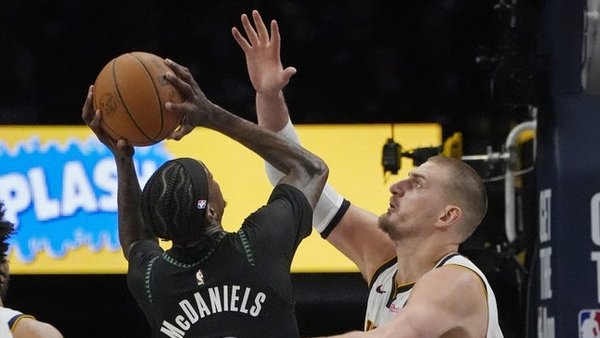
Minnesota’s defensive identity showed up in full force Thursday night. Jaden McDaniels posted 20 points and 10 rebounds while hounding Denver’s perimeter, and Ayo Dosunmu came off the bench for 25 points and nine assists. Donte DiVincenzo added 15 points and four steals, and that depth rotation is causing Denver real problems. Anthony Edwards leads the charge at 28.8 points per game on 48.9% shooting and 39.9% from three, giving them a legitimate closer who can create his own shot.
Julius Randle provides 21.1 points and 6.7 boards with solid playmaking at 5.0 assists per game, though his 31.5% three-point shooting creates some spacing concerns. Naz Reid gives them 13.6 points and 6.2 rebounds off the bench, and that frontcourt depth matters when Gobert picks up fouls battling Jokic. The Timberwolves 26-15 home record shows they protect their building, and their 57.6% clutch win rate edges Denver’s 54.8%.
The offensive rebounding edge at 25.8% compared to Denver’s 23.7% creates extra possessions, and in a playoff game where every possession matters, that’s real value. Their 101.5 pace pushes tempo slightly faster than Denver’s 99.5, which should create more transition opportunities off those steals and defensive rebounds.
The Matchup
The key battleground remains Gobert versus Jokic in the paint. Thursday showed what happens when Gobert gets physical and forces Jokic into difficult looks — the MVP finished 7-for-26, and that defensive pressure changed the entire game. Denver’s offense versus Minnesota’s defense projects as a strong mismatch favoring the Nuggets by 8.7 points per 100 possessions, but that’s a season-long number that doesn’t account for Gordon’s absence or Gobert’s recent dominance.
Minnesota’s offense versus Denver’s defense shows basically no edge at 0.4 points per 100 possessions within noise. The Timberwolves aren’t going to blow past this Denver defense, but they don’t need to — they just need to control pace, crash the glass, and let Edwards create in crunch time. The pace blend around 100.5 possessions means we’re looking at more scoring opportunities than a typical playoff grind, and my model projects this total landing around 233.8 points.
That’s a 4.3-point edge to the over, which qualifies as strong value against the posted 229.5. The shooting efficiency gap favors Denver, but Minnesota’s offensive rebounding and transition game off turnovers creates enough extra possessions to push scoring higher than the market expects. Both teams can score — Denver averaged 122.1 points per game during the season while Minnesota posted 118.0 — and this pace environment should create enough possessions for both offenses to eat.
Bash’s Best Bet & The Play
I’m looking at the over 229.5 in this matchup. The pace blend projects over 100 possessions, and even with playoff intensity tightening rotations, both teams have the offensive firepower to push this total higher. Denver’s 121.2 offensive rating and Minnesota’s transition game off defensive pressure create enough scoring opportunities to clear this number, especially if Gordon returns and opens up Denver’s paint game.
The spread basically prices correctly — the projection sees Minnesota by less than a point with home court, which aligns with the +1.5 market. But the total shows real separation. The model sees 233.8 points, and that four-point cushion gives you room for some playoff variance while still finding value. Minnesota’s offensive rebounding edge creates second-chance points, and Denver’s shooting quality means they’ll convert possessions even against this Timberwolves defense.
The risk is obvious — playoff games can tighten up late, and if this turns into a defensive slugfest like the first quarter Thursday, we’re in trouble. But the pace environment and offensive efficiency on both sides points toward a higher-scoring affair than 229.5 suggests. Take the over and trust the possessions to create enough scoring chances.