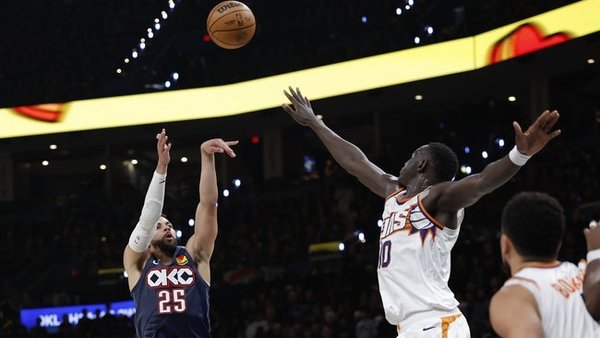
Bash sees a playoff series tilting toward a sweep, but the market’s giving Phoenix enough rope to make this Game 3 spread worth a hard look—even with Oklahoma City’s dominant form.
The Setup: Thunder at Suns
Phoenix comes home down 0-2 in this first-round series, and the market’s handing them 8.5 points Saturday night. That’s a big number for a desperate team with home court, but the projection sees Oklahoma City by just under three points when you bake in home-court advantage. The Thunder just dismantled the Suns twice in Oklahoma City, winning by 13 in both games, and Shai Gilgeous-Alexander looked every bit the Clutch Player of the Year in Game 2 with 37 points on efficient shooting. The Suns got 30 from Dillon Brooks before he fouled out, but they also coughed up 21 turnovers and couldn’t slow down a Thunder offense that shot 47.3% from the field.
Here’s the tension: Phoenix is facing elimination pressure with their season on the line, but they’re also dealing with the same fundamental problems that got them here. The efficiency gap between these teams is massive—Oklahoma City’s net rating sits at plus-11.1 while Phoenix checks in at plus-1.4. That’s a 9.7-point swing per 100 possessions, and it’s the foundation of why this series has played out the way it has. But the market’s asking whether desperation and home court can close that gap enough to cover a fat number.
Game Info & Betting Lines
When: Saturday, April 25, 2026 | 7:30 PM ET
Where: TBD
Watch: NBC, Peacock
Spread: Thunder -8.5 | Suns +8.5 (-110)
Total: 214.5 (Over/Under -110)
Moneyline: Thunder -420 | Suns +307
Why This Line Exists
The market’s pricing in playoff desperation and home-court advantage for a Suns team that went 25-16 at home during the regular season. Phoenix needs to protect home court to have any chance of extending this series, and historically, teams down 0-2 play with urgency in Game 3. The sportsbooks also watched five higher-seeded teams lose home games in the first week of these playoffs, including all three top seeds in the East. That kind of chaos creates hesitation about laying big numbers with road favorites, even when the road favorite is this dominant.
But here’s what the line is really respecting: Oklahoma City just lost Jalen Williams to a left hamstring strain. He exited Game 2 in the third quarter and won’t return for at least the next three games of this series. Williams averaged 17.1 points and 5.5 assists during the regular season, and losing that secondary creation puts more pressure on Shai and forces deeper rotation minutes from guys like Ajay Mitchell and Cason Wallace. Isaiah Joe is also doubtful for personal reasons, which thins out the Thunder’s wing depth even more. The market sees that injury situation and gives Phoenix a window.
The 214.5 total reflects the expected pace—my model projects 99.2 possessions, which is deliberate for a playoff game. Both teams slow it down relative to league average, and Phoenix especially grinds at 98.1 possessions per game. The market’s betting on playoff defense tightening up and possessions mattering more.
Thunder Breakdown
Oklahoma City finished 64-18 and earned the top seed in the West for a reason. Their offensive rating of 117.6 ranks elite, and their defensive rating of 106.5 gives them the kind of two-way balance that wins playoff series. Shai Gilgeous-Alexander is operating at an MVP level, averaging 31.1 points on 55.3% shooting with a 38.6% clip from three. He’s also the reigning Clutch Player of the Year, and that matters when games tighten up—the Thunder went 24-10 in clutch situations during the regular season with a plus-2.7 margin in those spots.
Chet Holmgren gives them rim protection and floor spacing, averaging 17.1 points and 8.9 rebounds with nearly two blocks per game. The Thunder also generate 9.7 steals per game as a team, which fuels transition opportunities and creates extra possessions. Their true shooting percentage of 59.9% is absurd, and their effective field goal percentage of 56.1% shows they’re getting quality looks consistently.
The Williams injury hurts, no question. But this team went 30-10 on the road during the regular season, and they just handled Phoenix twice without breaking a sweat. The depth takes a hit, but the core is still intact.
Suns Breakdown
Phoenix scraped into the playoffs as a seven seed at 45-37, and their plus-1.4 net rating tells you they were a borderline team all season. Devin Booker remains their offensive engine at 26.1 points and 6.0 assists per game, but he’s shooting just 33.0% from three and averaging 3.1 turnovers. Dillon Brooks has been their most aggressive scorer this series, dropping 30 in Game 2, but he also fouled out in crunch time when they needed him most. Jalen Green adds 17.8 points, but the shooting percentages across the roster are mediocre—45.5% from the field and 36.1% from three as a team.
The Suns do crash the offensive glass hard, grabbing 13.0 offensive rebounds per game, which gives them a 6.6-percentage-point edge over Oklahoma City in that category. That’s their best path to extra possessions and second-chance points. But they also turn it over more than the Thunder, and their defensive rating of 112.9 means they’re giving up efficient offense on the other end.
Mark Williams remains out with a left foot issue, which continues to thin their frontcourt depth. Jordan Goodwin is questionable with left calf soreness, though he was a full participant in Friday’s practice. Grayson Allen is questionable but hasn’t played in the last three games despite being upgraded to available. The rotation is shaky, and that matters in a must-win spot.
The Matchup
The efficiency gap is the story here. Oklahoma City’s offense against Phoenix’s defense projects to a plus-4.7 mismatch per 100 possessions, while Phoenix’s offense against Oklahoma City’s defense shows a plus-7.7 edge—but that’s more about the Thunder’s defensive rating being elite than Phoenix’s offense being explosive. The shooting quality gap is real: Oklahoma City holds a 3.1-percentage-point edge in true shooting and a 2.4-point edge in effective field goal percentage. Those margins compound over 99 possessions.
Phoenix’s offensive rebounding advantage is their best weapon. They grab 28.9% of available offensive boards compared to Oklahoma City’s 22.4%, and in a slower-paced game, those extra possessions matter. If the Suns can crash the glass and create chaos in the paint, they can extend possessions and keep this game closer than the efficiency numbers suggest.
But here’s the problem: Oklahoma City generates turnovers and converts them into transition buckets. Phoenix turned it over 21 times in Game 2, and the Thunder’s 9.7 steals per game create live-ball turnovers that lead to easy offense. The Suns also went 19-19 in clutch games during the regular season with a minus-0.4 margin in those spots, while Oklahoma City went 24-10 with a plus-2.7 margin. If this game is close late, you trust Shai and the Thunder to execute.
The pace blend sits at 99.2 possessions, which favors a grindier game. The model projects a total around 223.9, which is nearly 10 points higher than the posted 214.5. That’s a strong signal that the scoring environment could be more open than the market expects, especially if Phoenix pushes tempo out of desperation and Oklahoma City’s transition game gets going.
Bash’s Best Bet & The Play
The Play: Suns +8.5 (-110)
I’m backing Phoenix to cover at home. The projection sees this game landing around three points, and getting 8.5 with a desperate team protecting home court is too many points to pass up. The Suns have real problems—no question—but they also have enough offensive firepower to keep this competitive, especially if they can dominate the offensive glass and create second-chance opportunities. Oklahoma City is the better team, but they’re also dealing with rotation pressure after losing Jalen Williams and potentially Isaiah Joe. That thins out their depth and forces more minutes from guys who haven’t played heavy playoff minutes.
Phoenix went 25-16 at home during the regular season, and desperation is a real factor when your season is on the line. The efficiency gap is massive, but 8.5 points is a big enough cushion to absorb some of that difference. I also like the over at 214.5, given the projected total sits near 224, but the spread is the sharper play here. Phoenix covers, even if they don’t win outright.
Risk Note: If Oklahoma City’s depth holds up better than expected and they generate early turnovers that lead to transition buckets, this game could get away from Phoenix quickly. The Suns also have a tendency to self-destruct with turnovers and foul trouble, which is exactly what happened to Dillon Brooks in Game 2. If Phoenix can’t protect the ball and stay out of the penalty, this number won’t matter.