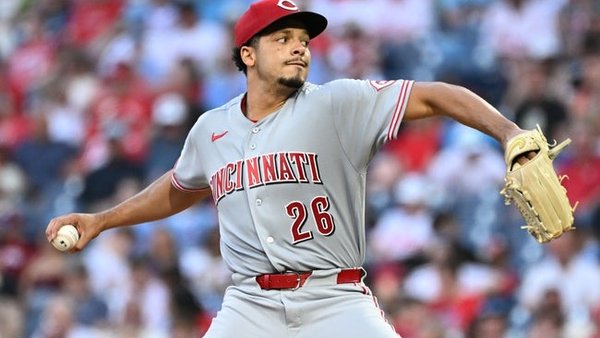
Chase Burns carries a 1.96 ERA and a slider hitters whiff on at 51.8% into a start against a Kansas City offense posting a .690 OPS and -53 run differential — the most pronounced pitching mismatch of this series. The total sits at 8.5 (-115 under), with projections landing at 9.8 combined runs, but park factor alone does not tell the full story when this caliber of arm faces this caliber of lineup.
Stephen Kolek vs Chase Burns: Kansas City Royals at Cincinnati Reds Betting Preview
After yesterday’s extra-inning 4-3 Reds win that ended on a walk-off single from Blake Dunn, the series shifts to a starkly different pitching dynamic. Yesterday the Royals got seven dominant innings from Noah Cameron and still lost. Today, Cincinnati sends Chase Burns — a 7-1, 1.96 ERA arm who has been arguably the best starter in the National League this season — to the mound against a Kansas City offense that ranks among the worst in baseball.
The market has set the total at 8.5, a number that acknowledges Burns’s dominance while factoring in Great American Ball Park’s hitter-friendly environment and Stephen Kolek’s competency on the other side. The 8.5 is not a lazy line. But the specific matchup between Burns and a Kansas City offense running a .690 OPS and -53 run differential on the season creates a scoring environment where one elite performance can compress the combined output well below what the park factor alone would suggest.
I already burned a unit on the over yesterday — a loss that reinforces exactly why raw park factor and projection numbers need to be filtered through who is actually standing on the mound. Today’s pitching gap is the story, and it’s why the under deserves serious attention even with the projection conflict sitting right in front of us.
Game Info & Betting Lines
- Date/Time: Wednesday, June 3, 2026 | 7:10 PM ET
- Venue: Great American Ball Park | Park Factor: 1.10 (hitter-friendly)
- Probable Starters: Stephen Kolek (KC, 3-1, 3.48 ERA) vs Chase Burns (CIN, 7-1, 1.96 ERA)
- Moneyline: Kansas City Royals +134 / Cincinnati Reds -158
- Run Line: Cincinnati Reds -1.5 (+134) / Kansas City Royals +1.5 (-162)
- Total: 8.5 (Over -105 / Under -115)
Why This Number Is Close
The market’s 8.5 is doing real work here, and I understand exactly why it’s priced where it is. Burns is elite, but Great American Ball Park plays at 1.10 — one of the more offense-friendly environments in the National League. The books are also looking at Kolek’s 3.48 ERA and reasonably crediting him as a functional mid-rotation arm who limits walks (6 in 31 IP) and keeps the ball in the park well enough. The Reds lineup, even without Elly De La Cruz, has legitimate threats: JJ Bleday (.301/.1.053 OPS), Nathaniel Lowe (.258/.879 OPS), and Sal Stewart (.261/.827 OPS) are all capable of tagging a starter for multiple runs in a single frame.
The numbers project 9.8 combined runs, which technically clears 8.5 by over a full run — that’s the most honest pushback I can give you right up front. This is not a marginal disagreement; it’s a meaningful gap pointing the other direction. The under is priced at -115, meaning we’re laying juice against a projection that favors the over.
Where I think the number is slightly off is in how much weight it assigns to Burns’s suppression upside on a specific opponent. Kansas City’s .690 OPS is not a generic weak offense — it’s historically bad, and Burns has faced lineups at this caliber and been dominant. The park factor matters, but Burns has consistently held opponents well below the run-environment baseline regardless of venue. That specific combination — elite arm, historically weak opposing lineup — is where I find the lean.
What Separates the Pitching
The gap between these two starters is the most pronounced pitching mismatch in this series. Burns operates at a completely different level. His four-seam fastball sits at 98.0 mph and accounts for nearly 57% of his pitch mix, generating a .321 xwOBA against — solid, not dominant on its own. But paired with a 90.8 mph slider that hitters whiff on at a 51.8% rate and produces a microscopic .183 xwOBA, Burns has a two-pitch combination that gives hitters almost no path to consistent hard contact. The slider is the separator — it’s the pitch that makes his 10.1 K/9 and 1.96 ERA over 64.1 innings feel sustainable rather than lucky.
Against Kansas City specifically, the matchup gets favorable fast. Bobby Witt Jr. carries a .457 xwOBA and is the most dangerous bat in the order, but his 21.7% whiff rate against right-handed arms suggests Burns’s slider will be tested. Carter Jensen shows a .334 xwOBA but whiffs at 29.6% — that’s a swing-and-miss profile Burns has exploited all season. Lane Thomas, hitting leadoff, posts a .304 xwOBA with only 20.9% hard-hit rate and a .285 xwOBA versus right-handers specifically.
Kolek, by contrast, is a competent but limited arm. His 94.1 mph four-seam sits at 29.9% usage with a modest 19.1% whiff rate. His best weapon is actually his slider — 39.3% whiff rate — but it only accounts for 10.9% of his pitches. The Reds’ top of the order punishes right-handed pitching: Nathaniel Lowe posts a .494 xwOBA versus righties, JJ Bleday sits at .473, and Sal Stewart checks in at .398. The concern about Kolek is not that he’ll implode — it’s that Cincinnati’s lineup has multiple dangerous matchups that could generate a multi-run inning before he exits in the fifth or sixth.
The innings these two pitchers create are fundamentally different. Burns generates swing-and-miss with an elite two-pitch arsenal against a lineup that has almost no margin for error. Kolek faces a Reds offense that could touch him for a crooked number in any given frame. The run-prevention gap is real, and it’s the core of the under argument.
The Pushback
The honest pushback here is threefold. First, the numbers project 9.8 combined runs — 1.3 runs above the line. That projection doesn’t come from nowhere. It factors in the park, both offenses, and both bullpens, and it lands on the over side in a meaningful way.
Second, Great American Ball Park at 1.10 is not neutral ground. On a night where Burns goes six innings and gives up two runs, Kolek still has to face Bleday, Lowe, and Stewart in a lineup that knows how to work counts and generate traffic. The Reds don’t need an explosion to push the number — they just need a multi-run inning at some point while the Royals scratch out a few runs late against Cincinnati’s depleted bullpen.
Third — and this one actually matters — Chase Burns’s health heading into this start is a live concern. He was scratched from Monday’s start with illness — the Reds were forced to turn to emergency arm Lyon Richardson, and Kansas City rolled to a 9-2 win. Burns is listed as the starter today, but if he’s managing any lingering effects, his pitch count could be limited, which would accelerate the bullpen timeline and change the scoring equation entirely.
I come back to the under because Chase Burns’s suppression profile is the single most reliable data point in this game. Even if he’s operating at 90% health, his 51.8% slider whiff rate and 10.1 K/9 against a .690 OPS offense represent the kind of ceiling-compressing combination that consistently outperforms park-factor projections. Kansas City is 23-38 with a -53 run differential — they are not a team that grinds out crooked numbers against elite arms. And if Burns logs six or seven clean innings, even a two-run Reds performance puts the combined total well within striking distance of 8.5.
Bet: Under 8.5 — 2 units at -115 (moderate confidence). The projection conflict is real, and Burns’s recent illness creates genuine uncertainty — I’m not pretending otherwise. But an elite 1.96 ERA arm against one of baseball’s worst offenses in a game where the under is priced at -115 is exactly the spot where I’m willing to fade the raw numbers. Burns’s elite suppression profile versus Kansas City’s historically weak offense is the thesis, and it’s strong enough to back.