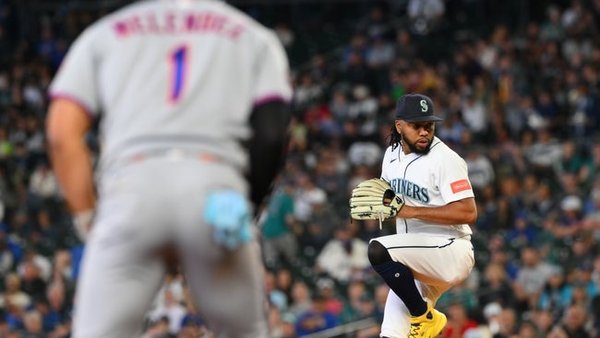
Christian Scott’s 39.7% whiff-rate curveball faces a Padres lineup posting a .651 OPS — and missing their most productive bat in Luis Campusano. San Diego carries a 1-9 skid into Petco Park yet still opens as -132 home favorites, a price that doesn’t fully account for how thin their offensive threat actually is right now.
Christian Scott vs. Michael King: New York Mets at San Diego Padres Betting Preview
The Mets arrive at Petco Park as +112 underdogs against a San Diego team that carries a 32-29 record but has lost nine of their last ten games. That overall record is doing a lot of marketing work for the Padres — the market is still pricing them as a legitimate home favorite at -132, but the recent body of evidence tells a different story. San Diego just got swept by Philadelphia and walked into this series off the back of a 6-4 loss Thursday night, their offense continuing to grind out ugly, low-leverage at-bats.
The pitching matchup deserves the most attention here, and it slightly favors New York. Christian Scott carries a 2.97 ERA in his young 2026 campaign (1-0), while Michael King is a legitimate mid-rotation arm at 3.18 ERA through 68 innings. The gap is narrow, but combined with the Padres posting a .651 OPS as a unit — one of the weakest offensive profiles in baseball — Scott’s edge over a suppressed lineup in a pitcher’s park creates a genuinely mispriced moneyline. The numbers project the Mets at 3.9 runs to the Padres’ 3.8. Getting the Mets at +112 in a coin-flip game is where the value lives.
Game Info & Betting Lines
- Date/Time: Friday, June 5, 2026 — 9:40 PM ET
- Venue: Petco Park (Park Factor: 0.92 — pitcher-friendly)
- TV: MLB.TV, Padres.TV, WPIX
- Probable Starters: Christian Scott (NYM, 1-0, 2.97 ERA) vs. Michael King (SD, 4-4, 3.18 ERA)
- Moneyline: New York Mets +112 / San Diego Padres -132
- Run Line: San Diego Padres -1.5 (+164) / New York Mets +1.5 (-200)
- Total: 7.5 (Over +100 / Under -122)
Why This Number Is Off
The case for the Padres at -132 is not irrational. They’re at home, they have a winning record at 32-29, and King has thrown 68 innings of legitimate mid-rotation baseball. The market is essentially treating this as a standard home-favorite setup — and on any given night, that framing is reasonable. Home field in MLB is worth roughly 0.3 runs, and King’s track record through nearly 70 innings gives bookmakers something real to price.
But here’s the problem: the Padres’ 1-9 skid is not random variance anymore. A team that has been swept twice by Philadelphia in the same week, scoring two runs or fewer in multiple games, is not a lineup that justifies -132 against a pitcher carrying a sub-3.00 ERA. Their .651 OPS as a unit is nearly identical to the Mets’ .652 — these two offenses are nearly indistinguishable in quality, which means the pitching matchup becomes the deciding factor.
The win probability implied by the numbers sits at 52.7% for the Mets. At +112, the market implies a 47.2% win probability. That gap — roughly 5.5 percentage points — is where the edge lives. It’s not enormous, but it’s consistent and price-valid. A +112 moneyline on a coin-flip game where the projection hands you the slight edge is exactly the kind of number worth a unit.
What Separates the Pitching
Scott and King are separated more by trajectory and run environment than by a wide talent gap, which is important context before overstating the edge. That said, the Statcast arsenal data reveals meaningful differences in how each pitcher attacks hitters.
Scott leans heavily on a sinker (35.0% usage, 94.9 mph) that generates a .277 xwOBA against — a genuine ground-ball suppressor. His curveball is the outlier pitch: 39.7% whiff rate and a .103 xwOBA against, making it one of the more dominant put-away offerings in the dataset. That combination — a heavy sinker to generate weak contact, a curveball that genuinely misses bats — is well-suited to a Padres lineup that doesn’t generate hard contact consistently. Tatis Jr. carries a 26.2% overall whiff rate, and Manny Machado sits at a 23.4% overall whiff rate — those are season-wide figures, not curveball-specific, but they do suggest both hitters are susceptible enough to breaking balls that Scott’s curve can be a real equalizer against the middle of San Diego’s order.
King attacks differently. His changeup (27.3% usage, 89.9 mph, 27.1% whiff) is his primary off-speed weapon, but his four-seamer is the concerning number: .459 xwOBA against at 26.4% usage. When King misses with that fastball, hitters do damage. Juan Soto, batting third for New York, carries a .515 xwOBA against right-handed pitching this season — a genuine mismatch against King’s four-seam heavy approach. Soto’s .943 OPS and 13 home runs make him the most dangerous bat in this game, and the Mets’ lineup construction funnels him into the optimal spot to face King in high-leverage counts.
The gap isn’t cavernous, but Scott’s superior ground-ball profile and elite curveball against a passive Padres lineup gives him a real advantage in expected run prevention at Petco.
The Pushback
I want to be honest about where this bet almost falls apart, because there are legitimate reasons the Mets are priced as underdogs here.
The injury situation in New York is genuinely rough. Francisco Lindor is on the 10-Day IL with a calf issue, Francisco Alvarez is out with a knee injury, Luis Robert Jr. is on the 60-Day IL, and Jorge Polanco is also shelved. The Mets are 27-35 on the season — a losing record — and the lineup they’re running out tonight is not their best version. That’s real and worth pricing in.
San Diego has their own injury concerns, though, and they cut deeper than the Padres’ overall record implies. Beyond the headline names, Luis Campusano — their catcher posting a .958 OPS in 52 at-bats, easily the most dangerous bat in their lineup — is also on the 10-Day IL with a toe injury. That’s not a minor omission. Campusano’s absence strips San Diego of their most productive hitter, which means that .651 OPS figure is arguably generous to what they’re actually putting on the field tonight. Ramon Laureano and Jake Cronenworth are also unavailable. When you strip out Campusano and account for the broader attrition, the Padres’ offensive threat is considerably more modest than their season numbers suggest.
The other honest caveat: Scott is 1-0 with a 2.97 ERA, which is a small sample. We don’t have a long track record to lean on, and one bad outing could make that number look very different. King, on the other hand, has 68 innings of data backing up his 3.18 ERA — that’s a more reliable signal. I’m not ignoring that asymmetry.
Still, the price accounts for some of this uncertainty. You’re not laying -132 on a depleted New York team — you’re getting them at plus money. That’s the whole point.
Run Environment & Game Shape
The projected 7.7-run total essentially matches the posted line of 7.5, which tells me the books have this game sized up reasonably on the over/under. I’m not fighting that number. Petco Park carries a 0.92 park factor — pitcher-friendly — and both offenses are operating near .651-.652 OPS on the season. The under at -122 is priced with juice for a reason, but laying that price in a game projected this close to the line doesn’t offer the kind of margin I need to act. The run line at -1.5 for San Diego paying +164 is interesting in theory given the projected 3.9-3.8 split, but the Mets winning by exactly two or more isn’t a comfortable lean when Scott is working on limited sample size. The moneyline is the cleaner vehicle.
Both starting pitchers profile as run-suppressors in a ballpark that suppresses runs. A tight, low-scoring game that comes down to one or two sequences is the most likely shape here — and in that environment, getting the Mets at a price that implies they lose more often than they actually should is a bet worth making.
Pick: Mets ML +112 — 1 unit. This is a lean, not a strong play — the injury uncertainty on both sides and Scott’s small sample keep it at one unit — but the price gap is real and the matchup construction supports New York in a game the market has slightly mispriced.