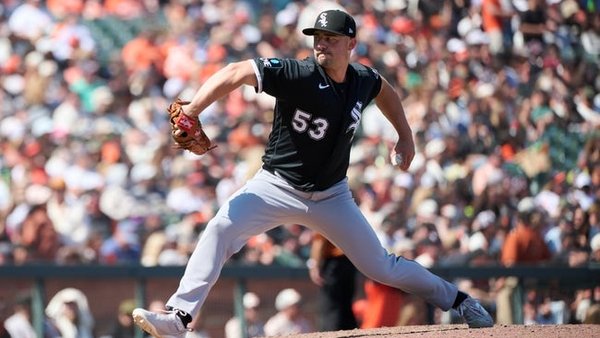
Andrew Painter carries a 5.74 ERA and a four-seam fastball opponents are posting a .409 xwOBA against — yet the Phillies are priced at -134, leaning heavily on a hot record backed by a -20 run differential. The gap between what Philadelphia has been and what the market is charging for them today is where the real friction lives.
Brandon Eisert vs Andrew Painter: Chicago White Sox at Philadelphia Phillies Betting Preview
The Phillies are riding genuine momentum — four straight wins, eight of their last ten, and the crowd at Citizens Bank Park buzzing after an 8-6 victory over these same White Sox last night. That’s the surface read, and it explains why Philadelphia is priced as a -134 favorite. But momentum narratives in baseball have a way of obscuring what’s actually on the mound, and what’s on the mound for Philadelphia today is a real problem: Andrew Painter, who has been one of the worst starting pitchers in baseball in 2026.
A 5.74 ERA over 53.1 innings isn’t a rough patch. It’s a pattern. The market is leaning on the Phillies’ hot record and home-field pricing, but Philadelphia’s -20 run differential behind that 34-29 mark tells a different story — this is a team outrunning its underlying quality. Chicago’s lineup, even without Murakami, projects to outscore the Phillies slightly at 4.8–4.6, and the White Sox are available at +114. There’s real value embedded in that price — enough to make this an interesting lean, even accounting for the uncertainty baked into this matchup.
Yesterday’s result is worth noting: both offenses combined for 14 runs and Painter’s counterpart allowed five. That kind of volatility is precisely why the White Sox plus-money today deserves attention — though it’s also a reminder that this game environment can swing either way.
Game Info & Betting Lines
- Date/Time: Saturday, June 6, 2026 — 4:05 PM ET
- Venue: Citizens Bank Park | Park Factor: 1.02 (slight hitter-friendly)
- TV: MLB.TV, NBC Sports Philadelphia, CHSN
- Probable Starters: Brandon Eisert (CWS, 1-0, 3.86 ERA, 1.37 WHIP, 11.2 IP) vs. Andrew Painter (PHI, 1-6, 5.74 ERA, 1.52 WHIP, 53.1 IP)
- Moneyline: Chicago White Sox +114 / Philadelphia Phillies -134
- Run Line: Philadelphia Phillies -1.5 (+138) / Chicago White Sox +1.5 (-166)
- Total: 9.5 (Over -122 / Under +100)
Why This Number Is Worth Questioning
The market is doing something understandable here: it’s combining home-field advantage, a hot Phillies record, and recency bias from last night’s win into a -134 price. There is a legitimate case for Philadelphia. Their bullpen is genuinely strong — Jhoan Duran has converted all 15 save opportunities, and their staff ERA of 3.98 is solid. The park factor nudges slightly toward offense, which theoretically benefits Philadelphia’s power bats. Schwarber (23 HR) and Harper (14 HR) are genuine threats, and the home crowd will be energized.
But here’s what gives me pause: -134 implies roughly a 57% win probability for the Phillies. The numbers have Chicago winning this game 56.7% of the time — a 13.9-point implied probability gap. That’s a meaningful discrepancy worth leaning into, even if I’m not ready to pound the table given the Eisert sample size and the complications discussed below. The Phillies’ -20 run differential is the quiet number that undercuts the hot-record framing — they’ve been winning close games at an unsustainable rate, not blowing teams out. Painter on the mound against a lineup that carries a team OPS of .735 is where that regression risk concentrates most acutely today. The +114 price doesn’t need a slam dunk case; it just needs the edge to be real, and I think it is — narrowly.
What Separates the Pitching
The gap between these two starters is the analytical foundation of this entire lean, and it runs deeper than the surface ERA difference.
Painter’s Statcast profile reveals why the 5.74 ERA is real, not just bad luck. His four-seam fastball sits at 96.5 mph — genuine velocity — but hitters are posting a .409 xwOBA against it with only a 7.5% whiff rate. That’s a fastball getting punished despite the speed, which suggests command and location issues rather than stuff problems. His sinker is even worse at a .410 xwOBA. The two pitches he throws most — the four-seamer at 37.3% and the slider at 19.4% — tell a split story: his slider generates a 40.2% whiff rate and .322 xwOBA, which is a legitimate weapon, but it’s not enough to carry starts when the primary fastball is this hittable. Worth noting: his split-finger (12.6% usage, .210 xwOBA, 37.1% whiff) is a genuine secondary weapon alongside the slider, so there are real put-away pitches in this arsenal. The problem is the heater. Nine home runs allowed in 53.1 innings reflects an arm that is living in the wrong parts of the zone too often. Against a Chicago lineup where Benintendi (.421 xwOBA), Vargas (.424 xwOBA), and Montgomery (.426 xwOBA) all post strong expected contact numbers against right-handed pitching, the exposure is real.
Eisert is working from an 11.2-inning sample, which demands appropriate humility. But the arsenal profile is interesting: his changeup draws a 32.7% whiff rate at 84.4 mph and generates a .288 xwOBA, while his slider sits at .241 xwOBA. His four-seamer is softer at 89.5 mph, but the changeup-slider combination gives him a genuine swing-and-miss profile that the Phillies lineup, which posts a team OPS of just .678, hasn’t seen. Schwarber’s .544 xwOBA and Harper’s .467 xwOBA are the obvious threats, but the BvP samples against Eisert are a single PA each — effectively meaningless. The pitching gap here leans toward Chicago, and that gap is the core of this play.
The Pushback
The case against this play is not trivial, and it deserves an honest accounting.
The Phillies are 8-2 in their last ten games and just beat these exact White Sox 8-6 last night. Momentum is a real psychological factor in a short series, and the home crowd at Citizens Bank Park will be loud. More importantly, Munetaka Murakami is out — the White Sox’s most dangerous bat (20 HR, .938 OPS) is on the IL with a hamstring issue, and his absence reshapes Chicago’s lineup ceiling in a meaningful way. That’s not a footnote; that’s a genuine reason to temper conviction here.
Eisert’s 11.2-inning sample is also worth being honest about. A 3.86 ERA over fewer than three starts isn’t a reliable signal — it’s a data point. He could be the real deal, or he could be a guy who gets exposed the second time through a lineup that has Schwarber, Harper, and a surging Brandon Marsh (hitting .332 to lead the NL) at the top. The Phillies’ bullpen depth with Duran at the back is a legitimate equalizer if Eisert gets into trouble early.
This isn’t a play I’m hammering. It’s a lean — the kind where the price is right and the underlying numbers point in one direction, but the sample size and injury context mean I’m keeping the exposure modest.
Run Environment & Game Shape
The 9.5 total is essentially line-validating — the projected combined score of 9.4 runs lands right on top of it, and the slight park factor of 1.02 at Citizens Bank Park doesn’t meaningfully tilt the environment either way. This isn’t a game that screams “under” or “over” from a structural standpoint, so the total is a pass.
What matters for the moneyline is what happens if this game plays out as a competitive, mid-scoring affair in the 5-4 or 6-5 range — which is exactly the environment where Chicago’s pitching edge at the starter level amplifies. In a blowout, the Phillies’ bullpen depth and Schwarber’s power ceiling take over. In a close game, Eisert’s ability to keep the ball in the yard longer than Painter figures to matter. The White Sox’s team OPS of .735 against a pitcher with a .409 xwOBA on his primary offering is a mismatch that shows up most clearly in low-margin games, which is what this figure of 9.4 projected runs suggests we’re likely to get.
The Phillies’ -20 run differential also reinforces this framing: they’ve been winning games they probably shouldn’t be winning at this rate. Lean toward regression when the price gives you the opportunity — and at +114, it does.
Bet: Chicago White Sox moneyline (+114) — 1 unit, lean confidence.