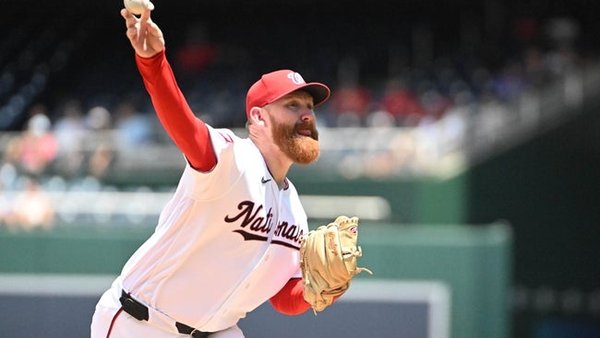
Jesus Luzardo’s 10.19 K/9 and a Nationals Park park factor of 0.98 point toward a quieter run environment than the posted total implies — yet the over is still carrying -118 juice. The Phillies’ .697 team OPS and Luzardo’s specific BvP edge over CJ Abrams create a structural ceiling the market has not fully priced into the number.
Jesus Luzardo vs. Zack Littell: Philadelphia Phillies at Washington Nationals Betting Preview
Monday’s game in this same ballpark ended 4-1 in Washington’s favor, and today’s game presents a fundamentally different puzzle. The Phillies bounced back and are installed as heavy favorites at -168, a number that immediately takes the moneyline off the table. What remains is a total question, and the answer runs directly through the chasm between the two starters taking the mound Tuesday night.
The over at -118 is where the public money is sitting. The books have tilted the juice to reflect that, and the numbers — a projected combined total north of 9 runs — technically support that lean. But projections carry error bars, and when one starter profiles as a legitimate strikeout weapon while the other is bleeding home runs at an alarming rate, the shape of this game is more nuanced than the headline number suggests. Luzardo’s ability to suppress Washington’s side of the ledger is the structural anchor here — and the Phillies’ own weak offense may not be able to generate enough on their own to carry the over.
The under at -104 represents genuine value in this context: lower juice, a pitcher-neutral park, and a quality arm with a real ceiling on one side of the equation.
Game Info & Betting Lines
- Date/Time: Tuesday, June 23, 2026 — 6:45 PM ET
- Venue: Nationals Park | Park Factor: 0.98 (slight run suppressor)
- TV: MLB.TV, NBC Sports Philadelphia, Nationals.TV
- Probable Starters: Jesus Luzardo (PHI) vs. Zack Littell (WSH)
- Moneyline: Philadelphia Phillies -168 / Washington Nationals +142
- Run Line: Philadelphia Phillies -1.5 (-102) / Washington Nationals +1.5 (-118)
- Total: 8.5 (Over -118 / Under -104)
Why This Number Is Close — But Tilted Wrong
The market has landed at 8.5 for a reason: Washington’s offense is legitimate, posting a team .742 OPS with 101 home runs on the season, and Zack Littell has been a live grenade all year. The books have seen Littell’s 20 home runs surrendered in just 71 innings and built some of that run-inflation expectation into the over juice. That is a defensible position. A Littell start genuinely carries blowout potential.
But here is where the market is slightly off: the total requires both halves of the ledger to cooperate. Luzardo’s strikeout profile creates a real ceiling on Washington’s scoring, and the Phillies’ own offense — sitting at a team OPS of just .697 — is not a machine capable of single-handedly pushing a combined total past 8.5. The Phillies are 42-36 with a run differential of -7, a quiet signal that they’ve been grinding through closer, lower-scoring games than their record implies.
The over at -118 juice is pricing in a run-heavy outcome. The under at -104 is offering better value on what is, structurally, a pitcher-tilted environment when you properly weight Luzardo’s side of this matchup. The gap between the implied total and the posted line is not a screaming margin — but the juice differential makes the under the smarter number.
What Separates the Pitching
The gap between these two starters is substantial, and it matters directly for the total. Jesus Luzardo brings a 10.19 K/9, a 1.31 WHIP, and a WAR of 1.83 into this start. His arsenal is built around a sweeper that generates a 46.5% whiff rate at 86.2 mph — the best swing-and-miss offering on either side tonight. He pairs it with a 97.0 mph four-seamer and a changeup that produces a 39.8% whiff rate. That’s a three-pitch mix capable of running through a lineup multiple times without repeating patterns. Against Washington’s top hitters, the BvP data is encouraging: CJ Abrams is just .154 in 14 PA against Luzardo with seven strikeouts — the kind of specific mismatch that keeps a lineup’s middle of the order from doing damage.
Zack Littell is a different story. His ERA of 5.45 and WAR of -0.59 reflect a starter who has been actively costing his team wins. His four-seamer — thrown 27.9% of the time at just 91.5 mph — generates an xwOBA-against of .413. His sinker is even worse: a .492 xwOBA against with a whiff rate of just 5.4%. Kyle Schwarber, sitting at a season xwOBA of .556 with a 9.6% barrel rate, is precisely the kind of left-handed power bat that feasts on a flat, low-velocity fastball profile like Littell’s. With 20 home runs allowed in 71 innings, Littell can crater in a single frame — but that volatility cuts both ways for the total, as explored below.
The starter WAR gap — 1.83 to -0.59 — is significant. Luzardo creates quiet innings and works deep enough to keep the Phillies’ bullpen fresh. Littell creates chaos. That asymmetry is the whole structural suppression case in miniature: one side of this game is far more likely to go sideways than the other, and going sideways with Littell on the mound means a crooked number on the Philadelphia side — not necessarily a high combined total.
Offense Breakdown: Monday’s Clues & Season Context
Monday’s 4-1 final in Washington was instructive. Foster Griffin dominated the Phillies lineup for 7.1 innings, surrendering just one run on four hits. Philadelphia’s lone extra-base hit came off Brandon Marsh’s seventh-inning homer. Washington’s offensive output came from timely execution — Wood, Crews, and Mead each contributed extra-base hits, with Mead’s two-run shot in the seventh the decisive blow. The Phillies’ lineup, even with Schwarber and Harper in it, can be contained when facing a pitcher who attacks the zone efficiently.
That Monday result reinforces what the season numbers already suggest. The Phillies rank among the league’s weaker offensive teams by OPS at .697, and their lineup construction — heavy on strikeouts (660 team SO) and light on on-base skills (.300 OBP) — plays into a pitcher’s hands. James Wood (.932 OPS, 20 HR) and CJ Abrams (.901 OPS, 17 HR) give Washington a dangerous 1-4 punch, but Luzardo’s BvP edge over Abrams (14 PA, .154, 7 K) directly neutralizes one of the Nationals’ best bats. Wood’s strong LHP splits (xwOBA .533 vs. lefties) are the one genuine concern, but at a 10.19 K/9 clip, Luzardo gives himself margin for error even against Washington’s best hitter.
The Pushback: Schwarber and Littell’s Ceiling
Here is the honest case against the under: Kyle Schwarber hit three home runs in a single game just days ago (June 20 vs. the Mets), and Littell has surrendered 20 long balls in 71 innings. The combination of a locked-in Schwarber and a shakeable Littell can produce a five- or six-run Philadelphia inning before this game gets past the fourth. If the Phillies stack the Philadelphia side of the ledger early, the combined total blows past 8.5 regardless of what Luzardo does.
That is a real risk. I’m not dismissing it. The Phillies’ 15-3 destruction of the Mets on Saturday was fueled almost entirely by a single eight-run inning, and Littell’s profile invites exactly that kind of explosive frame. Bryce Harper also went hitless in 14 PA against Luzardo per the BvP data (0-for-6, 2K), which matters for the Washington side — but Harper was 0-for-4 on Monday and is still capable of going deep against Littell’s subpar four-seamer.
The pushback is legitimate. But the under doesn’t need a quiet Schwarber — it needs Luzardo to do his job and the game not to become a blowout solely on Philadelphia’s offensive output. Given the Phillies’ season-long run differential of -7, that is a reasonable structural ask.
Run Environment & Game Shape
Nationals Park carries a park factor of 0.98, which makes it a marginal run suppressor. It’s not a factor that dramatically reshapes the total, but in a game where the under is already supported by a quality starting pitcher and a weak opposing offense, even a small atmospheric lean in the right direction matters at the margin. This is not Camden Yards or Coors — it’s a neutral-to-slightly-suppressive environment that doesn’t bail out a bad pitching matchup.
The game shape I’m anticipating looks something like this: Luzardo goes six-plus innings and limits Washington to two or three runs, leaning on that sweeper to exploit Abrams and keep the middle of the Nationals order off-balance. The Phillies score against Littell — Schwarber is too dangerous and Littell too hittable for a shutout — but the Phillies’ structural inefficiency as an offense (a -7 run differential on a 42-36 record tells you they don’t pile on) keeps their side manageable. A 4-2 or 5-3 final is well inside 8.5. A Schwarber explosion in one frame is the tail risk, but the median outcome here is a game that finishes between 6 and 8 total runs, with Luzardo keeping his half quiet.
The juice discount on the under (-104 versus -118) is doing real work here. You’re not paying a premium to take the side supported by the better pitcher, the weaker opposing offense, and a neutral park. That’s the structural edge in one sentence.
The Pick
This is a structural suppression case, not a blowout fade. Luzardo’s sweeper-changeup combination profiles as a genuine Washington run-limiter, the Phillies’ own offense has been quietly anemic all season, and Nationals Park adds nothing to either side. The Littell blowup risk is real but already priced into the over juice — at -104, the under is the side the market is underweighting.
Bet: Under 8.5 — 2 units, moderate confidence. Luzardo suppresses Washington’s half of the ledger, and the Phillies’ season-long offensive profile keeps their side from running away on its own. Take the cheaper juice, back the better arm, and let the game shape do the work.