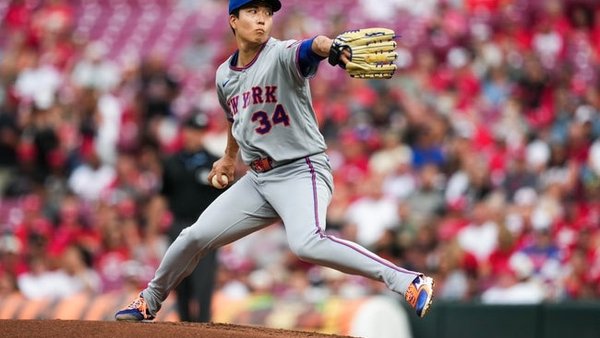
Kodai Senga owns a 9.00 ERA and a 1.875 WHIP across 24 innings, yet the Mets are still priced as -118 home favorites — home field doing most of the pricing work here. The Cubs carry a +21 run differential against New York’s -31, and getting plus money on the structurally superior club is the friction this number hasn’t resolved.
Edward Cabrera vs. Kodai Senga: Chicago Cubs at New York Mets Betting Preview
The Cubs are sitting at +100 on the moneyline tonight against the Mets, who are priced at -118. That’s a home-field number, not a quality-of-opponent number. The market is leaning on Citi Field and the general familiarity of backing the home team, but it isn’t accounting adequately for the structural gap between these two rosters — or how catastrophically bad Kodai Senga has been this season.
This isn’t a case where Chicago’s starter is commanding and the edge is obvious. Edward Cabrera has been a liability at 5.21 ERA with a -0.98 WAR. The bet isn’t Cabrera being good — it’s that Senga has been historically bad, and the Cubs’ lineup and organizational infrastructure are meaningfully superior to what New York is currently fielding. Getting plus money on the team projected to win at 57.5% probability is the story here.
Yesterday’s series opener between these two clubs ended in a scoreless draw through the data we have — both offenses arrive cold on paper relative to their season baselines, which makes the pitching gap tonight even more decisive. The numbers pointed toward the Cubs yesterday too; today’s matchup reinforces the same structural lean, with a different and arguably sharper price angle.
Game Info & Betting Lines
- Date/Time: Tuesday, June 23, 2026 — 7:10 PM ET
- Venue: Citi Field | Park Factor: 0.97 (slight pitcher’s park)
- TV: MLB.TV, Marquee Sports Net, SNY
- Probable Starters: Edward Cabrera (CHC, 4-4, 5.21 ERA) vs. Kodai Senga (NYM, 0-5, 9.00 ERA)
- Moneyline: Cubs +100 / Mets -118
- Run Line: Cubs -1.5 (+164) / Mets +1.5 (-200)
- Total: 8 (Over -122 / Under +100)
Why This Number Is Off
The market is doing what markets do — applying a reasonable home-field adjustment and pricing Senga as a pitcher with legitimate swing-and-miss stuff who is likely to stabilize. There’s a coherent argument for the -118 on the Mets: they’re at home, Senga’s 10.5 K/9 suggests the raw ability is still present even if the command is broken, and the Cubs have been ice cold offensively over their last three games.
But here’s where the line goes wrong. The Mets are 34-43 with a -31 run differential. The Cubs are 40-37 with a +21 run differential. That’s nearly a 60-run swing in underlying quality between these two clubs. You don’t build a -31 run differential by bad luck — you build it by consistently losing run-scoring battles, which is exactly what a team with a .669 OPS, a .297 OBP, and only 311 runs scored does.
The Cubs, meanwhile, are carrying a .738 OPS and a .337 OBP, and have scored 366 runs — 55 more than the Mets over comparable games played. The -118 on New York is pricing home field into a matchup where the visiting team’s profile is structurally superior. Getting +100 on Chicago isn’t a gambling speculation — it’s a value correction.
What Separates the Pitching
Senga owns the more electric raw arsenal. His four-seam fastball sits at 96.1 mph with a 16.2% whiff rate and a 23.7% put-away rate — but it carries a .380 xwOBA against, which means hitters are making plenty of quality contact on it when they connect. His forkball — the signature pitch — generates a 35.7% whiff rate with a .242 xwOBA against, which is legitimately elite when it’s working. His slider, used sparingly at just 5.5%, posts a 45.0% whiff rate but a nightmarish .972 xwOBA against — the most alarming individual pitch figure in his entire arsenal. When hitters do make contact on that slider, they’re absolutely destroying it. On paper, this is a weapon-laden arm; in practice, it’s a grenade missing its pin.
The problem is execution across the board. A 1.875 WHIP and 7 home runs in just 24 innings tell you that the arsenal is not translating into weak contact or clean frames. His sweeper, used 11% of the time, carries a .469 xwOBA against — a pitch that is actively getting hurt. And the Cubs’ top of the order is positioned to exploit him. Pete Crow-Armstrong carries a .476 xwOBA against right-handed pitching this season. Seiya Suzuki is at .472 xwOBA against lefties but still posts a .397 against righties with a .500 BvP against Senga in 5 plate appearances. Juan Soto looms large in the Mets lineup — more on that in a moment — but Senga’s own inability to miss bats consistently while also limiting hard contact is the defining structural problem.
Cabrera is not a good pitcher. But his Statcast numbers reveal a more controlled damage profile. His slider sits at 88.7 mph with a 42.7% whiff rate and a .206 xwOBA against — a legitimate put-away option. His changeup generates 27.2% whiffs at a .298 xwOBA. He’s allowing hard contact on his sinker (.404 xwOBA) and four-seamer (.461 xwOBA), which explains the 14 home runs in 67.1 innings — but his 1.396 WHIP versus Senga’s 1.875 reflects a meaningful gap in base-runner creation. Cabrera limits traffic better. When Senga walks batters into runs, Citi Field’s 0.97 park factor doesn’t suppress that damage.
On WAR, the gap is narrower than it might appear: Cabrera sits at -0.98 and Senga at -0.95. These are essentially the same negative value. The real separation between them isn’t WAR — it’s ERA (5.21 versus 9.00) and WHIP (1.396 versus 1.875). Those are the numbers that actually matter tonight, and they lean decisively toward Cabrera being the less damaging arm.
The Pushback
The strongest counterargument here is Juan Soto. He’s batting .301 with a .974 OPS and 17 home runs, and his xwOBA against right-handed pitching is .497 — a number that puts him in elite company. Cabrera is a right-hander who allows hard contact on his primary pitches, and Soto will hit third in the Mets order. That’s a dangerous middle-of-the-game moment waiting to happen. I’m not dismissing it.
The other legitimate concern is the Cubs’ bullpen. They’re already thin — Hunter Harvey (60-Day IL, triceps), Porter Hodge (60-Day IL, elbow), Riley Martin (15-Day IL, elbow), and Daniel Palencia (15-Day IL, elbow) are all out. If Cabrera unravels early, Craig Counsell is pulling from a depleted shelf. The Mets’ bullpen situation isn’t clean either, but New York has the home-field advantage in terms of comfort managing late-game leverage.
Both concerns are real. Neither changes the core thesis. Soto is one bat in a lineup that posts a .297 OBP as a collective. The Cubs’ bullpen, even depleted, is backed by a superior team that has outscored opponents by 21 runs. Cabrera limiting traffic better than Senga is the swing variable — and the Cubs’ offense getting to Senga early reduces the burden on the back end of Chicago’s pen entirely.
Run Environment & Game Shape
The total is set at 8, with the over juiced to -122. The projected total from the numbers comes in around 9.2 — indicating the market may be slightly underpricing scoring here. Citi Field’s 0.97 park factor is a marginal suppressor, not a decisive one. It’s not moving the needle significantly in either direction; it trims a fraction of expected run output and that’s about it.
What shapes this game is the likelihood that Senga doesn’t go deep into it. In 24 innings across five starts, he’s already surrendered 7 home runs and walked 17 batters. The Cubs’ lineup — with Crow-Armstrong (.454 xwOBA), Suzuki (.415 xwOBA), and Busch (.382 xwOBA) all capable of doing damage against right-handed pitching — is built to punish a starter who leaves pitches over the plate and can’t command his secondary offerings. If Senga exits before the fifth, it becomes a bullpen game, and the Mets’ depleted relief corps (Francisco Lindor on the IL, the rotation shorthanded with Clay Holmes and Christian Scott both out) is being asked to carry significant load.
The game shape favors a Cubs offense that gets into the Mets’ pen early, while Cabrera — imperfect as he is — gives Chicago a better chance of holding a lead deep enough that their bullpen, even in its current state, can close it out.
The Pick
This comes down to one thing: I’m getting plus money on the team that wins this matchup more than half the time by nearly every analytical measure available. The Cubs have a superior run differential (+21 vs. -31), a meaningfully better team OPS (.738 vs. .669), a starter who at least limits baserunners relative to his counterpart, and a lineup built to exploit the specific weaknesses Senga has demonstrated all season.
The Mets are home. Soto is dangerous. The Cubs’ pen is thin. I’ve accounted for all of it — and +100 still offers enough value to act.
Bet: Chicago Cubs Moneyline +100 — 2 units
The edge is real, the price is right, and the structural case doesn’t require Cabrera to be good. It just requires Senga to keep being Senga — a 9.00 ERA arm with a .972 slider xwOBA and a 1.875 WHIP who can’t get out of his own way. At plus money, that’s enough.