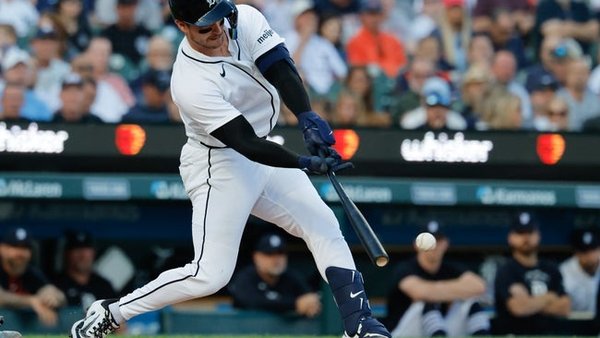
Troy Melton’s 2.56 ERA and 0.947 WHIP sit on one side of the ledger — Tatsuya Imai’s 6.15 ERA and 1.439 WHIP sit on the other — yet the moneyline is split at -104 / -112, pricing this like a near-even contest. The 3.59-run ERA gap between starters is real, and the number hasn’t accounted for it.
Tatsuya Imai vs. Troy Melton: Houston Astros at Detroit Tigers Betting Preview
There’s a 3.59-run gap between the two starters taking the mound Thursday night at Comerica Park, and the moneyline is priced like a coin flip. That’s the inefficiency. Troy Melton (4-0, 2.56 ERA, 0.947 WHIP) is quietly one of the more effective starters in the AL right now, and he’s getting a gift opponent in Tatsuya Imai (4-3, 6.15 ERA, 1.439 WHIP), whose profile reads like a textbook high-variance arm — high strikeouts, high walks, high contact damage when the stuff doesn’t land.
The market noise here is legitimate: Detroit is 34-46, sitting in the AL Central basement, and Houston has gone 6-4 over their last 10 games. Opening series openers also carry recency bias — bettors remember the Astros rallying for back-to-back wins in Toronto and price them accordingly. That home-team lean Detroit gets as a soft default at Comerica adds another layer of market static.
Cut through it and the core argument is simple: Detroit is getting a substantial pitching edge at a price that doesn’t charge you for it. At -112, you’re essentially getting the better starter at near-even money. That’s the bet.
Game Info & Betting Lines
- Date/Time: Thursday, June 25, 2026 — 6:40 PM ET
- Venue: Comerica Park (Park Factor: 0.99 — near-neutral, slight run suppressor)
- TV: MLB.TV, Tigers.TV, Space City Home Network
- Probable Starters: Tatsuya Imai (HOU) vs. Troy Melton (DET)
- Moneyline: Houston Astros -104 / Detroit Tigers -112
- Run Line: Detroit Tigers +1.5 (-196) / Houston Astros -1.5 (+162)
- Total: 9 (Over -105 / Under -115)
Why This Number Is Off
The market is doing something reasonable here: it sees two below-.500 teams, weights Houston’s stronger offense (OPS .732 vs. Detroit’s .709), acknowledges the Astros’ recent momentum, and sets a line that splits the difference around pick-em territory. That logic isn’t wrong on its face — Houston’s lineup is legitimately better, and the Astros have gone 6-4 over their last 10.
But the market is underweighting the pitching gap. The -104 / -112 split implies each team wins roughly half the time. The numbers disagree sharply: Detroit’s win probability comes out at 63.5%, which translates to a fair price closer to -171. You’re getting Detroit at -112 against what the numbers say is a substantial edge. That’s not a rounding error — it’s a meaningful gap between implied probability (47.2%) and projected probability (63.5%).
Where the market is probably right: Melton’s 31.2 innings is a small sample, and Houston’s offense is capable of doing damage against anyone. The concern about variance is real. But the pricing suggests the books see this as essentially a toss-up, and the pitching gap — plus Detroit’s systemic staff advantage (3.83 team ERA vs. Houston’s 4.81) — argues that the Tigers should be meaningful favorites, not near-even money.
What Separates the Pitching
Start with Imai’s arsenal, because it tells you exactly why his ERA is where it is. His slider is the primary weapon — used 43.9% of the time at 86.9 mph with a 39.1% whiff rate and a strong .267 xwOBA allowed. That’s a legitimate put-away pitch. The problem is everything else. His four-seam fastball (42.3% usage, 95.1 mph) is generating only a 17.6% whiff rate and surrendering a .373 xwOBA — hitters are squaring it up. His sinker is worse: a .457 xwOBA on 7.3% usage. And his changeup, while producing a 50% whiff rate in tiny samples, is being crushed when it doesn’t miss — .875 xwOBA is catastrophic. The pattern is an arm that gets swing-and-miss praise but allows hard contact at a rate his ERA reflects honestly. His 1.439 WHIP and -0.29 WAR aren’t outliers — they’re predictive.
Melton operates differently. His four-seam (39.9%, 95.7 mph) generates modest whiffs at 11.4% but posts a .347 xwOBA — manageable. His cutter (15.9%, 90.8 mph) is a genuine weapon at .267 xwOBA, and his slider (.262 xwOBA, 25.8% put-away rate) gives him a second pitch to generate weak contact. Most importantly, his curveball is elite in small samples: .112 xwOBA with a 36.4% whiff rate on 6.5% usage. Melton’s 0.947 WHIP reflects a pitcher who controls the running game, limits free passes (9 BB in 31.2 IP), and generates soft contact through pitch design rather than pure velocity. His K/9 of 5.4 is modest, but weak contact at a high rate is often more durable than swing-and-miss built on one good slider.
The gap isn’t subtle. Imai’s ERA is more than 3.5 runs higher, his WHIP is nearly half a run wider, and his WAR sits negative. Detroit’s starter has earned his numbers; Houston’s has not.
The Pushback
Here’s where I slow down. Melton has thrown 31.2 innings. That’s five or six starts. A 2.56 ERA over that sample can evaporate quickly — he’s already allowed 6 home runs, which is a non-trivial rate for a pitcher who doesn’t generate many strikeouts. If his weak-contact approach catches up to him, the ERA could normalize toward the mid-3s or higher in a hurry.
The concern deepens when you look at the second spot in Houston’s lineup. Yordan Alvarez is posting a .564 xwOBA this season with a 9.9% barrel rate and 31.3% hard-hit rate — and critically, his splits show almost no handedness preference (.558 vs. LHP, .566 vs. RHP). Melton can’t hide from him with a platoon angle. That’s a genuine threat that any honest read of this game has to account for.
Houston is also playing with momentum — 6-4 over their last 10 games — and Gleyber Torres missing with an oblique injury hurts Detroit’s middle-of-the-order depth. The concern is real on multiple fronts.
But the pushback doesn’t change the math. A 63.5% win probability against a -112 price is still a strong edge. The risks are already partially baked into why this isn’t priced at -171. At -112, you’re being compensated for taking on Melton’s sample-size risk and Alvarez’s threat. That’s the deal.
Run Environment and Rejected Angles
Comerica Park’s 0.99 park factor is essentially neutral — it won’t suppress or inflate run totals in any meaningful way. The total is set at 9, and with the projected combined score sitting right at 9.1, there’s no actionable edge on either side of the total. Both the over and under are priced efficiently relative to what the numbers support.
The run line is similarly unattractive. Detroit +1.5 at -196 is asking you to pay a heavy premium on a team whose offense (OPS .709, 87 HR on the season) isn’t built to blow games open. Houston -1.5 at +162 is tempting in theory but requires both Imai to implode and Detroit’s lineup to stay quiet — too many moving parts for a multi-run margin play. The pitching gap is real, but it doesn’t automatically translate to a comfortable winning margin given the offensive limitations on both sides.
The moneyline is the right vehicle here. It isolates the pitching edge without demanding a specific margin, and it does so at a price the market hasn’t fully corrected for. Detroit’s 3.83 team ERA versus Houston’s 4.81 is a systemic advantage that amplifies the individual starter gap — this isn’t one night’s matchup anomaly, it’s a reflection of how these organizations are built right now.
The Play
Detroit Tigers moneyline (-112), 2 units.
The pitching gap between Melton and Imai is real, measurable, and not reflected in the price. A 63.5% win probability against 47.2% implied is a 16-point edge. Melton’s sample size is a legitimate concern, and Alvarez is a genuine wildcard — but at -112, you’re not paying for those risks, the market is absorbing them. Take the Tigers.
Bet: Detroit Tigers Moneyline (-112) — 2 Units