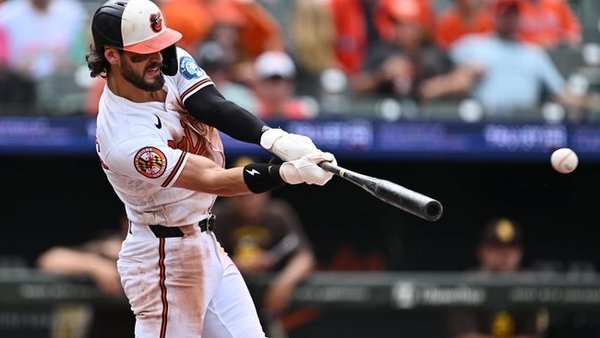
Trevor Rogers owns a 5.30 ERA, negative WAR, and a cutter the market hasn’t fully penalized — yet Baltimore sits at -142 as if the home bump erases a nearly two-run starter gap. Andrew Alvarez’s swing-and-miss curveball faces an Orioles lineup that has racked up 749 strikeouts, and the projected win probability says this price is off by 16 points.
Andrew Alvarez vs Trevor Rogers: Washington Nationals at Baltimore Orioles Betting Preview
The market sees a home team, a familiar park, and a visiting club that just got torched by Philadelphia’s ninth-inning heroics three nights running. What the market is underweighting is the pitching gap sitting right in front of it. Andrew Alvarez at 3.34 ERA against Trevor Rogers at 5.30 ERA is nearly a two-run differential between starters — and in a game projected to land in the 9-run range, that kind of gap doesn’t disappear because the Orioles are playing at home.
Baltimore’s -142 price reflects home-field and roster familiarity. But the Orioles are a legitimate sub-.500 club at 38-44 with a -25 run differential — the kind of team that keeps getting inflated by the simple fact they’re hosting. Washington arrives at .500 (41-41), carries a positive run differential of +4, and is sending out the better starter by a significant margin.
Yesterday’s under at 8.5 in Washington took a direct hit from that historically bad Nationals bullpen. That loss is a reminder of how late-inning volatility can torch a perfectly reasonable thesis. Tonight’s play accounts for that risk directly.
Game Info & Betting Lines
- Date/Time: Friday, June 26, 2026 — 7:05 PM ET
- Venue: Oriole Park at Camden Yards | Park Factor: 1.01 (slight hitter lean, negligible)
- TV: MLB.TV, MASN, Nationals.TV
- Probable Starters: Andrew Alvarez (WAS) vs Trevor Rogers (BAL)
- Moneyline: Washington Nationals +120 / Baltimore Orioles -142
- Run Line: Washington Nationals +1.5 (-172) / Baltimore Orioles -1.5 (+142)
- Total: 9 (Over -108 / Under -112)
Why This Number Is Off
The market is doing its job — it sees Rogers at home, in a slight hitter-friendly environment, against a Washington club whose bullpen just surrendered 15 ninth-inning runs in three games. Baltimore at -142 is defensible on surface. Home-field adds roughly 0.3 runs of expected value, the park factor is essentially neutral at 1.01, and Rogers has made 11 starts this season — he’s not an unknown quantity.
But here’s where the line drifts from defensible to exploitable: Rogers has been actively hurting Baltimore. His -0.1 WAR means he has cost them wins this season, not generated them. His 9 home runs allowed in 73 innings lines up squarely against a Washington lineup that has hit 109 home runs as a team — a genuine power-versus-contact mismatch. The Orioles’ rotation is so depleted (Kremer, Bassitt, Eflin, Povich all on IL) that Rogers is a rotation anchor by necessity, not by merit.
The numbers project Washington winning 61.8% of the time. The +120 moneyline prices the Nationals at roughly 45.5% implied probability. That 16-point gap is where the value lives. The market is overweighting the home bump and underweighting the starter discrepancy.
What Separates the Pitching
This is fundamentally a matchup between a pitcher generating weak contact and a pitcher giving up hard contact. The comparison isn’t close.
Alvarez built his arsenal around two breaking balls that complement each other beautifully. His curveball (28.9% usage) generates a .193 xwOBA against — that’s elite suppression, particularly for a pitch thrown at 82.8 mph with a 28.3% put-away rate and 31.7% whiff rate. His slider (29.3%) sits at a 35.9% whiff rate with .362 xwOBA allowed. Combined, those two pitches account for more than half his usage and generate consistent swing-and-miss. His 10.3 K/9 isn’t a fluke — it reflects an arm that punches hitters out rather than hoping for soft contact. Against a Baltimore lineup that has racked up 749 strikeouts on the season, that swing-and-miss profile matches up well.
The Orioles’ primary threat against Alvarez is Pete Alonso (.457 xwOBA, 6.6% barrel rate, .426 xwOBA vs LHP) — a right-handed power bat who genuinely punishes left-handed pitching. That’s the legitimate danger zone for Alvarez. Samuel Basallo (.434 xwOBA overall, 8.0% barrel rate) looks imposing on paper, but his splits actually favor Alvarez: Basallo’s vsLHP xwOBA sits at .328 compared to .460 against right-handers, meaning he is measurably less dangerous against left-handed pitching. Alonso is the bat Alvarez needs to navigate carefully; Basallo’s numbers say the matchup leans the starter’s way. Alvarez’s four-seamer sits at 92.3 mph with a .387 xwOBA against, which means he’ll need to lean heavily on that curveball and slider sequence against Alonso specifically to avoid damage.
Rogers goes in a completely different direction. His primary weapon is a 42.4% four-seamer at 93.2 mph — generating only a 19.8% whiff rate and a .346 xwOBA against. His best pitch is actually the sweeper (30.1% whiff, .218 xwOBA), but it only accounts for 11.8% of usage. The cutter is a liability at .470 xwOBA allowed. Against James Wood — who posts a .580 xwOBA overall and .614 xwOBA against right-handed pitching — Rogers’ fastball-heavy approach is a dangerous setup. Wood’s 11.7% barrel rate and 36.4% hard-hit rate profile as a genuine damage threat against a starter who already allows a home run every 8.1 innings.
The Pushback
The concern here is real, and it starts and ends with Washington’s bullpen. The Phillies didn’t just beat the Nationals this week — they systematically dismantled their relief corps, scoring 15 combined runs in the ninth inning across three games. Bryce Harper’s go-ahead homer off Gus Varland in the ninth on Thursday. Derek Hill going back-to-back with pinch-hit shots on consecutive nights. This bullpen isn’t just shaky — it’s historically bad, and Camden Yards in a close game is exactly the environment where that liability surfaces.
The other honest concern is Baltimore’s home-field performance. The Orioles aren’t the same team on the road that they are at Camden Yards, and even a below-average Rogers gets a boost from familiar surroundings and a home crowd. The Orioles also have genuine bats in this lineup — Gunnar Henderson, Pete Alonso, and Taylor Ward can do damage against anyone.
These are real risks. They’re also priced in, partially, by the +120 line. The question isn’t whether Washington’s bullpen is a liability — it clearly is. The question is whether that liability is enough to flip a matchup where the starting pitching gap is this wide. I don’t think it is.
Run Environment & Game Shape
The total sitting at 9 is roughly in line with what the numbers suggest — a projected combined 9.5 runs in a 1.01 park factor environment. Neither side has a dominant bullpen, both offenses have shown they can score in bunches, and a close game through six innings is the most likely shape. That environment amplifies the pitching advantage early — Alvarez keeping Baltimore off the board through five or six frames gives Washington’s offense the margin it needs to work with against a Rogers who has been bleeding runs all season.
Washington’s lineup against Rogers has real teeth. James Wood batting leadoff with a .614 xwOBA against right-handers is a problem Rogers hasn’t solved this year. Curtis Mead (.420 vsLHP xwOBA), Andrés Chaparro (.393 vsLHP xwOBA), and Dylan Crews (.429 vsLHP xwOBA) all post favorable splits against left-handed pitching — and Rogers is a lefty. The top of this order is built to do damage in this matchup.
The Lines I’m Passing On
The Washington +1.5 run line at -172 is overpriced for a team whose bullpen has demonstrated it can blow any lead at any moment. Laying -172 on a club with Washington’s relief issues is asking too much — you’re paying a steep price for the cushion and then watching that cushion evaporate in the eighth or ninth inning. Hard pass.
Baltimore -1.5 at +142 is tempting with the plus money, but the Orioles’ offense hasn’t shown the kind of floor that makes covering a run line reliable. At -25 run differential on the season, Baltimore winning by two-plus runs isn’t the most likely outcome even in a favorable environment. The juice on the run line in either direction doesn’t match the actual probability of how this game is likely to play out.
The Pick
The core of this handicap is straightforward: the pitching gap between Alvarez and Rogers is too wide for Baltimore’s home-field advantage to cover. The market is leaning hard on Camden Yards and a rough week for Washington’s bullpen — both legitimate factors that are already reflected in a -142 price that still leaves the Nationals as significant undervalued dogs at +120.
Alvarez at 3.34 ERA against a negative-WAR starter in Rogers, a Washington offense built to punish left-handed pitching, and a Baltimore team that is 38-44 with a -25 run differential despite playing in a near-neutral park — that’s the thesis. The bullpen risk is real but it’s not a reason to fade a team getting plus money with the better starter on the hill.
Play: Washington Nationals moneyline +120 — 2 units, moderate confidence.