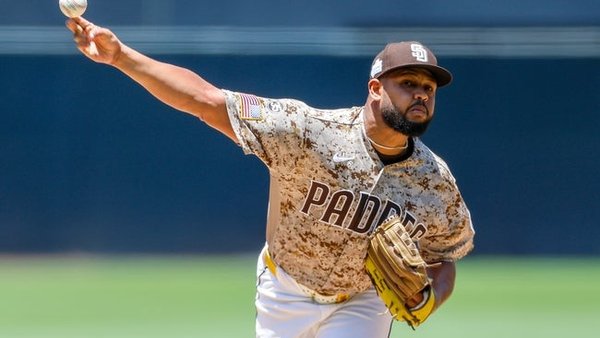
Yoshinobu Yamamoto’s 2.65 ERA and 0.87 WHIP walk into Petco Park against a Padres offense posting a .662 team OPS — one of the worst marks in baseball. The total is posted at 8 with flat -110 juice on both sides, treating this like a balanced run environment. The pitching profiles say otherwise.
Yoshinobu Yamamoto vs. Randy Vasquez: Los Angeles Dodgers at San Diego Padres Betting Preview
Friday night’s 7-1 Padres win absorbed a lot of air in the early chatter for this series — San Diego looked sharp, Walker Buehler was quietly excellent against his former team, and suddenly there’s momentum noise around the home side. That’s market noise. Set it aside. Today the pitching matchup shifts dramatically, and the entire conversation changes.
Yoshinobu Yamamoto is the unambiguous ace in this game. His 2.65 ERA, 0.87 WHIP, and just 17 walks in 91.2 innings represent one of the sharpest control profiles in the major leagues. He doesn’t make mistakes with runners on base, he doesn’t inflate pitch counts with free passes, and he doesn’t give innings away. At 86 strikeouts in those 91.2 innings — a K/9 just above 8.4 — he’s also consistently ending at-bats before they become baserunners. That’s the engine suppressing San Diego’s side of the total.
The overlay here is Petco Park’s 0.92 park factor — a legitimately pitcher-friendly environment that shaves roughly 0.3 to 0.5 runs off the expected scoring environment. The numbers project 8.1 combined runs, barely kissing the posted total. Flat juice at -110/-110 tells you the market sees this as balanced. The Yamamoto effect says it isn’t.
Game Info & Betting Lines
- Date/Time: Saturday, June 27, 2026 | 8:40 PM ET
- Venue: Petco Park | Park Factor: 0.92 (pitcher-friendly)
- Probable Starters: Yoshinobu Yamamoto (LAD) vs. Randy Vasquez (SD)
- Moneyline: Los Angeles Dodgers -205 / San Diego Padres +172
- Run Line: Los Angeles Dodgers -1.5 (-118) / San Diego Padres +1.5 (-102)
- Total: 8 (Over -110 / Under -110)
Why This Number Is Close — But Tilted
The market is doing its job. It knows the Dodgers’ lineup is loaded — Shohei Ohtani (.960 OPS), Freddie Freeman (.868 OPS), and Andy Pages (.793 OPS, 15 HR) are legitimate run-scoring threats against any starter. It knows Randy Vasquez carries a 4.17 ERA and 1.40 WHIP, suggesting the Dodgers’ half of the total could reach four or five runs on its own. Setting the total at 8 with even juice is the market’s honest acknowledgment that Vasquez is the weak link and LA could punish him.
The legitimate case for the over rests almost entirely on Vasquez melting early. If he exits in the third inning having given up four runs, the Dodgers’ side alone is already threatening the total before Yamamoto has even been fully tested. That’s a real scenario, not a phantom one.
But here’s where the market is slightly wrong: it’s pricing the San Diego offense as if it can carry its share of the scoring weight. The Padres are hitting .220/.296/.365 as a team — a .662 OPS that ranks among the worst in baseball. Against a pitcher with Yamamoto’s command and arsenal depth, that lineup profile doesn’t generate runs consistently. The market is balancing both offenses as if they’re comparable threats. They aren’t.
What Separates the Pitching
The gap between these two starters is substantial, and it shapes the entire run environment for this game.
Yamamoto commands a four-pitch mix with genuine put-away ability at every level. His slider sits at 86.6 mph and generates a 39.0% whiff rate — the best swing-and-miss pitch in this matchup — with an xwOBA of .259 against. His changeup pairs at 85.1 mph with a .268 xwOBA. Even his four-seam, used 43.8% of the time at 94.4 mph, keeps hitters honest at a .396 xwOBA, which is manageable when the secondary offerings are this sharp. The through-line for Yamamoto is the walk rate — 17 free passes in 91.2 innings means he rarely creates baserunners outside of contact, which makes big innings almost mathematically difficult against him.
The BvP data on Ohtani against Vasquez tells a story: 21 plate appearances, a .421 clip, 3 home runs, only 4 strikeouts. That’s a nightmare matchup for San Diego’s starter.
Vasquez, by contrast, leans heavily on his sinker (30.3% usage, 92.7 mph) — a pitch that generates only a 12.8% whiff rate and carries an xwOBA of .398. He supplements it with a changeup (25.8% usage, .320 xwOBA) and a sweeper (.315 xwOBA). His best offering is actually his slider — used sparingly at 4.9% but generating a .214 xwOBA — which means his most effective weapon is also his least-deployed one. His 1.40 WHIP reflects a pitcher who allows baserunners at a pace the Dodgers’ lineup can exploit. The 25 walks and 11 home runs allowed this season mean Vasquez creates multi-run opportunities for a lineup that converts them at a high rate. He is not a guaranteed blowup — his 6-5 record with a workable ERA suggests he survives most starts — but against Ohtani, Freeman, and Mookie Betts, his floor is lower than against almost any other team he’d face.
The innings these two create are fundamentally different in character. Yamamoto creates quick, low-stress frames for his defense. Vasquez creates leverage situations that put pressure on his bullpen earlier than the Dodgers’ lineup should allow.
Run Environment & Game Shape
The projection sitting at 8.1 combined runs is essentially a push against the posted total of 8 — but that number assumes both halves contribute relatively equally. The Padres’ .662 team OPS is the worst of any lineup in this series, and Yamamoto is not a pitcher who lets weak contact snowball into multi-run frames. San Diego’s best hitters — Tatis Jr. (.412 xwOBA, 36.0% hard-hit rate) and Manny Machado (.359 xwOBA) — are capable of individual moments, but Yamamoto’s 86 strikeouts in 91.2 innings mean he ends at-bats before rallies can build. The Padres are a base-hit-dependent offense trying to string together runs against a pitcher who simply doesn’t allow the strings to form.
On the other side, Vasquez’s baserunner creation against Ohtani, Freeman, and Betts is a real concern — but the Dodgers don’t need five or six runs to win this game. Yamamoto’s track record says he’s pitching into the seventh inning with two or fewer runs allowed on most nights. If Los Angeles scores three or four and Yamamoto stays efficient, the total lands somewhere between 6 and 7. One fewer base hit in a key inning, one Yamamoto strikeout to strand a runner, and San Diego’s half of the total deflates from marginal to minimal. The 0.92 park factor is doing real work here — Petco isn’t inflating anything. All the structural pressure in this game points toward the under: a dominant starter with elite command, a pitcher-friendly park, and a San Diego lineup that doesn’t have the on-base profile or power depth to manufacture a crooked number against this level of pitching.
The Play: Under 8 at -110, 2 units. Yamamoto suppresses a weak San Diego offense in a pitcher’s park, the numbers project 8.1 with Vasquez as the only real blowup risk, and the under cashes if this game plays anywhere close to its structural shape. Moderate confidence — the Vasquez implosion scenario is real, but it’s already baked into the flat juice. Take the under.