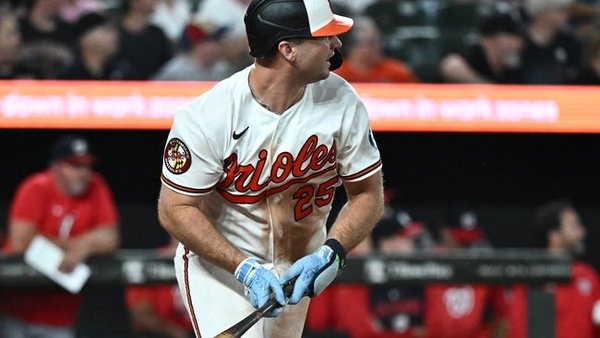
Trey Gibson’s 1.65 WHIP and 19 walks in 30.1 innings put Baltimore’s starter on a short leash — and the bullpen waiting behind him is already missing arms. The total sits at 10.5 with the under juiced at -115, but the pitcher in the middle of this game tells a sharply different story than that price implies.
Erick Fedde vs. Trey Gibson: Chicago White Sox at Baltimore Orioles Betting Preview
Yesterday’s game correctly set the tone for this series environment — Chicago put up 8 runs in a blowout win that reminded everyone what this White Sox lineup is capable of when it finds its footing. That 10-run game doesn’t guarantee a repeat, but it does tell you something meaningful about the offensive ceiling in play at Camden Yards this week.
The market has posted this total at 10.5 with the under juiced at -115 versus the over at -105. That asymmetry signals the books and sharp money are leaning under. I’m going the other direction. The case for the over starts with one name: Trey Gibson. His numbers aren’t a case of bad luck inflating ERA — his 1.65 WHIP tells you he’s allowing baserunners at a rate that compounds, not corrects. Against a White Sox lineup carrying 116 home runs and a team OPS of .739, that combination creates genuine over potential regardless of what the projection numbers say.
The biggest wrinkle is Chicago’s recent cold offense and the absence of Munetaka Murakami — the team’s most dangerous bat — on the IL. That’s a real dent. But the thesis here runs through Gibson’s arm and Baltimore’s depleted bullpen infrastructure, not Chicago’s lineup card. The pushback is real; I’m just not buying it as a reason to fade the over.
Game Info & Betting Lines
- Date/Time: Tuesday, June 30, 2026 — 6:35 PM ET
- Venue: Oriole Park at Camden Yards | Park Factor: 1.01 (neutral-to-slightly hitter-friendly, no suppression effect)
- TV: MLB.TV, MASN, CHSN
- Probable Starters: Erick Fedde (CHW, 2-6, 4.34 ERA) vs. Trey Gibson (BAL, 1-2, 5.64 ERA)
- Moneyline: Chicago White Sox +124 / Baltimore Orioles -146
- Run Line: Baltimore Orioles -1.5 (+140) / Chicago White Sox +1.5 (-170)
- Total: 10.5 (Over -105 / Under -115)
Why the Under Argument Doesn’t Hold Up
The case for the under isn’t hard to articulate. The numbers project this game landing at 9.6-9.7 combined runs — roughly a run under the posted 10.5. Baltimore’s offense is mediocre at .238 AVG and a .715 OPS, and Erick Fedde has shown a decent floor over 74.2 innings despite his pedestrian ERA. If Fedde pitches six innings of three-run ball, the Orioles need to do significant damage against Chicago’s bullpen to push over the number. That’s not a layup.
The under juice at -115 versus the over at -105 shows the books are protecting the under. And with Murakami on the IL, Chicago’s lineup loses its highest-ceiling bat — a .938 OPS hitter with 20 home runs in 200 at-bats. I acknowledge all of this. It’s a real argument.
But here’s where the under case collapses: it assumes Gibson pitches adequately, and his 2026 track record says that’s a deeply shaky assumption. His cutter is generating an xwOBA-against of .442 — hitters are squaring it up, not just making contact. His curveball is even worse at .468 xwOBA against, meaning his entire secondary package is getting punished. And his sweeper — used at only 4% frequency — is posting a .618 xwOBA against with a 0% whiff rate. That pitch is essentially a batting practice fastball when it shows up. When your sweeper, cutter, and curveball are all bleeding contact, you need your primary stuff to carry the load. Gibson’s 95.2 mph four-seamer is his best pitch at a .300 xwOBA against, but he’s only throwing it 17% of the time. Meanwhile, he’s issued 19 walks in 30.1 innings — a free-baserunner rate that compounds every other problem he has. Against a Chicago lineup with 116 home runs, those baserunners don’t stay on base.
What Separates the Pitching
The gap between these two arms is meaningful, and it runs sharply in one direction. Fedde is not a good pitcher — a 4.34 ERA and 1.42 WHIP tell you he’s giving up contact and runs — but he’s been relatively durable over 74.2 innings and has kept his team competitive. His primary weapon is a sweeper sitting at 81.8 mph that he throws 37.4% of the time, generating a .281 xwOBA against and a 21.8% whiff rate. That’s a legitimate put-away option. His changeup at 88.8 mph posts a 25.4% whiff rate — his best swing-and-miss pitch. Against a Baltimore lineup with modest exit velocity markers (Gunnar Henderson at 4.1% barrel rate, Taylor Ward at 3.1%), Fedde’s contact-management approach has a reasonable chance of limiting damage. Pete Alonso is the notable exception — his .463 xwOBA against right-handers and 6.7% barrel rate make him the hitter most likely to punish Fedde’s sinker, which is posting a bloated .374 xwOBA against. But even Alonso’s BvP history against Fedde (27 PA, .333 average, no home runs) suggests he’s making contact without generating extra-base damage consistently.
Gibson presents a fundamentally different risk profile. In 30.1 innings, he’s issued 19 walks — a walk rate that compounds every other vulnerability he carries. His sweeper, used at only 4% frequency, is posting a .618 xwOBA and a 0% whiff rate — essentially a meatball when it shows up. The cutter at 18% usage generates a .442 xwOBA. The only pitches that hold up at all are his slider (.297 xwOBA, 27.7% whiff) and his four-seam fastball (.300 xwOBA, 16.2% whiff) — but those two pitches alone won’t carry a start against White Sox hitters who have genuine power across the lineup. Randal Grichuk sits at an .480 xwOBA overall with an 8.2% barrel rate and 31.1% hard-hit rate. Junior Perez leads off at a .494 xwOBA with a .533 mark against right-handed pitching — exactly what Gibson is. Kyle Teel posts a .473 xwOBA against righties. This isn’t a lineup Gibson can navigate cleanly, and his walk problem means he’ll face deeper counts and more plate appearances than his stuff can handle.
The Bullpen Factor
Gibson’s likely early exit is the multiplier that makes the over case compelling. Baltimore is already without Keegan Akin (15-Day IL, elbow) among their relievers, and a rotation that’s lost Eflin, Kremer, and Bassitt to injuries means the bullpen has been overworked carrying the load for short starts. When Gibson gets pulled — and with a 1.65 WHIP, the question is when, not if — he hands the ball to a Baltimore bullpen that is stretched thin and operating without its full complement of high-leverage arms. That’s where totals games get inflated, and it’s the compounding factor the under side isn’t pricing adequately.
Chicago’s own bullpen situation isn’t pristine — Tyler Gilbert and Jordan Leasure are both on the IL — but the White Sox offense is the side generating over pressure tonight, not the pitching matchup itself. A team with 116 home runs and a .739 OPS, even missing Murakami, has the power upside to push this number. Gibson’s extreme hittability, his walk problem, and Baltimore’s depleted relief corps are three converging factors that make the under’s projection-based case look like it’s ignoring the actual pitcher on the mound.
Bet: Over 10.5, 2 units, moderate confidence. Gibson’s 5.64 ERA, 1.65 WHIP, and collapsed secondary arsenal — sweeper at .618 xwOBA, curveball at .468 xwOBA, 19 walks in 30.1 innings — set up a short, damaging start, and the White Sox power upside (.739 OPS, 116 HR) is more than enough to push this total past a number the market is slightly misprice on the wrong side.