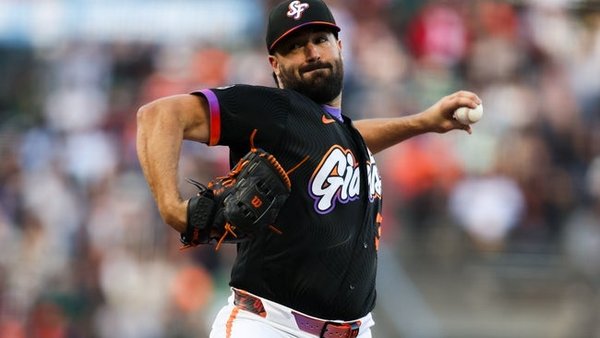
Tomoyuki Sugano’s 1.71 HR/9 rate is alarming on any field — at Coors Field, with a 1.38 park factor and a bullpen taxed by yesterday’s 15-3 blowout, it becomes a structural problem the posted 11.5 total has not fully absorbed. The projections put this game at 12.9 combined runs, and the gap between that number and the market price is the tension worth examining.
Robbie Ray vs Tomoyuki Sugano: San Francisco Giants at Colorado Rockies Betting Preview
Yesterday’s 15-3 beatdown sets the tone but doesn’t drive this bet. The Rockies pounded Logan Webb and the Giants bullpen for 15 runs on 18 hits — a result that was partly Webb underperforming and partly Coors Field being exactly what it always is. Today the pitching matchup shifts significantly, and neither replacement arm offers anything close to an upgrade over Webb’s baseline. That’s the crux of the argument for the over.
The market has posted 11.5, which is a number that seems to acknowledge Coors Field while stopping short of fully pricing in how damaging this specific pairing of starters is at altitude. Robbie Ray carries a 1.22 WHIP and has allowed 14 home runs in 95.2 innings. Tomoyuki Sugano has allowed 16 home runs in just 84.1 innings — a 1.71 HR/9 rate that is genuinely alarming anywhere, let alone at 5,200 feet. The numbers project 12.9 combined runs against a posted total of 11.5. That’s a 1.4-run gap, and in a neutral park that might not be enough. In Coors, it is.
This is an environment play layered on top of a pitcher profile play. Both teams are below .500 — the Giants at 36-51, the Rockies at 36-53 — so this isn’t about trusting either roster. It’s about two pitchers who give up fly balls and home runs stepping into the one venue in baseball that turns warning-track outs into souvenirs.
Game Info & Betting Lines
- Date/Time: Saturday, July 4, 2026 — 8:10 PM ET
- Venue: Coors Field, Denver CO | Park Factor: 1.38 (extreme hitter-friendly)
- TV: MLB.TV, NBC Sports BA, Rockies.TV
- Probable Starters: LHP Robbie Ray (7-6, 3.39 ERA) vs. RHP Tomoyuki Sugano (8-4, 4.80 ERA)
- Moneyline: San Francisco Giants -130 / Colorado Rockies +110
- Run Line: Colorado Rockies +1.5 (-142) / San Francisco Giants -1.5 (+118)
- Total: 11.5 (Over -122 / Under +100)
Why This Number Is Off
The market isn’t wrong to set a number in the 11s. Coors games don’t always go nuclear — there are legitimate pitcher-driven days at altitude, and the sharp money is clearly aware that books have gotten smarter about pricing Coors totals than they were a decade ago. The 1.38 park factor is baked in to some degree. The case for the posted total rests on Ray’s 3.39 ERA suggesting he may have enough quality to hold Colorado through five or six innings, and on Sugano’s 8-4 record implying competitiveness if not dominance.
But here’s the problem: ERA is a lagging indicator, and both of these surface numbers are masking underlying rates that are ugly in altitude. Ray’s WHIP of 1.22 means he’s putting baserunners on at a rate that compounds dangerously in a run-inflating environment. Sugano’s 1.71 HR/9 is the bigger alarm — that rate applied to Coors Field, where balls carry and outfield gaps play longer, projects to a catastrophic output against a lineup with Moniak (.951 OPS), Goodman (27 HR), and Rumfield (.860 OPS).
Where the market appears slightly wrong is in underweighting the combined bullpen tax from yesterday. The Rockies used significant arms in a 15-3 blowout. The Giants bullpen absorbed the bulk of 12 earned runs after Webb departed. Expect shorter outings and earlier hooks today, which means the weakest arms on both staffs see more high-leverage innings than normal. The over benefits from that shape.
What Separates the Pitching
Head-to-head, Ray and Sugano are not in the same tier — but the gap matters less here than it typically would because Coors Field is the great equalizer. Ray’s ERA of 3.39 is his headline number, but his 1.22 WHIP and 43 walks in 95.2 innings signal a pitcher who works with traffic constantly. He doesn’t miss enough bats (7.7 K/9) to strand runners efficiently, and at altitude where contact carries harder, the double-play ball that saves him at Oracle Park becomes a gap single.
Sugano’s arsenal tells an equally concerning story. His four-seam fastball sits at 93.0 mph — not a swing-and-miss pitch — and carries an xwOBA-against of .310. His changeup, which he deploys 21.3% of the time, gives up a .341 xwOBA. Most damaging: his sinker generates a .601 xwOBA against, and at Coors that’s a ball that doesn’t stay in the park. Giants leadoff hitter Jonah Cox carries a .929 xwOBA against right-handed pitching — a legitimate matchup threat for Sugano — but it comes with a 50% K rate and a 44.6% whiff rate. The danger is real on contact, but Sugano’s swing-and-miss stuff gives him a realistic path to neutralizing Cox before he does damage.
Ray has the clear edge in stuff and profile. But the Colorado lineup — Moniak hitting .280 with a .951 OPS, Carrigg carrying a .836 OPS after back-to-back multi-RBI games — is built to punish elevated contact pitchers. The xwOBA splits confirm Moniak and Carrigg hit left-handed pitching at a rate (.327 and .372 respectively) that doesn’t give Ray the platoon advantage he might expect. The pitching gap here is real but narrow enough that Coors swallows it.
The Pushback
The honest concern starts with Ray’s 3.39 ERA. If he’s genuinely pitching to that number, Colorado’s lineup — which grades out well below league average in xwOBA against left-handed pitching — may not be able to crack him for enough runs to matter. Sugano’s 8-4 record is another flag: wins accumulate when you’re keeping games close, and his team has clearly been scoring behind him at a clip that papers over his 4.80 ERA.
The stronger pushback is park regression. Books have spent years adjusting Coors totals, and the sharpest money in baseball has been burning over bettors who assume every game at altitude goes to 15. The 1.38 park factor doesn’t mean every game exceeds its total — it means the distribution of outcomes is wider. A quality start from Ray combined with a Sugano who avoids his sinker in key spots could produce a game that stays under 11.5.
I take those arguments seriously. But the 1.4-run gap between the projected 12.9-run total and the posted 11.5 clears that bar with margin to spare — and it’s built on concrete inputs, not optimism. A 1.38 park factor, two starters with documented home-run problems, and bullpen depletion from a blowout the night before isn’t a soft thesis. It’s a convergence of structural edges that Coors Field has historically rewarded.
Run Environment & Game Shape
The likely game shape here is high-scoring through the middle innings and chaotic late. Neither starter figures to get deep — Ray’s traffic-heavy profile and Sugano’s homer rate both project to early-to-mid-game exits — which means both bullpens are activated in innings five through seven rather than seven through nine. On a normal night, that might be fine. After yesterday’s 15-3 game, it means the back-end arms on both sides are either unavailable or on tight pitch limits.
Coors Field with a 1.38 park factor doesn’t just inflate scoring — it inflates variance. The projected 12.9 combined runs account for the altitude multiplier, the homer-prone starters, and the bullpen depletion baked in from Friday night’s blowout. That 12.9 projection clears the posted 11.5 by 1.4 runs. In a neutral park, I’d want more cushion. At Coors, a 1.4-run edge against a total that’s already elevated is more than enough to act on.
The core thesis is straightforward: Coors’ 1.38 park factor applied to two homer-prone starters, compounded by both bullpens operating at reduced capacity after Friday’s 18-run combined output, projects to 12.9 combined runs — clearing the 11.5 total by 1.4 runs with structural edge to spare. That’s not a coin flip. That’s a bet worth making.
Bet: Over 11.5 (-122) — 2 units, moderate confidence.