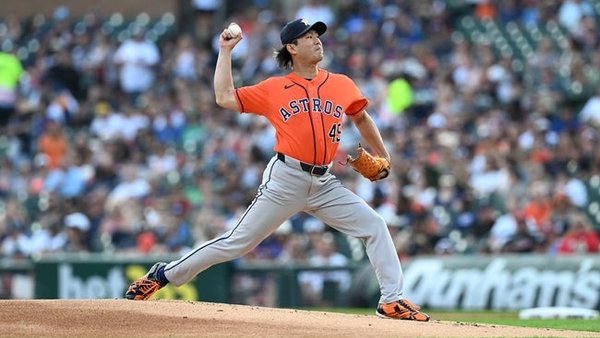
Andrew Alvarez holds a 3.05 ERA against Tatsuya Imai’s 6.14 — a nearly 3-run gap that almost never surfaces in a game priced this close to even money. The Nationals sit at -118, a number that should be further left given a WAR differential of nearly 2.0 between these two starters. The market is balancing Yordan Alvarez and a leaky Washington bullpen against the pitching gap, but the correction hasn’t gone far enough.
Tatsuya Imai vs Andrew Alvarez: Houston Astros at Washington Nationals Betting Preview
The market is pricing this game as a near coin-flip — Houston at +100, Washington at -118. That framing makes sense on the surface: two teams hovering around .500, a neutral park, and the ghost of last night’s 12-11 chaos still hanging over the series. But the -118 price is doing real work here, and the primary reason to bet Washington tonight isn’t the run environment or momentum — it’s the yawning gap between Andrew Alvarez and Tatsuya Imai on the mound.
Imai’s profile is one of the more troubling starter lines you’ll encounter in a mid-July regular-season game. A 6.14 ERA, 1.4689 WHIP, and -0.36 WAR in 48.1 innings tell the story of a pitcher who creates damage. Alvarez, by contrast, has built a quiet but legitimate 3.05 ERA in 41.1 innings with a 1.13 WAR — though his 1.379 WHIP does mean he puts runners on, so he’s not a lockdown, zero-baserunner type. Still, that’s nearly a 2.0 WAR gap in a single-game comparison — a number that almost never shows up in a game priced this tight.
Layer in that Washington is the better team by run differential (+10 vs. Houston’s -45), holds a 6-4 record over their last 10 games against Houston’s 5-5, and you have a situation where the moneyline price is a genuine discount relative to the underlying quality gap.
Game Info & Betting Lines
- Date/Time: Tuesday, July 7, 2026 — 6:45 PM ET
- Venue: Nationals Park (Park Factor: 0.98 — neutral to slight pitcher-friendly)
- TV: MLB.TV, Space City Home Network, Nationals.TV
- Probable Starters: Tatsuya Imai (HOU) vs. Andrew Alvarez (WSH)
- Moneyline: Houston Astros +100 / Washington Nationals -118
- Run Line: Washington Nationals +1.5 (-192) / Houston Astros -1.5 (+158)
- Total: 9 (Over -122 / Under +100)
Why This Number Is Off
The market is set at -118 because it has to account for legitimate Houston factors: Yordan Alvarez sitting at a .555 xwOBA and a .320 AVG / 1.065 OPS season line is a one-man run-environment alteration, and a home team with a compromised bullpen (Mitchell Parker and Richard Lovelady both on IL) creates late-game exposure that the market is right to price in. Yesterday’s blown lead, where Washington needed a grand slam comeback, confirms the bullpen is porous. The market isn’t ignoring these facts.
But here’s the problem with landing on +100 for Houston: the line is essentially saying there’s an even-money chance that a starter with a -0.36 WAR and a 6.14 ERA outperforms a starter with a 1.13 WAR and a 3.05 ERA in the same park on the same night. That’s where the math breaks down. The pitching gap is the dominant variable in MLB handicapping, and the gap here is exceptional. Washington’s lineup — posting a .753 OPS compared to Houston’s .725 — compounds the mismatch. The market is balancing Yordan’s presence and Washington’s bullpen fragility against all of that, but it’s slightly over-correcting toward the Astros. At -118, you’re getting real value relative to a line that should be sitting closer to -130 or -135 given the starter differential.
What Separates the Pitching
The comparison between these two starters isn’t close, and it’s worth examining the arsenal data to understand why.
Imai operates primarily off a slider (44.3% usage, 86.8 mph) that generates an elite 40.3% whiff rate — that’s legitimate swing-and-miss. His 11.2 K/9 is genuinely impressive. But the same profile that generates strikeouts also creates damage: his four-seamer sits at 95.0 mph and carries a .421 xwOBA against, and his sinker generates a brutal .457 xwOBA. Hitters are teeing off on the fastball family, and with 8 home runs allowed in 48.1 innings, the ball is leaving the park. His changeup is essentially non-functional — a 1.749 xwOBA against on limited usage signals hitters are sitting dead-red and not being fooled. The strikeouts are real, but the damage between them is real too.
Alvarez’s profile is structurally different. His curveball (28.2% usage, 82.8 mph) holds hitters to a .195 xwOBA with a 33.3% whiff rate and 27.8% put-away rate — that’s a genuine out pitch. His slider (.356 xwOBA, 36.4% whiff) complements it well, and his changeup (.171 xwOBA) provides additional depth. Critically, he has allowed only 2 home runs in 41.1 innings — compared to Imai’s 8 in 48.1. In a game where Nationals Park suppresses run scoring slightly at 0.98, Alvarez’s ability to limit the big inning is a real structural advantage, even accounting for the runners he’ll put on base along the way.
Washington’s top-of-order — James Wood (.583 xwOBA, 11.4% barrel rate), Luis García Jr. (.404 xwOBA), and Curtis Mead (.398 xwOBA) — profiles as a lineup that punishes fastball-heavy arms. Imai’s vulnerable four-seamer is exactly what these hitters hunt.
The Pushback
The case against Washington is real enough to slow down for. Start with Yordan Alvarez. His .555 xwOBA and 9.9% barrel rate aren’t team-level stats — that’s an individual force that can single-handedly reframe a game. More damaging to the Washington lean: Alvarez has no meaningful platoon split. His xwOBA sits at .549 vs. left-handed pitching and .557 vs. right-handed pitching — essentially identical. Andrew Alvarez being a lefty doesn’t buy Washington any protection here. Yordan will punish him at the same rate he punishes anyone else.
Then there’s the bullpen question. With Parker and Lovelady both on IL, the late-inning bridge is thinner than the roster card suggests. Yesterday’s 12-11 result wasn’t an aberration — it was a confirmation. If Alvarez exits with a lead in the sixth or seventh, the leverage situation gets uncomfortable fast. That’s a legitimate risk, not a talking point.
Small-sample caution on Imai is also warranted. His 48.1 innings is a real sample, but the changeup xwOBA of 1.749 comes on limited usage — it’s a data point, not a pattern. He can suppress lineups when his slider is sharp; it’s happened. And Houston’s lineup, despite a modest .725 team OPS, has real pop — 122 home runs on the season, with Walker (20 HR) and Paredes (12 HR) capable of doing damage even against a competent starter.
None of this flips the play. But it’s why this is a 2-unit moderate-confidence position, not a max bet.
Rejected Angles
The run line at Washington -1.5 (-192) is too expensive to chase. The Astros’ offensive capability — even against a better starter — is real enough that laying -192 asks you to essentially eliminate Houston’s entire win probability AND their ability to keep games close. Alvarez is a solid pitcher, not a shutdown ace. Pass.
The total at 9 doesn’t offer a clean angle either. The starter gap argues for suppressed Houston scoring, but Washington’s bullpen vulnerability and Houston’s power profile keep the ceiling open enough that the over/under math is muddied. The projected total comes in right at 9.0, which means there’s no edge baked in — and betting into a push-implied number on the total while the moneyline offers a cleaner edge is a money-allocation problem.
Run Environment & Game Shape
Nationals Park’s 0.98 park factor is close enough to neutral that it doesn’t meaningfully reshape expectations — this isn’t Coors Field flattening a pitching edge. The projected score of Washington 4.7 to Houston 4.2 reflects a moderate-scoring game where the starter gap shows up in the final line but doesn’t produce a blowout. That’s consistent with what Alvarez’s profile projects: a pitcher who limits the big inning, puts enough runners on (1.379 WHIP) to keep Houston interested, but doesn’t surrender the crooked numbers Imai is prone to allowing.
The game shape here favors a 4-3 or 5-3 Washington outcome more than a runaway — which is exactly why the run line at -192 is overpriced and the moneyline at -118 is the right vehicle. A pitcher who has allowed only 2 home runs all season can realistically keep Houston’s power threats in check for six-plus innings, even knowing Yordan represents a constant one-swing threat. The shape of the game — moderate scoring, starter advantage holding through five or six innings, Washington bullpen surviving a manageable deficit — is the scenario the -118 price is undervaluing.
The Pick
The thesis here is straightforward: the starter gap between Andrew Alvarez (3.05 ERA, 1.13 WAR) and Tatsuya Imai (6.14 ERA, -0.36 WAR) is the dominant variable in this game, and the -118 price doesn’t adequately reflect it. Washington’s lineup (.753 OPS, legitimate top-of-order damage against Imai’s vulnerable fastball family) compounds the mismatch. The risks are real — Yordan Alvarez’s .320 AVG / 1.065 OPS and platoon-neutral .555 xwOBA make him a legitimate game-changer on any single swing, and a thin Washington bullpen means any late lead is not a safe lead. But those risks are already priced into -118, and then some. The fair number on this game is closer to -130 or -135.
Bet: Washington Nationals moneyline -118 — 2 units — Moderate Confidence