The 10.5 total at Wrigley is doing heavy lifting for two depleted bullpens — but Buxton’s 10-Day IL absence has yet to fully register in the number. Ober’s cutter and split-finger profile projects a controlled early game, while the Twins’ replacement lineup carries a .738 team OPS that can’t reliably manufacture the run volume this total demands.
Bailey Ober vs. Colin Rea: Minnesota Twins at Chicago Cubs Betting Preview
The Cubs enter at 54-42, comfortably positioned in the NL Central race, while the Twins sit at 48-49 with a -14 run differential — a below-.500 club that’s been kept afloat by pitching more than offense. The numbers project a combined 9.7 runs, a full 0.8 below the posted 10.5 total, which at -110 juice represents genuine Under value. The market has likely inflated the total to account for Wrigley’s park factor and the shaky bullpens on both sides. That logic isn’t wrong, but it may be overcorrecting for a game where the first five or six innings should remain controlled.
Buxton’s absence on the 10-Day IL with a hip injury is the single biggest market signal that the 10.5 hasn’t fully adjusted. He’s batting .271 with a .904 OPS and 25 home runs — by far Minnesota’s most dangerous bat. Without him, the Twins are leaning on a lineup with a team .738 OPS that already ranks below average in run creation.
Game Info & Betting Lines
- Date/Time: Friday, July 17, 2026 | 8:05 PM ET
- Venue: Wrigley Field | Park Factor: 1.02 (essentially neutral)
- TV: MLB.TV, Twins.TV, Marquee Sports Net
- Probable Starters: Bailey Ober (MIN) vs. Colin Rea (CHC)
- Moneyline: Minnesota Twins +120 / Chicago Cubs -142
- Run Line: Chicago Cubs -1.5 (+150) / Minnesota Twins +1.5 (-182)
- Total: 10.5 (Over -110 / Under -110)
Why This Number Is Off
The 10.5 total is doing real work trying to account for two depleted bullpens. Both teams have significant relievers on the injured list — the Cubs are missing Porter Hodge, Daniel Palencia, Hoby Milner, Ben Brown, and Riley Martin; the Twins are without Garrett Acton, Cole Sands, Anthony Banda, and Marco Raya. The market is essentially pricing in late-inning leakage from both back ends, and that logic has merit.
But here’s the problem with that reasoning: the first-inning through sixth-inning phase of this game features two starters who are capable of keeping the run environment manageable. Ober’s control profile limits the kind of base-running traffic that snowballs into multi-run innings. Rea’s elevated WHIP is a concern, but his ERA of 4.75 is already baked into the 10.5 number — the market isn’t ignoring his struggles.
Where the market appears slightly wrong is in not fully pricing Buxton’s absence. His .904 OPS and 25 home runs represent a meaningful offensive subtraction, and the Twins’ remaining lineup — a strikeout-prone group (796 SO on the season) with a team OPS of .738 — doesn’t have the firepower to consistently manufacture crooked numbers against even average pitching. The 0.8-run gap between the projected total and the posted line exists for a reason, and that reason has a name on the IL.
What Separates the Pitching
The gap between these two starters is real, and it runs in the Under’s favor — though not for the reasons you might initially assume.
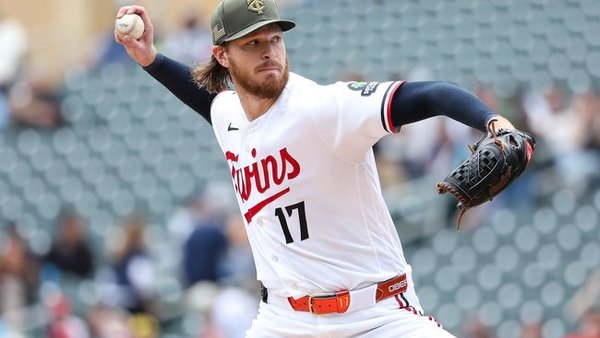
Bailey Ober is the cleaner arm here, and his Statcast arsenal explains why. His four-seam fastball sits at 96.9 mph and accounts for 48% of his pitches, but the pitch that defines his profile is his cutter — used 23.3% of the time, generating a 37.9% whiff rate and an xwOBA-against of just .232. His split-finger is equally punishing, posting a 32.5% whiff rate and .248 xwOBA. When Ober has command of those secondary offerings, hitters are chasing off the plate and making weak contact. His 19 walks in 71.2 innings (BB/9 of ~2.4) confirms he’s not beating himself — he’s making hitters earn everything.
The matchup data supports that. Pete Crow-Armstrong, Chicago’s best hitter (.917 OPS, 21 HR), has gone hitless in 3 PA against Ober with 2 strikeouts. Seiya Suzuki is 1-for-4 with 3 strikeouts in limited BvP history. Against a right-hander with three quality secondary pitches, the Cubs’ top of the order may not generate the volume of hard contact the 10.5 total implies.
Colin Rea presents more risk. His four-seam fastball averages just 92.8 mph — four full ticks below Ober — and produces a .399 xwOBA against, a number that signals genuine contact vulnerability. His slider is legitimate (.221 xwOBA, 48.1% whiff rate), and his curveball’s .143 xwOBA is striking. But his 1.447 WHIP through 94.2 innings tells the real story: Rea allows traffic, and traffic at Wrigley with a power lineup can turn into runs quickly. Kody Clemens (.405 xwOBA, 29.9% hard-hit rate) and Ryan Jeffers (.403 xwOBA) are the Twins’ most dangerous bats against Rea’s right-handed profile.
The arms aren’t equal, but both create innings that trend toward lower run environments than the 10.5 total suggests.
The Pushback
The honest counterargument starts with Ober’s home run rate. He’s surrendered 13 HR in 71.2 innings — a HR/9 of roughly 1.63 — and Wrigley, even at a near-neutral 1.02 park factor, has a history of playing big in the wind. If the breeze blows out on Friday night, Ober’s fly-ball tendencies become a genuine liability. The Cubs lineup, led by Pete Crow-Armstrong (21 HR) and Seiya Suzuki (15 HR), has enough pop to make one mistake count multiple times.
On the other side, Rea’s 1.447 WHIP is a flashing yellow light. That level of base-runner traffic is exactly what undoes pitchers when bullpens are thin. The Twins don’t need to hit Rea hard — they just need to grind at-bats and let the walks and singles accumulate. In a short-handed bullpen environment, inherited runners become scored runs at a higher rate.
One play that looked tempting and was ultimately rejected: the Cubs run line at -1.5 (+150). That price is genuinely attractive on the surface, but the numbers project a 5.0-4.8 final — a one-possession game with no clear path to multi-run separation. At those margins, the +150 is a false value signal. You’re not getting compensated for a margin of victory that probably doesn’t exist. The Under on the total is the cleaner play.
Run Environment & Game Shape
The projected 9.7 combined runs sits 0.8 below the posted total, and that gap holds up when you stress-test the individual components. Ober’s secondary arsenal — particularly that 37.9% cutter whiff rate and the split-finger generating weak contact at a .248 xwOBA — gives him a realistic path to five or six innings of two-run or three-run ball against a Cubs lineup that has shown strikeout vulnerability (808 SO on the season). Crow-Armstrong is 0-for-3 with 2 strikeouts against Ober in limited looks; Suzuki’s 1-for-4 with 3 punchouts tracks with the pitch data. These aren’t cherry-picked sample sizes — they’re consistent with what the whiff rates predict.
Rea’s side is messier, but the Twins without Buxton are a different offensive animal. The lineup the Twins are running out — Austin Martin, Ryan Kreidler, Luke Keaschall filling depth slots — doesn’t carry the same ceiling as a lineup with a .904 OPS center fielder protecting the middle of the order. Minnesota’s team strikeout rate (796 SO) and .738 OPS already suggest a below-average run-scoring environment even at full health. Shorthanded, they’re projecting closer to 4.8 runs against a pitcher who generates enough weak contact through his slider and curveball to strand runners.
The bullpen concern is real, but both back ends are equally depleted — that symmetry doesn’t advantage the Over in isolation, it just adds variance. The Under only needs the depleted bullpens to hold at roughly their recent rate, not to be dominant. With both teams running patchwork relief corps and a game shape that projects to a 5-4 or 4-4 finish through seven innings, the late-inning leakage needed to push this over 10.5 would require unusual timing from both offenses simultaneously. That’s a low-probability path.
I’m taking the Under. Under 10.5 (-110), 2 units. The 0.8-run gap between the numbers and the line, Buxton’s absence, and the pitching matchup all point the same direction. At flat juice, this is the cleanest total play on the board tonight. Don’t overthink it.