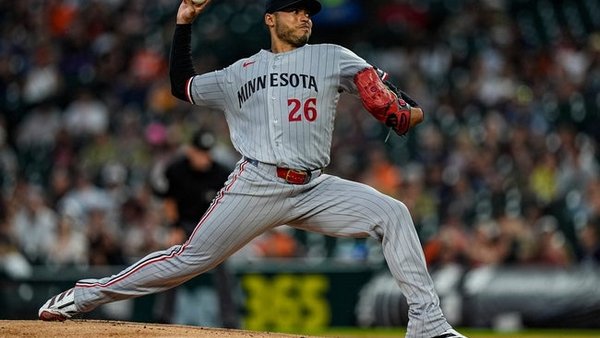
Taj Bradley’s 2.6 WAR in 102.2 innings represents sustained, elite contact suppression — Matthew Boyd’s 5-1 record rests on 46 innings with no statistical case for sustained dominance. The Cubs are priced at -142 on team quality and standings, but the projected run total lands at a dead-even 4.6–4.6 split. The number and the starter gap are pointing in opposite directions.
Taj Bradley vs. Matthew Boyd: Minnesota Twins at Chicago Cubs Betting Preview
The Cubs’ record (54-43) and run differential (+49) make them a reasonable favorite on paper. Minnesota sits at .500 with a -11 run differential, a number that signals some regression risk behind their recent hot streak. The market has done its homework on the team-level picture, and the -142 price reflects a legitimate edge for Chicago in the standings conversation.
But this is a pitching-driven game at a neutral park, and the starter gap tells a fundamentally different story than the team records do. Taj Bradley is one of the better arms in the American League right now. Matthew Boyd is a southpaw with a flattering win-loss record built on a 46-inning sample that hasn’t been stress-tested yet. When you’re being offered +120 on the pitcher who objectively dominates this matchup, the market is giving you something real.
Yesterday’s 5-2 Minnesota win — Ryan Jeffers’ three-run shot did most of the damage — was a reminder that this Twins offense has enough pop to back their starter. Today the matchup shifts, and the pitching gap widens considerably in Minnesota’s favor.
Game Info & Betting Lines
- Date/Time: Saturday, July 18, 2026 | 2:20 PM ET
- Venue: Wrigley Field | Park Factor: 1.02 (essentially neutral)
- Probable Starters: Taj Bradley (MIN, 9-3, 3.59 ERA) vs. Matthew Boyd (CHC, 5-1, 4.50 ERA)
- Moneyline: Minnesota Twins +120 / Chicago Cubs -142
- Run Line: Chicago Cubs -1.5 (+142) / Minnesota Twins +1.5 (-176)
- Total: 9 (Over -112 / Under -108)
Why This Number Is Off
The -142 on the Cubs is priced on team quality, recent record, and home-field support. That logic isn’t wrong — Chicago is the better team by most aggregate measures, Wrigley’s crowd is genuine, and Boyd’s 5-1 record gives casual money reason to back the home side. The market is balancing real factors.
But here’s the problem: the numbers see a dead-even 4.6–4.6 split. Home win probability sits at 52.2 percent — nearly a coin flip. When the gap between the two starting pitchers is this pronounced, a dead-even run projection shouldn’t produce a -142 price. You’d expect something in the -115 to -120 range for the home team in a true toss-up.
The Cubs’ superior run differential is driving that extra juice, but run differential is a team-wide metric. Today is not a team-wide event — it’s one pitcher against another. Bradley’s 2.6 WAR in 102.2 innings represents genuine, sustained elite performance. Boyd’s 0.03 WAR in 46 innings represents a guy who has gotten results without building any statistical case for continued dominance. The market is weighting records over process, and that’s where the +120 on Bradley emerges as a real number.
What Separates the Pitching
The gap between these two starters is significant — and it shows most clearly in the Statcast arsenal data. Bradley’s cutter is the pitch that defines him as a strikeout arm: sitting at 89.7 mph with a 37.9% whiff rate and a .232 xwOBA against. His split-finger adds another layer at 32.5% whiff rate and .248 xwOBA. These aren’t ERA-derived guesses — these are contact suppression numbers that hold up against quality lineups. His 96.9 mph four-seamer (48% usage) generates a 12.4% whiff rate at the top of counts, setting up the offspeed that actually puts hitters away. The Cubs’ top-of-order hitters — Pete Crow-Armstrong (0-for-3 with 2 Ks in limited BvP) and Seiya Suzuki (3 Ks in 5 PA against Bradley) — have already shown they struggle against this arsenal. Ian Happ, who crushes righties at a .443 xwOBA, is 0-for-3 with 2 strikeouts against Bradley.
Boyd is a different profile. His four-seamer sits at 92.8 mph — four full ticks below Bradley — and carries a concerning .399 xwOBA against with a 17.5% whiff rate. His slider is genuinely elite (48.1% whiff, .221 xwOBA), and his curveball (.143 xwOBA against) can be a weapon. But his changeup — his third-most-used pitch at 27.4% — only generates a 31.1% whiff rate against a .341 xwOBA. For the Twins lineup, Ryan Jeffers (.403 xwOBA overall, .362 vs. lefties) and Kody Clemens (.400 xwOBA vs. lefties, .405 overall) project as real threats against that changeup. The innings each pitcher creates are different in kind: Bradley builds stress-free frames through swing-and-miss; Boyd navigates contact, relies on the slider in two-strike counts, and has done so over a short 46-inning span that doesn’t yet prove he can sustain it through a full lineup cycle at playoff-caliber intensity.
Run Environment & Game Shape
Wrigley’s 1.02 park factor is essentially neutral — it’s not suppressing or inflating anything in a meaningful way today. The total sitting at 9 is consistent with two starters who, on balance, cancel each other’s run-prevention profiles out. Bradley keeps the Cubs near their floor; Boyd’s four-seamer vulnerability keeps the Twins near their ceiling. That equilibrium — a dead-even 4.6–4.6 projection — is the whole thesis on Minnesota +120. When the numbers say coin flip and the market says -142, you’re getting paid to take the side with the better starting pitcher. That’s the edge, and it’s a clean one.
The Pushback
The honest version of this bet requires confronting several uncomfortable facts. Chicago is 54-43 with a +49 run differential. Minnesota is 49-49 with a -11 run differential. That gap is not noise — the Cubs have genuinely outperformed the Twins in terms of run production and prevention over a large sample. A team sitting at .500 with a negative run differential is probably getting some luck in close games, and regression to the mean is a real concept.
The injury situation adds another wrinkle. Byron Buxton (OPS .904, 25 home runs) is on the IL with a hip issue — his absence removes the Twins’ most dangerous power threat from the lineup and meaningfully lowers their offensive ceiling. The bullpen behind Bradley is also compromised: Cole Sands, Anthony Banda, and Marco Raya are all unavailable. If Bradley runs into trouble early or exits before the sixth, the depth behind him is thinner than you’d want for a two-unit play.
And then there’s Ryan Jeffers (.942 OPS, three-run homer yesterday) — the guy carrying Minnesota’s offense right now. He’s hot, but that kind of reliance on one bat is fragile. The Cubs’ lineup, led by Pete Crow-Armstrong (.917 OPS) and a functional middle of the order, doesn’t have the same single-point-of-failure problem.
The run line, for what it’s worth, is a non-starter here. Minnesota +1.5 at -176 asks you to lay significant juice on a Twins team with a depleted bullpen — in a game where the numbers project a coin flip. The moneyline at +120 gives you the same rooting interest at a fraction of the cost and without burning your juice on a spread that doesn’t add value. Buying the 1.5 runs at -176 when both sides project to 4.6 runs is an inefficient use of capital.
All of that said: the Twins are riding real momentum (10-4 in last 14), Bradley has earned his 9-3 record with legitimate underlying numbers, and the +120 price is generous enough to absorb the downside risk. This isn’t a bet that requires perfection — it just requires the better pitcher to do his job.
THE BET: Minnesota Twins moneyline +120, 2 units (moderate confidence).