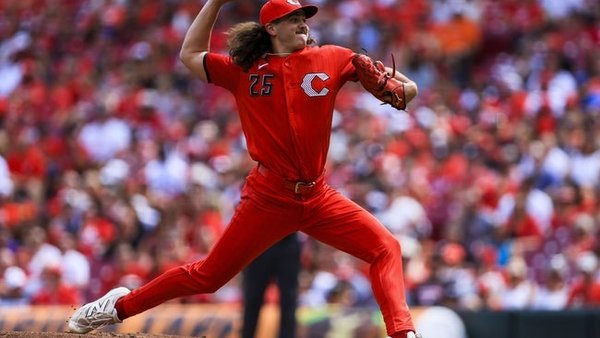
Rhett Lowder’s sinker-heavy approach and 1.54 WHIP is a liability at altitude, and Tomoyuki Sugano is listed on the 15-Day IL with a back injury that limits his ability to suppress hard contact. The total sits at 12.5 with the Over juiced to -120 — the market sees the run environment, but the starter downgrade from yesterday’s Singer hasn’t fully registered in the number.
Rhett Lowder vs. Tomoyuki Sugano: Cincinnati Reds at Colorado Rockies Betting Preview
The market has set this total at 12.5, respecting Coors Field’s notorious 1.38 park factor while pricing in two starters with ERAs approaching 5.00. That’s a reasonable starting point — but it doesn’t fully account for what’s actually happening on the mound today. Tomoyuki Sugano is listed on the 15-Day IL with a back injury. If he starts, he’s doing so compromised, with a pitch count that figures to be limited and a 1.71 HR/9 rate that Coors Field will not be kind to.
Yesterday, Brady Singer — a legitimate quality-start arm — held the Rockies to 2 runs over 7 innings, and the total still only reached 9. Today’s version features Rhett Lowder (4.91 ERA, 1.54 WHIP) against a Sugano who is either hurt or unavailable. The downgrade from Singer to Lowder is real, and the upgrade from Hughes to an injured Sugano is marginal at best. That run-environment gap matters.
Both bullpens are compromised. The Reds are missing Ashcraft (60-Day IL) and Santillan (15-Day IL). The Rockies are missing Castano, Herrera, Hill, and Halvorsen — four relievers, all IL. When starters exit early, what follows is thin. This is where Coors Field does its most damage: late-inning arms with no margin for error, elevated altitude amplifying every mistake. The Over is the environment play.
Game Info & Betting Lines
- Date/Time: Saturday, July 18, 2026 — 3:10 PM ET
- Venue: Coors Field (Park Factor: 1.38 — most extreme run inflator in MLB)
- Probable Starters: Rhett Lowder (CIN, 3-6, 4.91 ERA) vs. Tomoyuki Sugano (COL, 8-4, 4.80 ERA — listed 15-Day IL, back)
- Moneyline: Cincinnati Reds -115 / Colorado Rockies -105
- Run Line: Cincinnati Reds -1.5 (+130) / Colorado Rockies +1.5 (-155)
- Total: 12.5 — Over -120 / Under +100
Why This Number Is Off
The market’s logic is defensible. Yesterday’s game — same teams, same park — produced only 9 runs. Singer was sharp. Hughes settled in for 5.1 innings. The environment didn’t go full Coors. So the sportsbooks looked at that data point and kept the number near where it opened. That’s not wrong — it’s just incomplete.
The legitimate case for the Under starts with the juice. At +100, you’re getting the Under at even money, and Coors games don’t always deliver the carnage the park factor promises. Wind direction, temperature, and humidity all modulate offense at altitude. There are days Coors plays like a normal park. That’s real friction.
But here’s where the market is slightly wrong: it’s weighting yesterday’s outcome too heavily without accounting for the starter downgrade. Singer is a 4.00-ERA-range arm on a good day. Lowder has a 1.54 WHIP and has allowed 9 home runs in 69.2 innings. Those are different pitchers, and that difference is meaningful at altitude. The Sugano injury adds another layer — a compromised back affects a pitcher’s ability to generate downward plane and drive through pitches, which is exactly how flyball contact gets created. The -120 juice on the Over is the market telling you it sees the value there too. The number itself hasn’t moved far enough to reflect starter quality and injury risk fully.
What Separates the Pitching
Rhett Lowder leans heavily on a sinker (30.1% usage, 92.7 mph) that generates a .406 xwOBA against — that’s not a weapon, that’s a liability. His four-seamer runs at 93.4 mph with a .359 xwOBA allowed. The saving grace is his slider (33.9% whiff rate, .299 xwOBA), but that pitch can’t carry a full game plan, especially against a Colorado lineup anchored by Hunter Goodman (.465 xwOBA, 7.5% barrel rate) — the legitimate Statcast threat in this order. Goodman’s .510 xwOBA against left-handed pitching makes him the primary danger bat against Lowder, and his 27 home runs in 338 at-bats underscore what a sinker-heavy approach at 5,200 feet invites. Lowder’s contact-suppression floor is too low for Coors.
Tomoyuki Sugano presents a different kind of problem. His arsenal is more varied — split-finger at 29.7% whiff, sweeper at 10.7% usage — but the underlying contact numbers are alarming. His cutter generates a .516 xwOBA against, and his sinker checks in at .462 xwOBA. That’s a starter who gets hurt by hard contact regularly, and he’s already allowed 16 home runs in 84.1 innings this season. At sea level that’s manageable-ish. At 5,200 feet with a back injury limiting his stuff, that rate accelerates.
The matchup gap between these two arms isn’t massive from an ERA standpoint — 4.91 versus 4.80 is essentially a coin flip. But the Statcast data tells a sharper story. Lowder’s sinker-heavy approach invites hard contact from a Rockies lineup with Goodman at its core. Sugano’s flyball-prone arsenal meets Elly De La Cruz (.473 xwOBA, 9.4% barrel rate) and Spencer Steer (.407 xwOBA), who hit two home runs yesterday. Neither starter creates the kind of weak-contact, shutdown innings that keep totals in single digits. Both create damage innings — and Coors makes every damage inning worse.
The Pushback
The strongest case against the Over is also the most uncomfortable one to dismiss: yesterday’s game was a 9-total shutout of the Over 12, and Brady Singer was the one who kept it there. The counterargument writes itself — if the Reds can hold the Rockies to 2 runs with a quality arm, and the Rockies can’t score even at Coors, why does today look different?
It looks different because Singer (4-9 record, but genuine swing-and-miss stuff) is not Lowder. A 7.62 K/9 with a 1.54 WHIP at Coors is a blueprint for traffic. And the suppression case for the Under requires both starters to outperform their season-long contact rates at the exact park most punishing to that kind of failure. The suppression case requires a lot of things to go right simultaneously. The Over only needs the environment to do what it usually does when two sub-5.00 ERA arms with leaky arsenals take the mound.
The Under at +100 is a real number and deserves genuine consideration. But neither starter here qualifies as dominant, and the park factor doesn’t negotiate with mediocre sinker-ballers or flyball pitchers pitching through back injuries. The juice on the Over reflects that reality.
Run Environment & Game Shape
Games with leaky starters, depleted bullpens, and altitude don’t settle neatly into low-scoring outcomes. They sprawl. They produce crooked innings, pitching changes in the fourth and fifth, and leverage spots handed to relief arms that wouldn’t be trusted in high-leverage situations on healthier rosters. That’s the exact game shape set up here — on both sides.
When Lowder’s sinker gets elevated by a Goodman barrel in the third inning, there’s no Ashcraft or Santillan to steady the ship. When Sugano’s cutter (.516 xwOBA against) catches too much of the plate with De La Cruz standing in, the Rockies don’t have Hill, Halvorsen, Herrera, or Castano to absorb the damage cleanly. The middle innings of this game are going to be managed by the weakest available arms on two of the most depleted bullpens in the NL — at Coors Field, in a day game, with a 1.38 park factor doing what it always does to anything less than dominant pitching. The total opened at 12.5 for a reason. The reason it hasn’t moved higher is yesterday’s misleading 9-run output. That’s the inefficiency.
Two sub-5.00 ERA starters with contact-heavy profiles, four Rockies relievers on the IL, and the most run-inflated park in baseball — the Over 12.5 hits the right combination of environment, starter quality, and bullpen exposure to be the play here.
Bet: Over 12.5 — 2 Units — Moderate Confidence