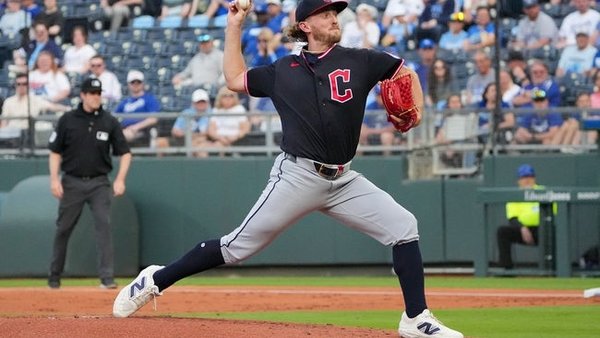
Tanner Bibee’s 1.59 HR/9 rate is a structural problem against a Twins offense carrying 123 home runs on the season — yet the moneyline sits at just -124, pricing this nearly as a coin flip. The pitching profiles point in one direction; the number has not fully followed.
Joe Ryan vs. Tanner Bibee: Minnesota Twins at Cleveland Guardians Betting Preview
The Twins arrive at Progressive Field fresh off a brutal series against the Cubs — a 10-1 beatdown Sunday that followed a competitive 6-2 loss Saturday. Cleveland, meanwhile, just absorbed back-to-back 7-1 losses to Pittsburgh before Travis Bazzana’s walk-off in a doubleheader nightcap offered some consolation. Neither team enters on a confidence high, but what happened in those previous series matters far less than who’s on the mound tonight.
The core argument here is simple: Joe Ryan’s 2.85 ERA against Tanner Bibee’s 3.90 represents genuine separation — not noise. That gap gets amplified by Bibee’s HR rate (20 allowed in 113 IP, a 1.59 HR/9), a Twins offense that ranks well ahead of Cleveland’s by every meaningful measure, and a Jose Ramirez-less Cleveland lineup that’s lost its most experienced middle-of-order threat to a hand injury — Ramirez is hitting .239 with a .757 OPS and 10 home runs, and Chase DeLauter’s statistical lead (.790 OPS) doesn’t replace what Ramirez brings as a seasoned run producer in the 3-hole. The market has set the Twins at -124 on the moneyline, which clears my juice ceiling for playability on a 1-unit lean.
After the numbers correctly identified value on the Pittsburgh Pirates ML yesterday against this same Cleveland club, today’s puzzle is different — it’s about whether the starter edge holds long enough for the better team to win a low-margin game.
Game Info & Betting Lines
- Date/Time: Monday, July 20, 2026 | 6:40 PM ET
- Venue: Progressive Field | Park Factor: 0.98 (neutral-to-slightly-suppressed)
- Probable Starters: Joe Ryan (MIN, 6-5, 2.85 ERA) vs. Tanner Bibee (CLE, 3-9, 3.90 ERA)
- Moneyline: Minnesota Twins -124 / Cleveland Guardians +106
- Run Line: Minnesota Twins -1.5 (+140) / Cleveland Guardians +1.5 (-170)
- Total: 7.5 (Over -115 / Under -105)
Why This Number Is Close
The market is pricing this as a near-pick’em, and that’s not unreasonable. Cleveland is the home team with a better overall record at 52-48 against Minnesota’s 49-51. The Guardians’ pitching staff ERA of 3.76 is meaningfully better than Minnesota’s 4.66, and the team’s run prevention component is a legitimate edge in a park that slightly suppresses scoring. The market isn’t wrong to make this competitive — home field, team ERA, and win percentage all point Cleveland’s direction.
But here’s the problem: those team-level ERA figures are disconnected from tonight’s specific starter quality. Bibee’s 3.90 ERA is the worst of the Cleveland rotation regulars, and his process numbers back that up — a K/9 of 6.93 below average, a WHIP of 1.15 that’s solid but masking a HR-per-inning rate that’s quietly alarming. The market appears to be weighting Cleveland’s staff ERA holistically rather than isolating Bibee’s specific vulnerability against a Twins lineup built around power.
Where the number is slightly off: it’s not properly penalizing Cleveland for starting the rotation’s weakest arm against a lineup that hits for power above the league average. The Twins’ team OPS of .735 versus Cleveland’s .678 is a 57-point gap — meaningful even accounting for Buxton’s absence. At -124, there’s enough gap between implied probability and projected win probability to justify the play.
What Separates the Pitching
Ryan’s arsenal is built for suppression. His four-seam fastball sits at 93.4 mph and generates a 21.0% whiff rate with an xwOBA-against of just .313 — and he deploys it 44.7% of the time as a foundation pitch. But the weapon that separates him from a generic strike-thrower is his sweeper: 80.3 mph with a 35.2% whiff rate and an xwOBA of .222 against. When you pair that with a knuckle curve sitting at .186 xwOBA and a split-finger at .230 xwOBA, Ryan’s offspeed mix creates legitimate swing-and-miss across all three zones. Cleveland’s top of the order reflects the problem — Steven Kwan, who has 28 PA of history against Ryan, is hitting just .222 with zero home runs. Kwan’s 6.5% whiff rate makes him the toughest out in the order, but his near-complete lack of power (0.4% barrel rate) limits his ceiling for damage.
Bibee’s picture is considerably murkier. His cutter is the primary weapon at 25.3% usage, and it’s a genuinely two-sided pitch — it generates a strong 33.2% whiff rate, which is well above average, meaning Bibee can miss bats with it. The problem is what happens when it gets hit: that same cutter posts a .369 xwOBA against, meaning contact results in hard, damaging outcomes. It’s not a hittable pitch so much as a high-variance one — Bibee gets his swing-and-misses, but he pays a steep price when hitters do make contact. His four-seam (94.0 mph) generates only a 13.3% whiff rate with a .326 xwOBA, which means Cleveland’s velocity reads as live but not deceptive. The changeup at .279 xwOBA with a 29.2% whiff rate is Bibee’s best secondary, but it doesn’t compensate for a cutter and fastball that talented right-handed hitters can drive when they get a piece of it. Josh Bell carries an xwOBA of .390 with a .415 mark against right-handed pitching — making him a significant mismatch in the middle of the Minnesota order. Royce Lewis at a 7.1% barrel rate and .372 xwOBA adds another dangerous dimension. Bibee’s HR leakage to this group isn’t hypothetical; it’s a structural problem in his profile.
The Pushback
The honest version of this lean includes some real friction. Start with Byron Buxton on the 10-Day IL — hip injury. Buxton’s .904 OPS and 25 home runs make him Minnesota’s most dangerous offensive weapon, and tonight he’s watching from the dugout. That’s a significant hole in the lineup. Minnesota also has five pitchers on the IL — Abel, Acton, Sands, Banda, and Raya — plus Prielipp, which means the bullpen is operating on a short bench if Ryan can’t get deep. And Ryan has a loss vulnerability: he’s 6-5 on the season, meaning he’s been beatable, and his sinker (.330 xwOBA) and slider (.405 xwOBA) are both live targets for Cleveland hitters who make contact.
Cleveland’s bullpen ERA of 3.76 as a staff figure is also worth noting — if Bibee exits early, the Guardians can stabilize with relief arms. DeLauter (.790 OPS, 11 HR) leads the Cleveland lineup statistically and represents a genuine threat, even without Ramirez. Rocchio’s 8-for-18 BvP line against Ryan (.429 in 8 PA) is a number worth watching.
The Lean
This is a 1-unit lean, not a heavy play. The starter edge is real — Ryan’s ERA, arsenal profile, and xwOBA-against data all point toward an advantage over Bibee. The Twins’ offensive profile (OPS .735, 123 HR) versus a depleted Cleveland lineup missing Ramirez gives Minnesota’s bats a structural edge at a neutral-to-suppressed park. The -124 price implies roughly 55% win probability; the numbers project Minnesota closer to 59%. That gap is enough to act, but not enough to pound.
The Buxton absence and Minnesota’s bullpen depth concerns keep this at a lean rather than a strong play. If the line moves to -130 or beyond before first pitch, pass.
Bet: Minnesota Twins Moneyline (-124) — 1 unit