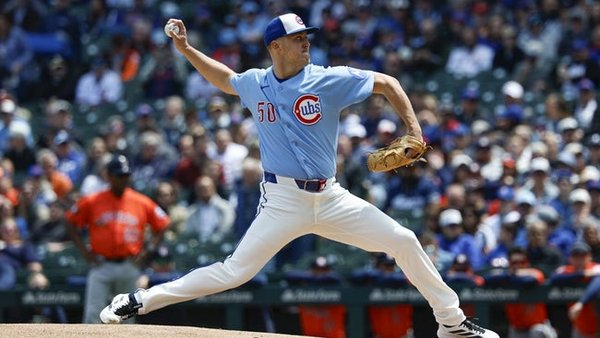
Wrigley Field carries a park factor of 1.02 — essentially a wash — yet the total sits at 11.5, a number that assumes both starters take a full beating. With Jameson Taillon on the 15-Day IL and Detroit’s staff posting a 3.58 team ERA, the run environment the market is pricing has a structural problem built right into it.
Jack Flaherty vs. Jameson Taillon: Detroit Tigers at Chicago Cubs Total Under Betting Preview
The headline here isn’t the pitching matchup as listed — it’s the fact that Jameson Taillon is on the 15-Day IL with a hamstring injury. Whether Chicago rolls him out on a severe pitch-count limit or turns to an emergency arm entirely, the Cubs’ offensive output is directly tied to how this roster spot plays out. The market has set 11.5 as if two known commodities are taking the mound, and that assumption may be doing a lot of heavy lifting for the Over.
On the Detroit side, Jack Flaherty carries a 4.48 ERA and a 1.41 WHIP that won’t inspire confidence. But beneath those surface numbers is a 10.71 K/9 that represents genuine swing-and-miss capacity — the kind of strikeout rate that limits traffic even when a pitcher is getting hit. And Detroit’s team pitching ERA of 3.58 is a quietly elite number that doesn’t get enough credit in a game environment priced this aggressively.
The numbers project a combined 9.3 runs against that posted 11.5 — a 2.2-run gap that is too wide to ignore. Wrigley Field’s park factor of 1.02 is essentially a wash, offering no meaningful run inflation to justify where this total sits. The math points firmly toward the Under, and the Taillon uncertainty only strengthens that case.
Game Info & Betting Lines
- Date/Time: Monday, July 20, 2026 | 8:05 PM ET
- Venue: Wrigley Field | Park Factor: 1.02 (neutral)
- TV: MLB.TV, Marquee Sports Net, Tigers.TV
- Probable Starters: Jack Flaherty (DET, 3-8, 4.48 ERA) vs. Jameson Taillon (CHC, 2-5, 5.19 ERA — 15-Day IL, hamstring)
- Moneyline: Detroit Tigers -106 / Chicago Cubs -110
- Run Line: Chicago Cubs +1.5 (-166) / Detroit Tigers -1.5 (+138)
- Total: 11.5 (Over -115 / Under -105)
Why This Number Is Off
I understand why 11.5 exists. The market sees two flawed starters — Flaherty with a 1.41 WHIP, Taillon with 20 home runs allowed in 67.2 innings — and prices in early exits, high pitch counts, and heavy bullpen usage. That’s a rational framework. Add in Chicago’s lineup (OPS .749, led by Pete Crow-Armstrong at .898 OPS) and Detroit’s own middle-of-the-order threats in Riley Greene and Dillon Dingler, and you can construct the 10-9 game in your head pretty easily.
But here’s the problem: 11.5 only works if both starting pitchers are both active and both get shelled. The Taillon IL situation disrupts that calculus entirely. If Chicago starts an emergency arm who hasn’t built up innings, pitch counts will be conservative and managed carefully. If Taillon is somehow activated and does pitch, he’s doing so coming off a hamstring issue — which almost certainly means a hard limit, not a full outing. Either way, the Cubs’ side of the run-scoring ledger is compromised.
Meanwhile, Detroit’s team ERA of 3.58 tells you their pitching staff — starters and bullpen combined — has been significantly better than the league average. Flaherty’s underlying strikeout numbers support run suppression even when he’s not at his best. The line at -105 for the Under is pricing in legitimate upside risk without fully accounting for the Taillon variable. That’s where the value lives.
What Separates the Pitching
The gap between these two arms is real, but it runs deeper than ERA suggests. Flaherty’s arsenal centers on a sinker thrown 45.9% of the time at 93.9 mph — not a swing-and-miss pitch (10.4% whiff), but a heavy ground-ball inducer that keeps the ball in the park. His curveball at 27.8% usage generates a 30.0% whiff rate and an xwOBA of .264, making it his primary putaway sequence. The slider — used sparingly at 4.6% — is genuinely filthy: 40.9% whiff rate and an xwOBA of just .133. Flaherty’s problem is he leans so heavily on the sinker that his xwOBA against (.361 on that pitch) creates hard contact risk. But his 10.71 K/9 tells you the secondary stuff is cashing strikeouts when he needs them.
Against Chicago’s lineup, the matchup data is relevant. Michael Conforto posts a .412 xwOBA vs. right-handed pitching and a concerning 24.7% whiff rate — he’ll chase, but he can do damage when he makes contact. Alex Bregman is the stabilizer: .309 xwOBA against righties, 15.7% strikeout rate — he’s a contact hitter who won’t punch out, but he’s not a power threat here either. Kevin Alcántara at 31.7% whiff rate is a strikeout candidate against Flaherty’s secondary mix.
Taillon’s profile — assuming he pitches — is the more concerning side. His cutter sits 43.5% usage at 93.0 mph with a 17.5% whiff rate and an xwOBA of .364, and his sweeper (38.7% usage) generates 26.6% whiffs. But 20 home runs allowed in 67.2 innings is a catastrophic power-contact rate. Detroit’s hitters like Dillon Dingler (.450 xwOBA, 5.7% barrel rate) and Riley Greene (.458 xwOBA, 6.7% barrel rate) are genuine threats against a pitcher surrendering this many long balls. And don’t overlook Spencer Torkelson (.427 xwOBA, 7.2% barrel rate) — he homered twice against the Angels on Saturday and has the barrel-rate profile to punish a hamstrung Taillon throwing his cutter into right-center. The gap in run-prevention reliability between these two starters is significant, and it tilts toward Flaherty holding this game down longer than expected.
Pushback: The Case for the Over
Let’s be honest about the friction here. Chicago’s lineup is legitimately dangerous, and the Sunday blowout of Minnesota wasn’t a fluke or a full-roster effort — it was driven by a handful of hitters who are locked in right now. Alex Bregman hit a two-run homer and finished with four RBI. Nico Hoerner hit a bases-loaded triple and drove in four runs. Michael Busch went 3-for-5 and has been on of the more consistent bats in Chicago’s lineup all series. Pete Crow-Armstrong doubled to lead off the fourth. That’s real offensive firepower, and those hitters don’t disappear because Taillon might be limited.
The Detroit bullpen situation is also a legitimate counter. With Will Vest (elbow), Brant Hurter (back), and Burch Smith (shoulder) all on the IL, the Tigers’ relief corps is thinner than it appears on paper. If Flaherty gets knocked around early — which his 1.41 WHIP says is entirely possible — the backend of Detroit’s pen could get exposed in a hurry. That’s how you get to 11.5 even without Taillon going deep into a game.
I take this pushback seriously. A short Flaherty outing plus a patchwork Cubs pitching staff managed on pitch count is not a guaranteed low-scoring affair. The over is not dead money at -115.
Run Environment & Game Shape
Here’s the framing I keep coming back to: the market is treating this game like a normal high-variance pitching matchup between two shaky starters. That framing may be right about the starters’ quality, but it completely misses the structural constraint on the Chicago side of the ledger.
When one team’s starting pitcher is coming off a hamstring injury on a mandated pitch limit — or isn’t pitching at all — the run environment on that side gets compressed regardless of lineup quality. Hoerner, Bregman, and Busch can hit. But they’re going to do it against a pitcher who is either operating on fumes or being replaced by a depth arm managing traffic conservatively. Meanwhile, Detroit’s 3.58 team ERA — the actual whole-staff number, not just Flaherty’s surface marks — supports a run-prevention floor that the 11.5 total doesn’t respect.
The projected combined total of 9.3 runs isn’t a coin flip away from 11.5. That’s a 2.2-run gap. At Wrigley with a 1.02 park factor, there’s no environmental tailwind to bridge that distance. You’d need both starters to get shelled simultaneously, the bullpens to both implode, and the offense on both sides to run hot — all in the same game. That’s not a moderate risk; that’s a parlay of bad outcomes stacking on top of each other.
The Under at -105 is one of the better-priced totals I’ve seen this week. You’re getting a number that requires the over to work harder than the lineup quality alone can justify, against a backdrop where Chicago’s pitching situation is actively compromised. Flaherty isn’t an ace, but he doesn’t need to be — he just needs to be good enough, and Detroit’s bullpen depth concerns are partially offset by the fact that the Cubs are in the same boat on the mound.
I’m playing this at 2 units with moderate confidence. The 11.5 is mispriced, the Taillon variable is real, and -105 is a fair price to lay on a total that the numbers peg closer to 9.3. Take the Under, let the pitching situation do the work, and don’t need fireworks to cash.
Bet: Under 11.5 — 2 Units | Moderate Confidence