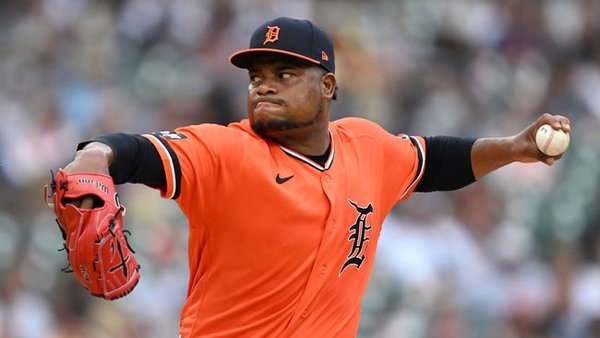
Framber Valdez (4.10 ERA, 1.32 WHIP) lines up opposite David Peterson (6.45 ERA, 1.64 WHIP, -1.37 WAR) — a pitching gap wide enough to see from the bleachers at Wrigley. The Cubs are priced at -118 on the back of a better record and home field, but the numbers project this game as a virtual dead heat, and the market hasn’t accounted for who’s actually taking the ball tonight.
Framber Valdez vs. David Peterson: Detroit Tigers at Chicago Cubs Betting Preview
The market has Chicago installed as a modest -118 home favorite, which on the surface looks reasonable — the Cubs are 56-44, playing at Wrigley, and they’ve got one of the better offenses in the NL. But that price ignores a pitching disparity that is genuinely stark. Framber Valdez brings a 4.10 ERA, a 1.32 WHIP, and positive WAR (1.36) to the mound tonight. David Peterson counters with a 6.45 ERA, a 1.64 WHIP, and a WAR of -1.37. You are being offered the team with the clearly superior starter at +100 moneyline — even money on a game where Detroit’s win probability sits at 53.1% against an implied ~54% for Chicago at -118.
Home field matters, and so does Chicago’s overall record. But in MLB handicapping, the starter drives the outcome more than any other single variable. When the gap between those starters is this wide, and the price doesn’t reflect it, there’s a real edge to extract.
Detroit took Game 1 of this series 8-6 on Monday in extra innings, with Dillon Dingler going deep twice and Spencer Torkelson delivering the go-ahead hit in the 10th. The Tigers have won 12 of their last 16 games. The Cubs are better on paper — but tonight’s pitching matchup belongs to Detroit.
Game Info & Betting Lines
- Date/Time: Tuesday, July 21, 2026 — 8:05 PM ET
- Venue: Wrigley Field (Park Factor: 1.02 — slight hitter tilt)
- Probable Starters: Framber Valdez (DET) vs. David Peterson (CHC)
- Moneyline: Detroit Tigers +100 / Chicago Cubs -118
- Run Line: Chicago Cubs +1.5 (-188) / Detroit Tigers -1.5 (+155)
- Total: 8.5 (Over -108 / Under -112)
Why This Number Is Off
The market is doing reasonable work here. Chicago’s -118 price reflects their home field, their superior record (56-44 vs. Detroit’s 47-53), and a Cubs lineup that carries a team OPS of .749 against Detroit’s .710. The Cubs also lead in run differential (+60 vs. +33). Those are legitimate reasons the line tilts Chicago’s way.
But here’s the problem: the numbers project this game as a virtual tie — 4.8 runs for each team, with Detroit holding a 53.1% win probability. At -118, you’re paying a meaningful premium for a home team that the numbers say shouldn’t be favored at all. The Cubs are priced roughly 5-6% more expensive than their actual win probability warrants.
The flip side of that is simple: the Tigers at +100 represent positive expected value on the side with the better starting pitcher, the better team ERA (3.58 vs. 4.27), and recent momentum. Getting even money on a team that projects to win slightly more than half the time isn’t a massive edge — but it doesn’t need to be. In a game shaped around two starting pitchers, this is exactly the kind of small, real edge that builds a winning betting record over time.
What Separates the Pitching
This is not a close pitching matchup. Valdez and Peterson sit at opposite ends of the quality spectrum right now, and the Statcast data confirms it isn’t just ERA noise.
Peterson’s four-seam fastball — his most-used pitch at 41.9% of offerings — generates only a 13.8% whiff rate and holds an xwOBA of .381 against it. That’s a pitch hitters are consistently making contact on, and hard contact at that. His sinker is a separate and actively dangerous problem: at 9.1% usage, it carries an xwOBA of .458 — hitters are sitting on it and punishing it. His cutter is similarly exploitable at a .479 xwOBA. The Cubs are asking a starter with a -1.37 WAR to neutralize a lineup that features Riley Greene — who posts a .458 xwOBA overall and an even scarier .483 xwOBA specifically against right-handed pitching — along with Dillon Dingler (.444 xwOBA, 29.4% hard-hit rate). Those are two distinct Greene figures: his season-wide number and his platoon split against righties like Peterson. Peterson has allowed 9 home runs in just 82.1 innings — a concerning rate for a pitcher whose two best put-away options (his slider at 28.7% whiff and his sweeper at 27.2%) account for only about 20% of his pitch mix combined.
Valdez operates differently. His sinker (22.9% usage, 94.7 mph) holds an xwOBA of .289 and generates a 17.2% put-away rate — a genuine weapon for inducing weak contact. His changeup (13.7% usage, 87.0 mph) is arguably his best swing-and-miss offering at 24.7% whiff and a .213 xwOBA against, making it particularly effective against the Cubs’ right-handed hitters. His slider (.271 xwOBA, 26.4% whiff) gives him a third credible put-away option. The concern is the Cubs’ top of the order: Pete Crow-Armstrong (.437 xwOBA, .463 vs. right-handers) and Ian Happ (.411 xwOBA, .441 vs. right-handers) are exactly the profile that can work counts and punish Valdez’s 1.32 WHIP tendencies. But the gap between what these two starters project to deliver tonight is significant, and the price doesn’t price it in.
The Pushback
The case against Detroit is real, and it deserves honest treatment. Chicago is the better team by record (56-44), playing at home, and their lineup is patient — a .337 OBP and 431 walks on the season means they will work counts against Valdez. Detroit’s injury list is extensive: Perez, Meadows, Baez, and Verlander are all unavailable, which pushes McKinstry and Outman into the bottom third of the lineup and effectively caps the ceiling on Detroit’s offense. The Tigers’ .710 team OPS is a real number — they can score enough to win this game, but they are not a lineup that routinely runs up crooked numbers. And Peterson’s ERA is partially inflated; he’s been bad, but not necessarily 6.45-bad going forward.
On the run line: Detroit -1.5 at +155 looks tempting on paper, but the math doesn’t support it as the primary vehicle here. The projected score is 4.8-4.8, and Detroit’s .710 OPS offense has no reliable path to multi-run separation against even a mediocre starter on a given night. The most likely game shape — a one-run decision in either direction — makes the moneyline the correct vehicle for this edge. Chasing the run line means needing Detroit to win by two or more in a game that projects as a near-coin flip. That’s asking too much from a lineup with genuine holes in it.
Valdez doesn’t need to be dominant tonight — he needs to be better than Peterson. Given a six-run ERA gap, a WAR gap of nearly three wins, and Statcast data that confirms Peterson’s struggles are real and structural, that’s a reasonable ask. The Cubs’ patient offense makes this a grind, but a grind favors the pitcher with more reliable secondary stuff. Valdez has it. Peterson doesn’t.
The Pick
This is a game where the market price and the pitching reality point in opposite directions. Chicago’s -118 is defensible on record and home field alone, but it overweights factors that don’t move the needle as much as starter quality does on a given night. Detroit is getting even money with the better pitcher, the better team ERA, and genuine recent momentum (12-4 over 16 games). The projected score is a dead heat at 4.8 each, which means this line should be closer to a pick’em — and at +100, the Tigers are on the right side of that gap. It’s a one-run game environment with a clear pitching edge for the underdog, and the moneyline is exactly the right vehicle for how this game is likely to play out.
Bet: Detroit Tigers moneyline +100, 2 units — moderate confidence.