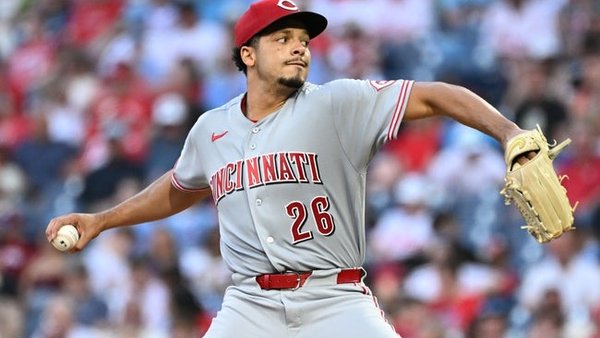
Chase Burns is running a 49.7% whiff rate on his slider and facing a Cleveland lineup that has been shut out in back-to-back completed games — yet the total sits at a flat 9 with juice split evenly at -110 on both sides. The pitching gap between Burns (2.42 ERA) and Cecconi (4.60 ERA) is real, and the run environment has not fully accounted for it.
Slade Cecconi vs Chase Burns: Cleveland Guardians at Cincinnati Reds Betting Preview
Monday’s rainout reshuffled the schedule and handed us a doubleheader Tuesday at Great American Ball Park. Game 1 features one of the sharpest pitching mismatches on the board this week: Chase Burns (12-1, 2.42 ERA) against Slade Cecconi (4-7, 4.60 ERA). The market has the total posted at 9, and Cincinnati’s moneyline is sitting at -158.
The juice ceiling kills the Cincinnati straight-up play. At -158, you’re paying a premium that doesn’t produce sustainable value regardless of how dominant Burns looks. But the pitching gap here is real, and it points cleanly at the total rather than the moneyline. Burns has suppressed run-scoring all season regardless of venue. The question is whether Cecconi can limit Cincinnati’s offense enough to keep the combined number from climbing — and given what Cleveland’s bats have done lately, the under starts to look like the cleaner path.
This is Game 1 of a doubleheader, which introduces some structural uncertainty around pitch counts and bullpen management. But even accounting for a shorter Burns outing, the quality he delivers through five or six innings should hold Cleveland’s struggling lineup in check. The edge here isn’t about a blowout — it’s about a tight, pitcher-influenced game that stays under 9.
Game Info & Betting Lines
- Date/Time: Tuesday, July 28, 2026 — 1:40 PM ET
- Venue: Great American Ball Park | Park Factor: 1.10 (hitter-friendly)
- Probable Starters: Slade Cecconi (CLE, 4-7, 4.60 ERA) vs Chase Burns (CIN, 12-1, 2.42 ERA)
- Moneyline: Cleveland Guardians +134 / Cincinnati Reds -158
- Run Line: Cincinnati Reds -1.5 (+132) / Cleveland Guardians +1.5 (-160)
- Total: 9 (Over -110 / Under -110)
Why This Number Is Close
The market has set this total at 9 for a reason. Great American Ball Park plays at a 1.10 park factor — a meaningful nudge toward run inflation in a game where Cecconi’s profile (1.45 WHIP, 15 HR allowed in 103.2 IP) gives Cincinnati’s power lineup real opportunities to score in bunches. The projected combined total of 9.7 runs suggests the market is actually pricing this slightly under true expectation, which is what makes the under a lean rather than a conviction play.
The legitimate case for the over is Cecconi’s volatility. His sinker generates a .369 xwOBA against, and his sweeper — while generating 27.9% whiffs — is used only 5.1% of the time. He doesn’t miss enough bats to confidently strand runners in a park that amplifies contact. Elly De La Cruz (.471 xwOBA, 9.0% barrel rate) is the most dangerous hitter in this lineup, and Nathaniel Lowe posts a .440 xwOBA overall, with a .455 mark against right-handers specifically — and he carries a .333 average against Cecconi in limited prior looks (6 PA, 1 HR). JJ Bleday (.409 xwOBA, .430 vsRHP) rounds out a top-five that can genuinely punish a shaky starter.
Where the market drifts slightly wrong is on the Cleveland side of the equation. Burns’s 10.37 K/9 against a lineup that has posted 895 strikeouts on the season and been shut out in back-to-back completed games is a suppression dynamic the total hasn’t fully discounted. Cleveland scored just 3 runs total across their three-game Tampa Bay series, and has been shut out in consecutive completed games entering Tuesday. That isn’t just noise.
What Separates the Pitching
The gap between these two starters is significant enough to anchor a betting thesis on its own. Chase Burns is operating as one of the most dominant starters in baseball right now. His 97.8 mph four-seam sits at 56.9% usage and holds hitters to a .325 xwOBA, but the real weapon is his slider — 37.1% usage, 90.4 mph, and a staggering 49.7% whiff rate with a .193 xwOBA against. That combination is elite. When a pitcher can generate a 49.7% whiff rate on a pitch he throws more than a third of the time, he controls at-bats at a level most starters can’t approach. Burns’s 2.42 ERA and 1.10 WHIP over 107.2 innings is not a sample-size mirage — it reflects a genuine quality-contact suppression profile.
Cleveland’s lineup looks poorly equipped to solve him. Steven Kwan holds a .295 xwOBA overall with a 6.6% whiff rate, making him a contact hitter who likely won’t drive runs. José Ramírez (.361 xwOBA, 3.6% barrel) presents the best Cleveland threat on paper, but his .337 xwOBA against right-handed pitching is notably below his left-handed splits. Travis Bazzana carries a 23.8% whiff rate and a .265 xwOBA against lefties — and while Burns is right-handed, his slider mimics the movement profile that gives Bazzana trouble with its lateral break.
Slade Cecconi is a different story. His 4-Seam Fastball sits at 93.5 mph with only a 16.4% whiff rate and a .346 xwOBA against — hittable. His curveball generates 28.2% whiffs but is used only 15% of the time. The arsenal lacks a true swing-and-miss anchor, which is why his 7.12 K/9 pales against Burns’s 10.37. The Reds’ lineup carries real power — 137 HR on the season — and Cecconi projects to allow runs. The question is whether the Cincinnati offense scores efficiently enough to push the total over, not whether they score at all.
The Pushback
The honest concern here is the park. Great American Ball Park at a 1.10 park factor is not Oracle Park — it amplifies contact, and Cecconi’s profile is built to get hit. The Reds have enough power in De La Cruz, Bleday, and Sal Stewart (21 HR) to post a crooked number in a single inning. If Cecconi unravels early and Cincinnati pads a 4- or 5-run lead, the under becomes harder to cash even with Burns keeping Cleveland quiet. That’s the primary risk vector on this ticket.
The doubleheader context also cuts both ways. Burns may be pulled earlier than normal to preserve him for potential playoff positioning down the stretch — Cincinnati at 49-55 isn’t in contention, but the organization still manages workloads. If the Reds turn to the bullpen in the fifth or sixth, Cincinnati’s relief unit (4.52 ERA, 1.421 WHIP) gives Cleveland a window it wouldn’t otherwise have against Burns.
Run Environment & Game Shape
The projected combined total of 9.7 puts this number just under the market line of 9 — which is why this is a lean, not a lock. The Burns-vs-cold-Cleveland suppression dynamic is the real edge here. Cleveland has been shut out in back-to-back completed games, is posting a .680 team OPS on the season, and now faces the most dominant starter they’ve seen in weeks. Even if Cecconi gives up three or four runs, Burns limiting Cleveland to one or two keeps the combined total in range. A 4-1 or 3-2 final gets this done comfortably. A 5-4 game doesn’t.
The math is straightforward: Burns suppresses Cleveland’s anemic offense, Cecconi gives up his share but not a blowout number, and a hitter-friendly park that cuts both ways still doesn’t fully offset a lineup that’s been blanked twice in a row. That’s the shape of an under-9 game, and at flat -110, the price is right.
Bet: Under 9 — 2 units, moderate confidence. The projection at 9.7 makes this a lean, not a lock, but the Burns-versus-cold-Cleveland suppression dynamic is the edge. Play it at -110 or better.