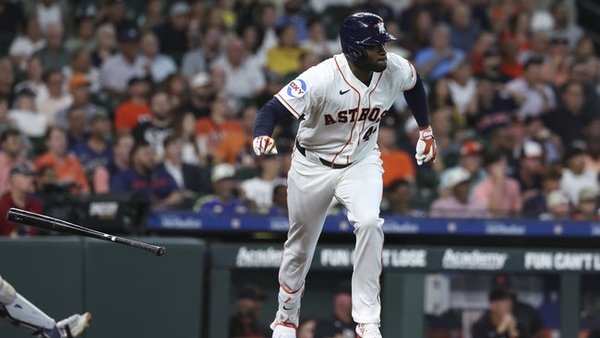
Grayson Rodriguez’s 8.54 ERA and 1.79 WHIP make this one of the most lopsided starter matchups on the board — yet the Astros are sitting at -138, a price that compresses a real edge into something marginal. The pitching profiles point one way; the number asks you to pay just enough juice to make the math uncomfortable.
Hayden Wesneski vs. Grayson Rodriguez: Houston Astros at Los Angeles Angels Betting Preview
After Yordan Alvarez walked off Angel Stadium on Tuesday with a ninth-inning RBI single to cap a 3-2 Houston win, the Astros arrive for the series finale with genuine momentum and an enormous pitching mismatch working in their favor. The Angels counter with Grayson Rodriguez, who has been one of the most punishable starters in baseball this season. Houston answers with Hayden Wesneski, who is analytically unknown through the current season — his last MLB data point is a 4.50 ERA across 32 innings in 2025.
The gap between those two arms is real. The problem isn’t the side — it’s the number. -138 clears my juice ceiling of -130 by enough that I can’t back this as a standalone unit play. The numbers project Houston winning 65.9% of the time against an implied probability of roughly 57.9% at -138, which is a legitimate edge. The question is whether that edge is worth paying the current price. The answer is: barely, and only as a parlay leg or beer money.
Houston has won seven of their last eight games, including back-to-back wins over these same Angels. The Angels have dropped 17 of 22. The directional case is clean. The price just takes a clean edge and turns it into a marginal one.
Game Info & Betting Lines
- Date/Time: Wednesday, July 29, 2026 — 9:38 PM ET
- Venue: Angel Stadium (Park Factor: 0.95 — slight run suppressor)
- Probable Starters: Hayden Wesneski (HOU) vs. Grayson Rodriguez (LAA)
- Moneyline: Houston Astros -138 / Los Angeles Angels +118
- Run Line: Houston Astros -1.5 (+115) / Los Angeles Angels +1.5 (-138)
- Total: 9.5 (Over -115 / Under -105)
Why This Number Is Close
The market is pricing a meaningful favorite — a team on a 7-of-8 run against a club that has lost 17 of 22 — at -138. That’s not an overreaction. It’s a fair reflection of how far apart these rosters are right now. The legitimate case for the line being set here: the Angels are at home, Wesneski is an unknown commodity in the current season, and the total of 9.5 signals the market expects offense from both sides.
But here’s the problem — Rodriguez’s season numbers are catastrophic. An 8.54 ERA and 1.79 WHIP over 39 innings is not a “rough stretch.” That’s a pitcher who is consistently failing to get through lineups, and Houston’s offense — led by Alvarez — is exactly the type of lineup that punishes command issues and elevated location.
Where the market is slightly off: it’s pricing this like a genuine two-starter game. It isn’t. One arm is a question mark, and the other is a known liability. The 65.9% win probability for Houston suggests the -138 is underpricing the Astros by several percentage points. The concern isn’t the direction — it’s whether that gap is wide enough to absorb the juice at this price. At -130 or better, I’m on Houston without hesitation. At -138, the math gets thin.
What Separates the Pitching
Grayson Rodriguez is the central inefficiency in this game. His 8.54 ERA, 1.79 WHIP, and -1.29 WAR this season make him one of the most exploitable starting pitching assignments on the board. He has walked 19 batters and surrendered 7 home runs across just 39 innings — a BB rate and HR/9 combination that consistently creates multi-run innings rather than preventing them. His 6.92 K/9 isn’t generating enough swing-and-miss to compensate for the command problems. Hitters are making contact, and it’s landing in the seats.
Hayden Wesneski is the analytical unknown here. His 2025 numbers — a 4.50 ERA, 1.09 WHIP, and 8.16 K/9 over 32 innings — paint a serviceable mid-rotation profile, but those are prior-season numbers and cannot be treated as current benchmarks. He kept walks down (6 BB in 32 IP last season), which is the profile you want against an Angels lineup that strikes out at a high clip (1,022 SO on the season). But we simply don’t know what version of Wesneski is taking the ball tonight.
The gap between the two arms still tilts heavily toward Houston even accounting for Wesneski’s uncertainty. Rodriguez’s damage profile — elevated hard contact, walk rates that load bases, a negative WAR — creates the type of innings that swing moneylines. Wesneski’s 2025 WHIP of 1.09 suggests cleaner innings, fewer baserunners, and less catastrophic exposure. That’s the pitching advantage the -138 price is trying to capture, and it’s legitimate — just not quite worth the full juice on a standalone basis.
The Pushback
The case against Houston tonight starts with Wesneski’s opacity. He has no current-season data, which means any number of outcomes are possible — a short outing, elevated pitch count, early hook. If he struggles through three innings, Houston’s bullpen gets extended in the same series where it just burned through Enyel De Los Santos, Bryan Abreu, Steven Okert, and Josh Hader to close out a one-run game Tuesday. Hader threw only four pitches for his 14th save, so he’s available — but the bridge arms may be working on shorter rest than ideal.
One conflicting signal worth noting: some underlying offensive tracking data shows a scoring gap that doesn’t reconcile cleanly with the recent game recaps, which confirm Houston has scored in both wins over these Angels. I’m flagging it as a caveat rather than treating it as a hard signal — the game results are the stronger data point here, and the directional lean doesn’t change.
The Angels also offer a few live bats worth respecting. Mike Trout (.244/.853 OPS, 18 HR) went 4-for-4 in his most recent outing — though that performance came against San Francisco’s staff last Sunday, not Houston’s pitching. Zach Neto (.234, 19 HR) and Vaughn Grissom (.264, 7 HR) can punish mistakes, and Jose Siri (.267, .790 OPS) adds speed at the top of the order. The lineup isn’t toothless, and Rodriguez getting through five innings with moderate damage is not an implausible outcome.
Note that Carlos Correa is not available for Houston — he is on the 60-Day IL with an ankle injury and should not be factored into any active lineup assessment. Jeremy Peña (.314/.863 OPS, 11 HR) is the primary shortstop and has been on a nine-game hitting streak, which partially offsets the Correa absence. The depth still works, but it’s worth acknowledging the lineup is operating without one of its key pieces.
I also looked at the run line: Houston -1.5 at +115 has some surface appeal given Rodriguez’s profile, but with a projected win margin of just 0.3 runs, asking for a cover by two or more doesn’t clear the threshold. The juice savings at +115 don’t compensate for the additional margin required. That angle was considered and rejected.
Run Environment & Game Shape
Angel Stadium’s park factor of 0.95 applies a modest run-suppressing effect relative to neutral environments — not dramatic, but enough to shade the total slightly downward from a raw expectation. The projected combined score of 9.3 runs sits just under the posted total of 9.5, which aligns with an Under lean on the total, though that’s not the focus here and there’s no actionable edge identified on that side.
The game shape most likely to emerge: Houston scores early against Rodriguez’s leaky command, builds a two- or three-run lead through five innings, and then navigates the back half with a fresher bullpen than the Angels can deploy. That’s the blueprint from Tuesday’s game — Alvarez doing damage in the first, Walker adding a homer, and Houston’s relievers locking the door. Rodriguez has allowed 7 home runs in 39 innings, which means Alvarez (35 HR, 1.082 OPS) and Walker (21 HR) are prime candidates to make noise early in a game expected to play out as a moderate-scoring affair in a slight pitcher’s environment.
The Angels’ bullpen has been patchwork all season, and with Rodriguez likely on a short leash given his ERA, Houston could be facing inferior arms by the fourth or fifth inning — which only amplifies the offensive edge the Astros already carry into this matchup.
The pick: Houston Astros ML (-138) is a lean — not a standalone unit play. The edge is real (65.9% win probability vs. roughly 57.9% implied), the pitching mismatch is genuine, and the momentum is firmly in Houston’s favor after winning two straight in Anaheim. But -138 clears my juice ceiling of -130, and that extra eight cents of juice is enough to push this out of the unit-play category entirely. If you’re building a parlay or looking for a directional add-on, Houston fits cleanly. As a solo bet, the math is too thin to commit a unit. Beer money or parlay leg only.
Bet: Houston Astros Moneyline (-138) — Lean (0 units)