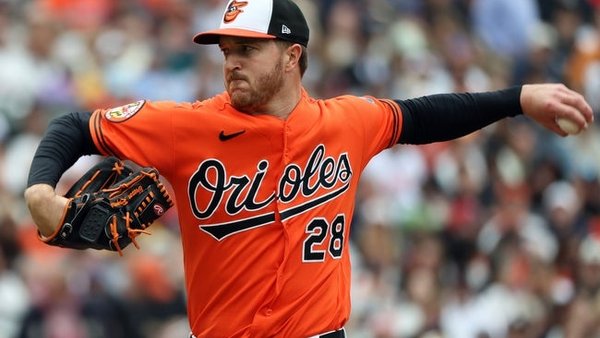
Freddy Peralta’s 5.33 ERA and 1.50 WHIP have produced sustained traffic all season — not a cold stretch — yet the total sits at 8.0 in a dome that provides modest suppression at best. Trevor Rogers has surrendered 12 home runs in under 120 innings, and this series has already produced 17 combined runs across two games. The number and the starters are telling different stories.
Trevor Rogers vs. Freddy Peralta: Baltimore Orioles at Tampa Bay Rays Betting Preview
The Orioles took the first two games of this series, winning 6-5 Friday and 4-3 in extras Saturday — both messy, back-and-forth affairs that needed extra baserunners, late rallies, and bullpen volatility to resolve. That context matters because it frames tonight’s pitching matchup honestly: neither Rogers nor Peralta inspires confidence as a run-suppressor, and the 8.0 total feels like the market is still anchoring to a pitcher’s park narrative at Tropicana Field that the actual starters don’t support.
Tampa Bay’s Freddy Peralta comes in at 5.33 ERA and 1.50 WHIP across 123.1 innings — a stat line that signals sustained vulnerability, not a bad stretch. Baltimore sends Trevor Rogers, who’s been better at 4.21 ERA and 1.25 WHIP over 119.2 innings, but is no shutdown arm either. The numbers project a combined 8.8 runs. The over is at -103. That’s a spot worth targeting.
Game Info & Betting Lines
- Date/Time: Sunday, August 16, 2026 — 12:15 PM ET
- Venue: Tropicana Field (Park Factor: 0.95 — slight run suppressor, dome)
- TV: Peacock
- Probable Starters: Trevor Rogers (BAL, 7-8, 4.21 ERA) vs. Freddy Peralta (TB, 5-9, 5.33 ERA)
- Moneyline: Baltimore Orioles +131 / Tampa Bay Rays -140
- Run Line: Tampa Bay Rays -1.5 (+148) / Baltimore Orioles +1.5 (-180)
- Total: 8.0 (Over -103 / Under -116)
Why This Number Is Off
The market set 8.0 here for defensible reasons. Tropicana Field runs a 0.95 park factor — a dome that historically suppresses offense by keeping wind and humidity out of the equation. The Rays’ team ERA of 3.71 suggests a pitching staff capable of holding scores down, and Tampa Bay’s home-field edge is real. On paper, 8.0 is a reasonable anchor.
But the line is pricing this game as if the starters are going to eat innings efficiently, and neither one has done that consistently in 2026. Peralta’s 1.50 WHIP means roughly 1.5 baserunners per inning — that’s sustained traffic across every frame he pitches. Rogers is cleaner at 1.25, but he’s surrendered 12 home runs in 119.2 innings and carries a walk total that keeps counts long and bullpens warm early.
The Statcast projections see 8.8 combined runs — a 0.8-run gap over the posted total. That gap isn’t enormous, but at -103 juice, the over doesn’t need the game to blow up. It just needs two imperfect starters to do what imperfect starters do: give up runs. Both have done exactly that, repeatedly, all season.
What Separates the Pitching
Trevor Rogers leans heavily on his four-seam fastball at 44.3% usage, sitting 93.6 mph with a 20.9% whiff rate and a .329 xwOBA against. It’s a usable pitch, but not a swing-and-miss weapon at that velocity. His sweeper is the best pure whiff tool in his arsenal — 30.2% whiff rate and .219 xwOBA against — but he deploys it only 13.1% of the time. The changeup and cutter are roughly average. What this means for the Rays lineup: a contact-friendly profile that a disciplined offense can work.
Freddy Peralta is the more volatile arm. His four-seam is his bread-and-butter at 52.7% usage, 94.1 mph, but it carries a .340 xwOBA against — hitters are doing real damage when they connect. His changeup is his second-most-used pitch at 21.7% usage, mixing in at 87.2 mph with a .282 xwOBA and 25.8% whiff rate — a legitimate complement that tempers the pure fastball-heavy characterization, though it doesn’t fundamentally change the run-prevention picture given his 1.50 WHIP. His slider, used only 5.4% of the time, is a genuinely high-variance offering: it produces a staggering 48.8% whiff rate, but the .449 xwOBA against tells you that when hitters do make contact, the damage is catastrophic. Elite whiff rate, ruinous contact quality — that duality actually reinforces the over thesis, because Peralta may dodge barrels some nights and surrender them in bunches others. His curveball at 34.4% whiff is legitimately good, but the fastball-heavy approach against an Orioles lineup that includes Pete Alonso’s .475 xwOBA is a mismatch worth flagging. Alonso has 27 home runs, a 6.9% barrel rate, and a 33.1% hard-hit rate — the kind of hitter who punishes a 94 mph fastball over the middle.
The gap between these two isn’t dramatic in terms of quality, but the direction is clear: Rogers can keep games manageable more often than Peralta, who has surrendered 20 home runs in 123.1 innings. In a game where Tropicana provides modest suppression but neither pitcher provides elite suppression, the scoring environment tilts toward the over.
The Pushback
Here’s where this lean gets uncomfortable: both offenses have been cold recently. The data shows both clubs scoring zero runs in their last three tracked games — though context matters, since the recent recaps show these teams combined for 17 runs across Friday and Saturday’s games. The “cold offense” signal conflicts with the actual game logs, which suggests the underlying trend is not as dramatic as the raw number implies.
But the concern is real in a different direction: over totals are the most variance-prone bet in baseball. A lights-out first four innings from Peralta, a couple of Rays bullpen holds, and suddenly the under cashes despite everything pointing the other way. Bullpen volatility also cuts both ways — Baltimore’s pen has been better recently (Cam Sanders earning his second save Friday and his third Saturday in this series), but Tampa Bay’s bullpen allowed three in the ninth Friday before holding Saturday. That kind of late-game unpredictability can compress scores unexpectedly.
Joe Jensen’s Pick
I’m on the over 8.0 (-103). At 8.8 projected combined runs against a posted total of 8.0, this is a half-run edge priced at near-even juice — a projected-total-to-market gap of 0.8 runs at -103 is exactly the kind of number worth a lean-confidence unit. Two starters with ERA’s north of 4.00, a combined 32 home runs allowed this season, and a recent series history that produced 17 runs across two games. The dome suppresses some offense, but it doesn’t suppress a 5.33 ERA and a 1.50 WHIP.
I weighed Tampa Bay Rays -1.5 at +148, but laying the run line on a lean-confidence play with two imperfect starters and bullpen volatility on both sides introduces too much margin risk for the edge it offers. If either starter exits early and the bullpens trade crooked numbers, the Orioles’ ability to keep it within a run or two is real — we’ve seen exactly that in both games this series. The over is the cleaner expression of the thesis: I don’t need to call a winner or a margin, I just need runs to score. With these arms, that’s the easier ask.
Bet: Total Over 8.0 (-103) | Lean | 0 Units