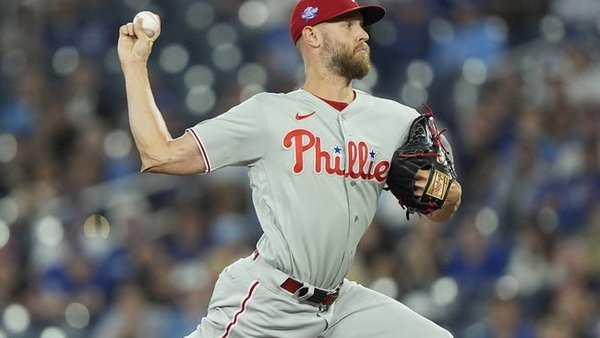
Zack Wheeler’s 2.89 ERA and 44.9% splitter whiff rate line up against a Marlins lineup that has struck out 1,026 times on the season — yet the total sits at 8.0, pricing both halves of this game as roughly equal contributors. Gibson’s 5.61 ERA and 1.54 WHIP signal Philadelphia can score, but Wheeler’s arsenal is specifically built to suppress exactly the lineup he’s facing tonight.
Cade Gibson vs. Zack Wheeler: Miami Marlins at Philadelphia Phillies Betting Preview
Last night’s 6-5 Phillies win closed out on a Jhoan Duran save, with both bullpens working deep into a back-and-forth game. Tonight the pitching matchup shifts dramatically. Zack Wheeler takes the ball for Philadelphia, and on the other side, the Marlins send out Cade Gibson — a starter with a 5.61 ERA and 1.54 WHIP in 33.2 innings. The market has posted a total of 8.0, which implies a moderately run-suppressed environment. That number looks about right on the surface, but it doesn’t adequately account for what Wheeler does to a lineup like Miami’s.
The core argument here isn’t complicated: Wheeler is one of the best starters in baseball right now, and the Marlins are one of the worst matchups for an elite strikeout pitcher. The 8.0 total needs both halves of the game to produce — and Wheeler’s half is going to be lean. The under at -105 is the cheaper side of the total, which adds a small but real value edge on top of the analytical lean.
This isn’t a play on Gibson getting shelled. A Phillies offensive explosion is possible, even probable given the roster and the starter they’re facing — but even a crooked number from Philadelphia and a suppressed Miami output puts you at 7 or 8 combined, which is right at or under the number.
Game Info & Betting Lines
- Date/Time: Tuesday, August 18, 2026 | 6:40 PM ET
- Venue: Citizens Bank Park | Park Factor: 1.02 (marginally hitter-friendly)
- Probable Starters: Cade Gibson (MIA) vs. Zack Wheeler (PHI)
- Moneyline: Miami Marlins +212 / Philadelphia Phillies -229
- Run Line: Philadelphia Phillies -1.5 (-110) / Miami Marlins +1.5 (-110)
- Total: 8.0 (Over -115 / Under -105)
Why This Number Is Close But Slightly Off
The market set 8.0 here for defensible reasons. Citizens Bank Park carries a park factor of just 1.02 — barely above neutral — so it’s not artificially inflating the number. Gibson’s track record does invite run-scoring from Philadelphia, and the Phillies have real power in their lineup with 154 home runs on the season. The market is also aware of Wheeler’s dominance and has already baked in some run suppression on the Miami side. So the 8.0 isn’t a naive number.
Where I think it’s slightly wrong: the market is pricing Gibson’s liability as a moderate risk rather than a near-certainty, and it’s not fully weighting Wheeler’s elite strikeout profile against a Miami lineup that whiffs 1,026 times on the season. The numbers project a combined 9.2 runs, which would favor the over — but that projection leans heavily on Gibson getting hit hard and Miami contributing to a two-sided scoring game. Wheeler’s elite suppression profile is the dominant variable the raw projection underweights: even if Philadelphia hangs 5 on Gibson, Wheeler holding Miami to 3 or fewer gets you to 8 or under, and that’s precisely the game shape his arsenal and strikeout rate project. The -105 juice on the under is the market giving you a slight discount on what I think is the more probable game shape.
What Separates the Pitching
The gap between these two starters is as wide as you’ll find in a regular-season game. Wheeler carries a 2.89 ERA, 1.0 WHIP, and 10.69 K/9 with 137 strikeouts in 115.1 innings. His arsenal is built to miss bats at an elite level: his four-seam fastball sits at 95.1 mph with a 24.0% whiff rate, and his split-finger is one of the nastier put-away pitches in the game — 44.9% whiff rate and a microscopic .208 xwOBA against. His curveball isn’t far behind at 44.7% whiff and .205 xwOBA. Wheeler creates swing-and-miss at every count, and against a Miami lineup that carries a 27.9% K rate from Heriberto Hernández and a 29.3% K rate from Griffin Conine — two of their most dangerous bats — the ceilings for Miami’s big hitters are severely compressed. The BvP data on Hernández against Wheeler shows 5 plate appearances with 3 strikeouts; small sample, but consistent with the whiff profile.
Gibson, by contrast, is operating with a sinker-heavy approach at 92.1 mph that generates almost no whiffs (2.8%), a sweeper and curveball that show better put-away rates (20.4% and 17.6% respectively), and a changeup that actually misses bats at 34.5%. The problem isn’t the arsenal — it’s the execution. A 1.54 WHIP and 5.61 ERA over 33.2 innings tells you he’s putting too many runners on base. Schwarber carries a .517 xwOBA and 37 home runs, and the BvP data shows him 0-for-7 against Gibson — but that’s a small enough sample that I wouldn’t lean on it heavily. The risk is real that Philadelphia hangs a 4 or 5 in the early innings.
The key distinction: Wheeler creates innings where batters go back to the dugout. Gibson creates innings where baserunners accumulate. That asymmetry is the core of the under thesis.
The Pushback
Here’s where it genuinely gets uncomfortable. Gibson’s 5.61 ERA means the Phillies could post a crooked number early, and if that number is 6 or 7, Miami only needs 2 or 3 to cash the over — a threshold that’s achievable even against Wheeler. The Marlins aren’t a dead lineup; they’ve got a positive run differential of +19 on the season and have scored 8 runs in each of their last two road wins before last night. Hernández’s xwOBA sits at .443, Conine is at .522 — these are legitimate threats, not filler. There’s also the bullpen angle: if the Phillies are up big by the fifth, Wheeler might not see the 7th inning, and Philadelphia’s relief corps has been taxed. Last night’s game went deep into both pens.
The Gibson blow-up scenario is the real threat to this play. If he exits in the third or fourth having allowed 4 or 5 runs, the over can cash on the Phillies’ half alone if Miami scrapes together even a modest contribution. That’s the scenario where the under loses, and I want to be honest that it’s a real one. I’m not pretending that risk doesn’t exist.
What keeps me on the under: the game shape most likely to produce a high combined total requires Miami to contribute — and Wheeler is exceptionally well-equipped to prevent that. His .208 xwOBA on the splitter and .205 xwOBA on the curve are neutralizers against a lineup that already strikes out at one of the highest rates in the NL. The over needs Miami to show up offensively. Wheeler’s job tonight is specifically to make sure they don’t.
Rejected Angles
The Phillies moneyline at -229 is a reasonable favorite, but I’m not paying that price for a team with Gibson going on the other side — the variance in Gibson’s starts means you’re occasionally paying -229 for a 6-5 grind, which happened literally last night. The run line at -1.5 (-110) is more interesting, but it requires Gibson to either get rocked early without a massive Marlins rally, or for Wheeler to be dominant across 6+ innings, which still leaves the back end of the bullpen exposed in a close game. The -110 juice on -1.5 doesn’t reflect the Gibson volatility risk adequately — you’re not getting compensated for the coin flip of whether Gibson lasts five innings while keeping it close. The under at -105 is the cleanest expression of the Wheeler dominance thesis without needing the Phillies to score a specific number.
Run Environment & Game Shape
Citizens Bank Park’s 1.02 park factor is essentially a non-factor here — it nudges the run environment ever so slightly, but not enough to move the needle on a total. The weather situation isn’t flagged as an issue. This game shapes like a Wheeler-controlled effort where Philadelphia generates 4-5 runs through some combination of Gibson’s leakiness and their own lineup quality, and Miami is held to 2-3 runs on the strength of one of the most dominant strikeout arsenals in baseball.
Philadelphia projects at 4.9 runs and Miami at 4.3 — but that Miami number assumes a more balanced offensive contribution than Wheeler’s profile typically allows. His splitter (.208 xwOBA), curveball (.205 xwOBA), and sweeper (.253 xwOBA) are precisely the pitches that dismantle a high-strikeout lineup like Miami’s. The over needs both sides to contribute. Wheeler’s entire profile is built to prevent that from happening on the Miami side.
This game doesn’t get to 8+ unless it becomes a high-scoring, both-sides-contribute kind of affair — and the pitcher standing in the way of that outcome is one of the best in baseball tonight. I’ll take the under at -105 and trust Wheeler to hold up his end of the thesis.
Bet: Under 8.0 (-105) | 2 units | Moderate confidence