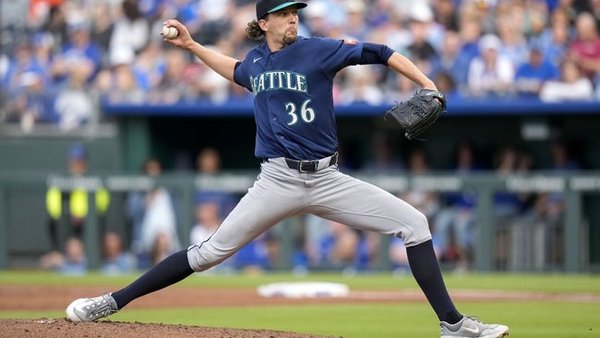
Logan Gilbert’s 3.28 ERA and 0.99 WHIP make Seattle a legitimate threat for six innings — but once he exits, Milwaukee’s 3.43 bullpen ERA takes over against a Mariners lineup hitting .229 as a team. The -125 price accounts for the ace on the mound; it does not account for everything else tilting toward the Brewers.
Logan Gilbert vs. Dustin May: Seattle Mariners at Milwaukee Brewers Betting Preview
The Brewers are one of baseball’s best teams at 78-48 with a +158 run differential. Seattle limps in at 59-67, carrying a -45 run differential, a thinned-out roster, and the psychological weight of getting torched 22-0 the night before. On paper, laying -125 on Milwaukee should feel automatic.
But the reason it isn’t automatic is standing on the mound in a Seattle uniform. Logan Gilbert is a genuine ace — 3.28 ERA, 0.99 WHIP, 9.41 K/9 across 145.1 innings. He can neutralize lineups that looked dominant 24 hours earlier. The market isn’t pricing this at -140 or -150 precisely because Gilbert gives Seattle a legitimate path to a win regardless of Tuesday’s result.
Where the number becomes playable is here: Milwaukee’s lineup quality gap is real, the Brewers’ staff ERA advantage is meaningful, and -125 clears the juice ceiling for a team this much better. The pitching matchup favors Seattle’s starter, but the rest of the equation tilts toward Milwaukee — and at this price, that asymmetry is enough.
Game Info & Betting Lines
- Date/Time: Wednesday, August 19, 2026 | 7:40 PM ET
- Venue: American Family Field (Park Factor: 1.00 — neutral run environment, domed)
- Probable Starters: Logan Gilbert (SEA) vs. Dustin May (MIL)
- Moneyline: Seattle Mariners +104 / Milwaukee Brewers -125
- Run Line: Milwaukee Brewers -1.5 (+170) / Seattle Mariners +1.5 (-208)
- Total: 7.0 (Over -118 / Under -102)
Why This Number Is Close
The market is doing something reasonable: it’s discounting the 22-0 blowout as the extreme outlier it was and resetting to a game where an elite starter takes the hill for the underdog. Gilbert’s presence alone narrows what should be a wider talent gap — the books know Milwaukee is the better team, but they also know one ace can erase a lineup advantage for seven innings.
The legitimate case for Seattle at +104 is straightforward: Gilbert keeps this game tight, Dustin May gives up two or three runs early, and the Mariners steal a one-run game with their bullpen holding late. That’s a realistic outcome. It’s why +104 is where Seattle sits, not +140.
Where I think the market is slightly wrong is in the aggregate team quality gap. Milwaukee’s .733 OPS versus Seattle’s .686 OPS isn’t a marginal difference — it’s a lineup that generates runs at a consistently higher rate across a full game. The Brewers’ staff ERA of 3.43 versus Seattle’s 3.97 means the bullpen matchup after Gilbert exits tilts Milwaukee’s way. And the injury attrition on Seattle’s roster — J.P. Crawford, Luke Raley, Colt Emerson, Bryan Woo all compromised — has quietly thinned their depth. The -125 price accounts for Gilbert; it doesn’t fully account for everything else working against Seattle.
What Separates the Pitching
The gap between these two starters is real, and it runs in Seattle’s favor — at least for the first five to six innings.
Gilbert’s arsenal is built around a 96.1 mph four-seam fastball he throws 38.5% of the time, holding hitters to a .356 xwOBA — workable but not soft. The weapon that makes him genuinely dangerous is his split-finger, thrown at 82.0 mph with a 40.2% whiff rate and an elite .198 xwOBA against. His slider adds another strikeout layer at 33.9% whiff. The combination of a riding fastball up and a diving splitter down creates a tunnel that neutralizes most lineups. Against Milwaukee’s top of the order, the numbers are sobering: William Contreras is 1-for-9 with 4 strikeouts against Gilbert in limited BvP exposure, and even Christian Yelich — who carries a .392 xwOBA versus right-handers — has managed just a .444 mark in 9 PA, though two of those were home runs, which is worth flagging.
Dustin May operates differently and with more vulnerability. His 96.9 mph four-seamer generates only an 18.9% whiff rate, and his primary secondary weapons — a 93.3 mph cutter (.304 xwOBA) and a sweeper (.283 xwOBA) — are solid but not swing-and-miss generators at Gilbert’s level. His 4.13 ERA and 1.25 WHIP reflect real contact allowed; 19 home runs surrendered by Gilbert versus 9 by May in fewer innings looks like a May advantage on the surface, but May’s 40 walks in 122 innings (versus Gilbert’s 33 in 145.1) means he creates traffic that compounds. Against Seattle’s lineup, Dominic Canzone’s .423 xwOBA and Julio Rodríguez’s .414 xwOBA are the danger points — both are capable of doing damage against May’s contact-oriented profile.
The pitching edge belongs to Gilbert tonight. The question is whether Milwaukee’s lineup quality and bullpen depth flip the outcome after he exits — and history says yes, more often than not.
The Pushback
Here’s the problem: the projected score of 4.6-4.2 is a razor-thin margin. That’s not a confident win — that’s essentially a coin flip dressed up in team quality data. When your edge is 0.4 runs on a projected total, the confidence ceiling has to stay modest.
Gilbert is legitimately capable of going seven innings, allowing two runs, and handing a one-run lead to a Mariners bullpen that, while not elite, is functional enough to hold for nine outs. That’s a completely plausible path to a Seattle cover at +104, and I’m not going to pretend otherwise.
I’m also not chasing the run line. Milwaukee -1.5 at +170 is tempting given the talent gap, but Gilbert’s suppression profile makes the two-run cushion unreliable — his 0.99 WHIP means he doesn’t give away extra base runners, and a one-run Milwaukee win is more likely than a two-run blowout in this pitching matchup. I’m not touching the total either; the 7.0 line reflects Gilbert’s presence accurately, and the over at -118 is too expensive when one ace can hold an offense to three runs.
I still come back to Milwaukee, though. The team quality gap — the run differential, the lineup depth, the bullpen ERA — doesn’t disappear because Gilbert is good. It gets compressed. And at -125, I’m not paying for certainty. I’m paying for an edge that exists even when Gilbert is sharp.
Run Environment & Game Shape
American Family Field’s dome largely eliminates weather as a variable, and the neutral park factor (1.00) means neither offense gets a structural lift. This game shapes up as a low-to-mid scoring affair through the first five innings — Gilbert’s split-finger alone (.198 xwOBA, 40.2% whiff) is enough to keep Milwaukee off the board in bunches early — before the bullpen phase opens things up on both sides.
The narrow projected margin (4.6-4.2) suggests a game that stays within a run or two through most of regulation — which is exactly the kind of game where team quality and bullpen depth become the deciding factors, not starter brilliance. Gilbert exits, Milwaukee’s 3.43 ERA bullpen takes over against a Seattle lineup hitting .229 as a team, and the advantage shifts back to the home side. That’s the thesis in one sentence: the ace gives Seattle a fighting chance, but the back half of this game belongs to the better organization.
The play is Milwaukee Brewers -125, 2 units. Moderate confidence. The team quality gap is real, the bullpen edge is real, and -125 is a price that doesn’t require Gilbert to implode — it just requires Milwaukee to be Milwaukee for a full nine innings. At this number, that’s a bet worth making.