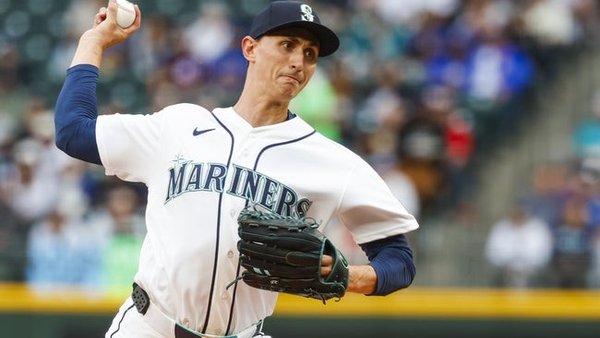
George Kirby’s sweeper and a 30.8% whiff rate on his changeup make a legitimate case against a Brewers lineup with real strikeout exposure — but Milwaukee’s +156 run differential against Seattle’s -43 is a 199-run gap that doesn’t disappear because Gasser’s ERA sits at 4.54. The price at -127 is threading a needle between starter quality and team-quality chasm, and one of those forces is being underweighted.
George Kirby vs. Robert Gasser: Seattle Mariners at Milwaukee Brewers Betting Preview
The series finale in Milwaukee features a genuine pitching mismatch that the market has already accounted for — Kirby is the better arm, and the price reflects it. But handicapping this game purely off the starter matchup misses the larger story: the Milwaukee Brewers (78-49) own the best record in baseball for a reason, and that reason isn’t Robert Gasser. It’s lineup depth, run prevention, and organizational quality that has produced a +156 run differential against Seattle’s -43. That’s a 199-run gap, and it doesn’t vanish because Gasser’s ERA sits at 4.54.
The market noise here is yesterday’s 7-5 Seattle win. Recency has a way of flattening perception, and bettors who watched the Mariners light up Milwaukee’s pitcher are inclined to trust that offense again today. But that seven-run effort came off Dustin May — Milwaukee’s starter who surrendered all seven runs in the first two innings — a deadline acquisition who had allowed just two combined runs in his two prior starts since being acquired from St. Louis. That was a bad individual outing from May, not a reliable indicator of Gasser’s vulnerability or Seattle’s sustained offensive ceiling against Milwaukee’s usual arms. Logan Gilbert was on the mound for Seattle that night; the game shape today is fundamentally different. Gasser takes the hill with real vulnerability, yes. But Milwaukee’s lineup, which crushed Seattle 22-0 two nights ago, is the class outfit in this series.
At -127, the Brewers are priced within what I’d call the juice ceiling for a team of their caliber facing a sub-.500 opponent. The question isn’t whether Milwaukee is better — they clearly are. The question is whether -127 is fair value given the starter edge Seattle carries today.
Game Info & Betting Lines
- Date/Time: Thursday, August 20, 2026 | 2:10 PM ET
- Venue: American Family Field (Park Factor: 1.00 — neutral run environment, domed)
- Probable Starters: George Kirby (SEA) vs. Robert Gasser (MIL)
- Moneyline: Seattle Mariners +119 / Milwaukee Brewers -127
- Run Line: Milwaukee Brewers -1.5 (+158) / Seattle Mariners +1.5 (-194)
- Total: 8.0 (Over -114 / Under -107)
Why This Number Is Close
The market is doing something reasonable here: it’s crediting Kirby as the superior starter (which he is) while still making Milwaukee a moderate favorite based on the team-quality gap. That tension produces -127, a number that’s neither dismissive of Seattle’s pitching advantage nor overreactive to the Brewers’ dominant overall record.
The legitimate case for Seattle at +119 is built almost entirely on Kirby. He’s a genuine run-suppressor who limits walks (31 BB in 136.2 IP) and keeps the ball in the yard at an acceptable clip. His sweeper sits at 87.3 mph with a 25.9% whiff rate and an xwOBA-against of .261 — that’s a legitimate weapon against a Milwaukee lineup that has real strikeout exposure (1,066 team K’s). Kirby’s 4-seam at 96.6 mph holds a .331 xwOBA against, which is hittable, but his ability to mix in the sinker at 96.9 mph (xwOBA .291) creates genuine two-plane difficulty. You can build a case that Kirby pitches six innings, holds Milwaukee to two or three runs, and +119 is free money.
But here’s the problem: the market is pricing this as if the game begins and ends with the starters. Milwaukee’s lineup — with Bauers (.450 xwOBA), Chourio (.423 xwOBA), and Turang (.410 xwOBA) — represents sustained quality-of-contact pressure that Kirby hasn’t entirely neutralized even in his better outings. And on the other side of the ledger, Gasser’s 4.54 ERA and 13 home runs allowed in 73.1 innings make him genuinely vulnerable, but Milwaukee’s offense doesn’t need Gasser to dominate — it just needs him to survive long enough for a lineup that scores 5.0 runs per game to take over. The market is slightly underweighting how much the team gap matters across nine full innings.
What Separates the Pitching
Kirby is the better pitcher in this game. That’s not debatable. His 3.89 ERA and 1.31 WHIP over 136.2 innings outpace Gasser’s 4.54 ERA and 1.24 WHIP over just 73.1 innings — and the underlying arsenal data reinforces the gap. Kirby’s changeup at 88.7 mph is his premier swing-and-miss weapon, carrying a 30.8% whiff rate and a 23.7% put-away rate. Worth noting, though: its xwOBA-against is .361, meaning when hitters do make contact, it can be hit. It generates chases and misses — not soft contact — so its value is in the swing-and-miss it creates, not in suppressing hard contact when the bat connects. His sweeper’s put-away rate of 20.2% gives him multiple ways to finish hitters, and when he’s operating with the sweeper low and away and the sinker in, he creates the kind of weak-contact ground ball innings that define quality starts.
Gasser’s profile is more concerning. His sinker at 92.4 mph carries an xwOBA-against of .365 — that’s a pitch getting hit hard — and his cutter (.372 xwOBA against) offers minimal suppression. His sweeper (xwOBA .272, whiff 27.9%) is his best weapon, but at 80.6 mph, it’s a significantly softer version of what Kirby brings. The velocity gap between these two arsenals is real: Gasser’s fastball family sits 3-4 mph below Kirby’s, which matters when Seattle’s dangerous bats — Arozarena (.385 xwOBA, .397 vs RHP), Julio Rodríguez (.414 xwOBA, .478 vs LHP), and Canzone (.420 xwOBA) — are all capable of doing damage against that sinker.
The key distinction is what type of innings each starter creates. Kirby generates soft contact and keeps Milwaukee in single-run frames. Gasser’s profile — 13 HR allowed in 73.1 IP, elevated xwOBA on his secondary pitches — creates multi-run inning risk that Milwaukee’s lineup is well-positioned to exploit.
The Bullpen Factor
Milwaukee is carrying six relievers on the injured list — Brian Fitzpatrick, Rob Zastryzny, Angel Zerpa, Joel Kuhnel, JoJo Romero, and Abner Uribe. That’s a real depletion, and it matters for game shape. If Gasser exits early, which his profile makes plausible, Milwaukee’s bridge options are thin. Seattle’s bullpen, while not elite, is in better available shape for tonight.
But here’s the context that keeps me on Milwaukee: after a seven-run first-inning eruption drained Milwaukee’s pen yesterday — combined with the 22-0 blowout Tuesday requiring minimal late-inning work — the shape of this bullpen situation is more complicated than the IL list suggests. The arms that matter most for tonight are the ones who didn’t throw yesterday, and Milwaukee’s best available relievers largely fit that description.
The Pushback
Before I land the pick, I want to be honest about two bets I looked at and walked away from. The Milwaukee -1.5 run line at +158 is genuinely tempting — +158 is a strong number and the Brewers’ run differential makes covering by 1.5 feel achievable on paper. But the numbers project a margin of roughly half a run between these clubs tonight, and Gasser’s short-start risk means there are real paths to a close Milwaukee win that doesn’t cover. The -1.5 demand adds too much variance for a spot where the edge is directional, not emphatic. I considered it and left it alone.
I also looked at the over at 8.0. There’s a case: Gasser’s home run rate, Milwaukee’s offensive depth, Seattle’s lineup capable of exploiting a depleted pen. But Kirby’s run-suppression quality and Milwaukee’s 3.46 team ERA create enough directional murkiness on the total that I couldn’t get comfortable taking the over without clearer conviction. The over is live — it’s not a bad bet — but it’s not where my edge sits tonight.
The Pick
Seattle’s team OPS sits at .687 — a below-average mark that ranks among the bottom third in baseball — and the Mariners’ lineup, outside of a few dangerous individual bats, doesn’t generate the sustained contact quality to reliably exploit a compromised Milwaukee pen across nine innings. The 199-run differential between these clubs doesn’t lie. Milwaukee is the significantly better team, Gasser’s vulnerability is real but not disqualifying with this offense behind him, and the bullpen depth advantage for Seattle is narrower than the IL list implies.
Bet: Milwaukee Brewers ML -127 | 2 units | Moderate confidence
The core thesis is simple: the talent gap between a 78-win club and a sub-.500 opponent doesn’t disappear because one pitcher is having a better season. Milwaukee’s run differential, offensive depth, and superior run prevention make them the right side at this price. Kirby keeps it close — that’s the risk — but close games at American Family Field tend to favor the team that scores more runs over 162 games, and that team is Milwaukee. Two units on the Brewers.