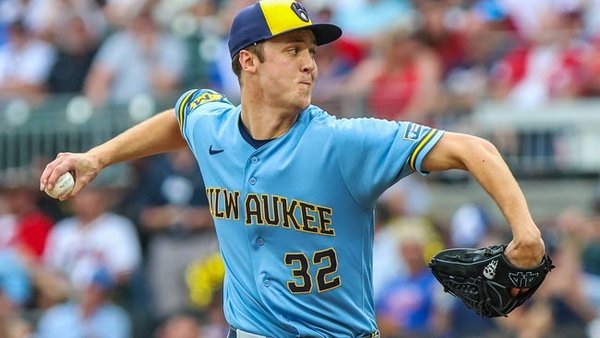
Chris Sale and Jacob Misiorowski represent two of the sharpest pitching profiles in baseball right now, and the dome at American Family Field strips away every weather variable that could inflate a run environment. The 6.0 total looks tight on the surface — but Misiorowski’s 0.75 WHIP and Sale’s 11.16 K/9 make a case that the number is actually achievable, not a trap, even with both bullpens operating shorthanded.
Chris Sale vs. Jacob Misiorowski: Atlanta Braves at Milwaukee Brewers Betting Preview
On paper, this looks like the kind of matchup that shuts bettors up: two of the best starters in baseball, a dome neutralizing weather, and a total so low it feels like the market already knows the outcome. The narrative writes itself — Chris Sale against Jacob Misiorowski, ace vs. ace, total set at 6.0, trust the pitching and collect. The market hasn’t overcorrected here. It has read the room correctly. What makes this interesting — and what creates the betting opportunity — is that the posted number actually undersells just how dominant these two starters are capable of being, and the case for staying under 6.0 is stronger than the bullpen noise suggests.
Atlanta arrives off a 2-0 win in Chicago where Grant Holmes nearly no-hit the White Sox — low-scoring, tight, efficient. Milwaukee just beat Seattle 7-4 after an earlier 22-0 demolition. Context matters: that 22-0 blowout came against a Mariners lineup getting carved up by a rested Brewers staff, and it is not a template for Friday. What is a template is the game shape you get when Misiorowski or Sale takes the mound — deep outings, limited traffic, games that stay in the 2-3 range per side until the starters exit. The 6.0 total is achievable. I’m betting it stays under.
Game Info & Betting Lines
- Date/Time: Friday, August 21, 2026 | 4:10 PM ET
- Venue: American Family Field (Dome) | Park Factor: 1.00 — neutral run environment
- TV: ESPN Unlimited, MLB.TV, BravesVision, Brewers.TV
- Probable Starters: Chris Sale (ATL) vs. Jacob Misiorowski (MIL)
- Moneyline: Atlanta Braves +131 / Milwaukee Brewers -141
- Run Line: Milwaukee Brewers -1.5 (+162) / Atlanta Braves +1.5 (-198)
- Total: 6.0 (Over -108 / Under -111)
Why This Number Is Fair — And Why the Under Still Has Edge
The market’s logic for setting 6.0 is not just defensible — it’s grounded. You have two starters with sub-2.20 ERAs, one of whom (Misiorowski) is running a 0.75 WHIP that belongs in a different sport. The market is essentially saying both starters dominate for six-plus innings and the game stays in the 2-3 range per side. That’s not an optimistic scenario — it’s the base case when you look at what these two are actually doing on the mound.
The tension, the thing that keeps me honest about the under, is the bullpen situation behind both starters. Milwaukee’s relief corps is operating with significant attrition: Brian Fitzpatrick, Rob Zastryzny, Angel Zerpa, Joel Kuhnel, JoJo Romero, and Abner Uribe are all sidelined. That’s not a depth chart, that’s a lottery. Atlanta’s pen is also compromised — Robert Suarez and Reynaldo Lopez are both on IL. If either starter exits earlier than expected, what follows is a crapshoot. That’s the genuine risk to the under, and I won’t pretend it isn’t real.
But here’s why I’m still backing the under: the path to 6.0 being beaten runs almost exclusively through early starter exits. If Sale goes six and Misiorowski goes six or seven — which is their documented pattern — both depleted bullpens are inheriting a manageable game in the fifth or sixth inning, not a three-run deficit that forces them to throw everyone. The under wins when the starters do their job. And right now, these two starters are doing their jobs better than almost anyone in baseball.
What Separates the Pitching
These are unquestionably two of the best starters in baseball right now, but they’re not equal, and understanding the gap matters for how this game scores.
Misiorowski is in a different tier of suppression. His four-seam fastball sits at 100.5 mph and generates a 36.9% whiff rate with an xwOBA-against of just .222 — he throws it 62.5% of the time and hitters can’t catch up to it. His curveball at 87.6 mph produces a 41.9% whiff rate and an xwOBA of .156, which is borderline unhittable. His 1.75 ERA and 0.75 WHIP over 139 innings aren’t a small-sample artifact — they’re backed by elite Statcast suppression across his entire arsenal. Atlanta’s top of the order has real questions against him: Olson is 0-for-3 in limited BvP exposure, and Baldwin is 0-for-3 with two strikeouts against him. That said, Olson’s season xwOBA sits at .455 with a 7.5% barrel rate — he’s the one Brave with the profile to change a game in a single swing, and that’s the legitimate threat to any under ticket.
Sale is excellent but operates differently. His slider at 79.4 mph generates a 36.1% whiff rate with an xwOBA of .226 — it’s his out pitch, and he leans on it alongside a 95.9 mph four-seamer at 41.1% usage. His 2.16 ERA and 11.16 K/9 over 129 innings are legitimate. Sale has allowed 8 home runs in that sample, and Milwaukee’s lineup presents real challenges: Jake Bauers (.891 OPS, .450 xwOBA, 8.6% barrel rate) has a .474 xwOBA against right-handed pitching specifically. Jackson Chourio is 5-for-12 in BvP exposure against Sale with a .437 xwOBA vs. left-handers. Sale limits walks — only 28 in 129 innings — which is actually a feature, not a bug, for the under: no free passes, no baserunner accumulation, fewer situations for Milwaukee’s lineup to do damage in bunches.
The gap favors Milwaukee in the starter matchup. But both pitchers create innings where a single mistake — one elevated fastball to Olson, one hanging slider to Bauers — resets the scoring picture quickly. That’s the nature of elite matchups: low floors, but non-zero variance. The under absorbs that variance as long as the starters are on the mound.
The Pushback
The strongest case against the under isn’t the bullpen fragility — it’s the raw offensive capability on both rosters. Atlanta is carrying a .723 team OPS with 167 home runs on the season. Milwaukee at .734 OPS with 535 team walks is built to grind out baserunners and manufacture runs even without big power numbers. These lineups don’t go quietly.
Atlanta’s recent RISP struggles are real friction: the Braves are 8-for-43 with runners in scoring position over their last six games, and their team OBP sits at just .310 — the lowest of the two sides. That actually supports the under argument. A team that isn’t converting opportunities even when they generate them is less dangerous in a tight game than the raw slugging numbers suggest. Milwaukee’s .337 OBP is better, but they’ve also just played through three games of significant run variance — a 22-0 blowout followed by a 7-5 loss followed by a 7-4 win — which tells you more about opponent quality and starter performance than any stable offensive baseline.
There’s also the dome factor working both ways. No wind, no weather, neutral park factor at 1.00 — it removes the random run-environment boost you sometimes get in hitter-friendly parks. This game will be decided by pitching quality and lineup execution, not environment. That’s exactly the scenario where trusting two elite starters to control innings makes sense.
Run Environment & Game Shape
The blueprint for this game: Misiorowski goes six or seven innings, generates 8-10 whiffs off that 100.5 mph fastball and that .156 xwOBA curveball, and hands a 1-2 run lead to Milwaukee’s patchwork bullpen. Sale goes six, leans on the 36.1% whiff slider, limits the walk totals that Milwaukee’s lineup is built to generate, and gives Atlanta’s depleted relief corps a workable game to protect. Both teams score somewhere in the 1-3 run range. The combined total lands at five or six.
The scenario where this blows past 6.0 requires at least one of the following: an early starter exit before the fifth inning, a multi-run home run sequence in the middle innings, or a bullpen implosion that turns a manageable deficit into a crooked number. All of those are possible. None of them are likely in the first three to four innings when the elite starters are operating at full throttle in a dome with neutral conditions.
Even a modest underperformance from the relief corps — a two-run inning in the seventh, a blown lead in the eighth — doesn’t automatically push this over 6.0 if both starters have kept the game in a 1-2 range through six. The under doesn’t need a perfect game. It needs what these two starters have been delivering all season: efficiency, strikeouts, and limited damage. At -111, I’m comfortable paying the slight juice to trust the two best starters I’ve seen go head-to-head in weeks.
The pick: Under 6.0 (-111) — 3 units, strong confidence. Misiorowski’s 1.75 ERA and 0.75 WHIP, Sale’s 2.16 ERA and 160 strikeouts — the posted number is fair, and the under cashes when elite pitchers pitch like elite pitchers. I’ll back the arms over the attrition.