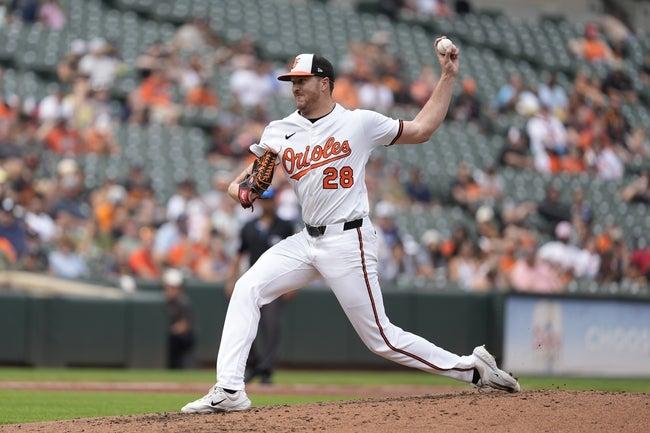
Peralta’s 53 walks in 128 innings and a .341 xwOBA against his four-seamer make him the volatility variable in a game where Baltimore’s lineup has dropped five combined runs in three games against New York. The total sits at 8.5, but neither offense is operating anywhere near its seasonal baseline — and Camden Yards offers no park-factor boost to push it over.
Freddy Peralta vs Trevor Rogers: Tampa Bay Rays at Baltimore Orioles Betting Preview
Both offenses arrive cold. Tampa Bay just finished a 2-5 homestand — and their most recent game produced exactly one run. Baltimore got swept by the Yankees, going 0-3 in that series and scoring a combined five runs across three games. The market has set the total at 8.5 with slight juice toward the Under at -117, and based on what’s actually happening at the plate right now, the pricing feels like it’s still anchored to season averages that neither team is matching.
The pitching gap matters here, but not in the obvious direction. Trevor Rogers is the quieter story — a legitimately solid arm that doesn’t dominate statistically but controls damage. Freddy Peralta is the volatility variable, the kind of starter who can either blow the total open single-handedly or give you five decent innings while his team’s offense goes nowhere. The Under thesis doesn’t depend on Peralta being good. It depends on Baltimore’s lineup being what it’s been: one of the weaker offensive units in this data set against a Tampa Bay staff that’s posted a 3.86 ERA on the season.
This is a Rogers-carries-the-Under bet with Tampa Bay’s recent offensive cold stretch as the supporting structure. The Rays’ lineup has real threats, but those threats have been dormant — and Camden Yards isn’t doing them any favors.
Game Info & Betting Lines
- Date/Time: Friday, August 21, 2026 | 7:15 PM ET
- Venue: Oriole Park at Camden Yards | Park Factor: 1.01 (essentially neutral)
- TV: Apple TV
- Probable Starters: Freddy Peralta (TB) vs Trevor Rogers (BAL)
- Moneyline: Tampa Bay Rays +109 / Baltimore Orioles -131
- Run Line: Baltimore Orioles -1.5 (+159) / Tampa Bay Rays +1.5 (-194)
- Total: 8.5 (Over -103 / Under -117)
Why This Number Is Close
The market has priced this at 8.5 for good reason. Both starters have ERA numbers that land in a range where run-scoring is expected — Peralta’s 5.27 ERA practically begs for a higher total, and Rogers’ 4.15 ERA is respectable but not shutdown-caliber. Season-long team averages are serviceable on both sides: Baltimore scores 4.48 runs per game, Tampa Bay 4.56. Add those up and you get a projected game right around 9 runs — which lands comfortably over 8.5.
That’s the legitimate case for the Over. Peralta is a liability who has allowed 20 home runs in 128 innings, and Baltimore’s lineup — despite a weak team average — has six hitters with xwOBA north of .350. The market is saying: one bad Peralta inning, one or two Rogers mistakes, and you’re at 9 runs easily.
But here’s where the number starts to slip. Neither offense is operating at its seasonal baseline right now. Tampa Bay has been held to a combined one run in their most recent game and went just 2-5 on their last homestand. Baltimore just dropped three to New York while scoring five total. The park is neutral at 1.01 — no wind-aided Coors multiplier here. And the projection of 9.3 combined runs is only 0.8 runs over the total — that’s not a ringing endorsement of the Over; it’s barely over the line.
When the projection is that tight and both offenses are trending cold, the market’s slight shade toward the Under at -117 is the direction I trust.
What Separates the Pitching
The gap between these two starters isn’t as wide as the ERA difference suggests, but it exists — and it runs in a specific direction. Trevor Rogers is the more reliable run-suppressor in this environment. His four-seamer sits at 93.6 mph and generates a .330 xwOBA against, which is respectable but not overpowering. The weapon that matters more is his sweeper: 13.0% usage, .218 xwOBA against, 30.1% whiff rate — a true put-away pitch that he can deploy against right-handed hitters. His sinker adds ground-ball potential at 93.2 mph. The stat that defines his profile more than ERA is his 13 home runs allowed in 125.2 innings — that’s exceptional contact suppression, particularly against a Rays lineup that has real power threats when healthy.
Freddy Peralta is a different animal. His four-seamer leads usage at 53.2% and sits 94.1 mph — fine velocity, but the pitch generates a .341 xwOBA and only a 19.2% whiff rate. The concerning number is his slider: 5.3% usage but a .449 xwOBA against — hitters are teeing off on it when he goes there. His changeup (.287 xwOBA, 25.8% whiff) is his best weapon, and his curveball (34.2% whiff) gives him a second breaking option. But his overall command profile is shaky — 53 walks in 128 innings is a meaningful gap over Rogers’ 35 in a comparable workload. Free baserunners against Baltimore’s xwOBA threats like Pete Alonso (.482 xwOBA) and Christian Encarnacion-Strand (.468 overall xwOBA) are combustion waiting to happen.
Worth noting on Encarnacion-Strand: she’s a right-handed hitter facing a right-handed pitcher in Peralta, and her vsRHP xwOBA sits at just .361 — far less threatening than her overall number implies. She’s also working from only 89 at-bats this season, so any splits carry significant noise. The power concern in this lineup against Peralta is really concentrated at Alonso (.492 vsRHP xwOBA) and Samuel Basallo (.458 vsRHP xwOBA) — not Encarnacion-Strand.
The type of innings each creates is different. Rogers produces weaker contact and fewer runners — his game shapes toward low-leverage outs. Peralta creates jams: walks, loud contact, sequences that force his bullpen early. In a low-total environment, that asymmetry between the two starters is real, but it cuts both ways — Peralta’s volatility is already baked into the 8.5 line.
Baltimore’s Offensive Structure
The Orioles’ team batting line tells the story before you even look at individual matchups: .235 AVG, -36 run differential, 1,182 strikeouts on the season. That’s a roster built around power upside with significant contact risk, and it shows up in the names. Coby Mayo is striking out at a 31.2% clip with a .211 average. Gunnar Henderson — supposed to be the engine of this offense — is hitting .221 with a .703 OPS. Samuel Basallo carries a 26.0% K-rate. This isn’t a lineup that manufactures runs in volume against average pitching; it’s a lineup that waits for the ball to travel and strikes out when it doesn’t.
Rogers’ sweeper is particularly well-suited to exploit this profile. Right-handed hitters chasing a breaking ball with a .218 xwOBA against and 30.1% whiff rate is exactly the sequence Baltimore’s high-strikeout bats are vulnerable to. And with Ryan Mountcastle already sidelined on the 60-day IL with an oblique injury, there’s no margin for error in the middle of this order.
Tampa Bay’s Cold Stretch
The Rays went 2-5 on their last homestand and just got throttled 5-1 by Toronto — Shane Bieber retired the first nine batters and Tampa Bay’s lone run came on a fluke infield chopper. The Rays are 5-5 over their last 10. Junior Caminero (.412 xwOBA, 35 HR) is the legitimate threat in this lineup, and Yandy Díaz (.386 xwOBA) has history against Rogers — 14 plate appearances, .538 average in that sample. Those are the two names Rogers has to navigate carefully.
But the rest of the order facing Rogers is a problem for Tampa Bay. Chandler Simpson has a .268 xwOBA against right-handers and has generated exactly zero barrels on the season. Cedric Mullins carries a .297 vsRHP xwOBA. Rogers’ sweeper and sinker combination is built to neutralize exactly this kind of lineup — moderate contact, no elite barrel threat outside of Caminero. Find Caminero and Díaz, limit everyone else, and Rogers keeps this game in the 4-5 run range for Tampa Bay.
Run Environment & Game Shape
Camden Yards carries a 1.01 park factor — essentially a coin flip on run environment. No dome, no short porch quirk inflating the number. The game’s shape is going to be determined almost entirely by pitching and recent offensive momentum, and on both fronts, the indicators point lower.
The projected total of 9.3 combined runs lands only 0.8 over the posted 8.5. That’s not a gap that supports aggressive Over action — it’s a projection that’s roughly in line with the market’s own estimate, with a slight lean that the numbers don’t back with conviction. When you layer in two teams trending well below their season averages offensively, a genuinely strong run-suppression profile from Rogers, and Peralta’s volatility already priced into the line, the market is projecting a tight, pitcher-controlled game — and the Under at -117 is the right side of that.
The Pick
The Rogers suppression argument is the backbone of this bet. His sweeper (.218 xwOBA, 30.1% whiff) is a genuine weapon against Baltimore’s high-strikeout lineup, and his contact suppression — only 13 HR allowed in 125.2 innings — gives him a realistic path to a clean 5-6 inning outing that keeps Baltimore in the 2-3 run range. Peralta’s command issues (53 BB in 128 IP) are real, but Baltimore’s structural offensive weakness — .235 team average, -36 run differential, K-rates north of 24% for multiple hitters — limits how much damage those free baserunners actually produce. And Tampa Bay just finished a homestand where they scored one run in their final game. The cold stretch is real on both sides.
You’re paying -117 for the Under versus -103 for the Over. That’s a price gap worth acknowledging — the market does shade slightly toward the Under here. I think it’s justified. The gap between 9.3 projected and 8.5 posted is narrow enough that any further offensive regression from either team — and both have shown regression in their last week — pushes this under the number. At Bovada, the Under 8.5 at -117 is the play.
Bet: Under 8.5 — 2 units at -117 (moderate confidence)