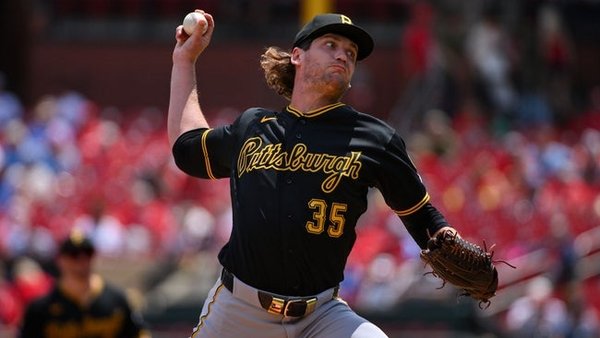
Braxton Ashcraft’s 11.07 K/9 walks into Petco Park against a Padres lineup posting a .707 OPS — yet the under at 7.5 is priced at only -117, a narrow premium for a structural case built on park suppression, elite whiff rates, and two offenses that have done little to threaten totals. Robbie Ray’s walk rate is the friction point, but stranding runners is different from surrendering crooked numbers in a pitcher-friendly environment.
Braxton Ashcraft vs Robbie Ray: Pittsburgh Pirates at San Diego Padres Betting Preview
The Pirates arrive in San Diego fresh off a two-game drop at Dodger Stadium, managing just seven combined runs against Tarik Skubal and Yoshinobu Yamamoto. The Padres, meanwhile, just swept Minnesota in convincing fashion, posting 21 runs across three games. On the surface, that momentum argues for offensive life from San Diego. But context matters: the Twins’ pitching isn’t what Petco Park and Braxton Ashcraft represent Monday night.
This isn’t a team-win piece. The market has both moneylines parked at near-even money — Pittsburgh at -109, San Diego at -111 — which tells you the sharp money sees a coin-flip game. When the outcome is that murky, you stop trying to pick a winner and start asking what kind of game this shapes into. The answer, given the park, the starters, and the offensive profiles involved, points toward fewer runs than 7.5.
San Diego’s offense sits at a .239 average and .707 OPS on the season, ranking among the weaker units in the NL. Pittsburgh carries a .738 OPS, modestly better, but is playing out a 63-69 season with limited lineup coherence. Neither club is manufacturing runs at a rate that should make you nervous about the over.
Game Info & Betting Lines
- Date/Time: Monday, August 24, 2026 — 9:40 PM ET
- Venue: Petco Park (Park Factor: 0.92 — pitcher-friendly)
- TV: MLB.TV, Padres.TV
- Probable Starters: Braxton Ashcraft (PIT) vs Robbie Ray (SD)
- Moneyline: Pittsburgh Pirates -109 / San Diego Padres -111
- Run Line: San Diego Padres +1.5 (-182) / Pittsburgh Pirates -1.5 (+150)
- Total: 7.5 (Over -103 / Under -117)
Why This Number Is Close
The market has done its homework here. A 7.5 total in a pitcher-friendly park with two above-average starters is not a number the books set carelessly. The case for the over is real: Robbie Ray’s walk rate — 58 BB in 149 IP, a 3.50 BB/9 — puts runners on base consistently, and Pittsburgh has legitimate power threats in Oneil Cruz (16 HR, .845 OPS), Brandon Lowe (27 HR), and Esmerlyn Valdez (14 HR, xwOBA .483) who can make you pay for that. If Ray has a two-walk inning and Cruz gets into one, the over gets very close very fast.
The concern on the under side is the juice. At -117, you are laying a modest price premium to back what the market already leans toward. That’s not a value bonanza — it’s a “math points here” situation, and you need to be honest about that. But here’s the problem for the over: the numbers project only 8.3 combined runs at a park that suppresses scoring below league average. That overhang is barely half a run above the posted number. That’s not the kind of buffer that makes the over an actionable bet. The lean is under, but it’s narrow, and the price reflects it.
What Separates the Pitching
The gap between these two arms isn’t dramatic, but it tilts toward a quieter game. Braxton Ashcraft is the more intriguing profile. His 11.07 K/9 is genuinely elite — strikeout pitchers limit baserunner accumulation and minimize the multi-run innings that blow totals open. His four-seam fastball sits at 96.8 mph with a 27.7% whiff rate and a .277 xwOBA against, and his changeup generates a 35.0% whiff rate with a .237 xwOBA. His sweeper (.223 xwOBA against) gives him a third weapon that keeps right-handed bats off balance. Against a Padres lineup that manages a .239 team average, those whiff rates matter. Fernando Tatis Jr. (xwOBA .433, hard-hit 36.5%) is the primary threat — he’s the one bat in this order who can damage Ashcraft’s sinker (.344 xwOBA) if it catches too much of the plate. Ashcraft has allowed 14 HR in 139 IP, so the power vulnerability is real, but his 3.95 ERA comes with a 1.14 WHIP that speaks to general control.
Robbie Ray operates differently. His 3.38 ERA and 1.17 WHIP over 149 IP reflect a volume starter who keeps games manageable without dominating hitters. His sweeper (.258 xwOBA, 26.6% whiff) and changeup (.293 xwOBA, 25.5% whiff) do work, but his sinker — used 29.0% of the time — carries a .390 xwOBA against, which is the soft underbelly of his arsenal. Pittsburgh’s Cruz (.533 xwOBA overall) and Valdez (.483 xwOBA, .484 vs LHP) match up well against that sinker. The walk rate is the real issue: 58 free passes in 149 IP is a consistent baserunner problem. But loading bases and scoring runs are different things, and in a park that deflates scoring, Ray’s ability to strand runners has kept his ERA in a reasonable range.
The head-to-head sample sizes are too small to carry weight — three plate appearances for most Padres hitters against Ashcraft. What the Statcast numbers do tell us is that Ashcraft’s strikeout ceiling is meaningfully higher than Ray’s, and that gap favors a lower-run game when Ashcraft is on.
The Pushback
The strongest argument against this ticket starts and ends with Robbie Ray’s walk rate. You cannot simply hand-wave 58 walks in 149 innings. That’s a starter who routinely creates traffic, and Pittsburgh’s power core can capitalize. Cruz’s .533 xwOBA and Valdez’s .483 xwOBA suggest two legitimate threats in the middle of the order. If Ray opens an inning with two walks and Cruz deposits a sinker into the left-field seats, we’re looking at a three-run frame before anyone blinks. The -117 juice means you need this to hit at roughly a 54% clip just to break even — and a Ray meltdown inning erases the edge in one sequence.
That said, Ray’s strand rate has been durable all season precisely because he pairs the walk problem with a changeup (.293 xwOBA) and sweeper (.258 xwOBA) that generate weak contact when he needs outs. The sinker is the liability, but he leans on it selectively against right-handed bats where it plays better. Pittsburgh’s lineup, batting .254 as a team with 1,247 strikeouts on the season, isn’t going to consistently punish him the way a top-five offense would. The traffic Ray creates is real — so is his ability to navigate it without surrendering crooked numbers.
The Lean
I’m landing on the under at -117 with two units. The price is not comfortable — I’ve said it twice now because it genuinely matters — but the structural case holds. Petco’s 0.92 park factor is a real suppressor. Ashcraft’s elite strikeout rate (11.07 K/9) limits the multi-run innings the over needs. San Diego’s .707 OPS and Pittsburgh’s offensive inconsistency point to a grind-it-out game rather than an offensive showcase. And 8.3 projected combined runs at a pitcher-friendly park leaves barely enough runway to clear 7.5 even in an above-average offensive performance from both sides.
This is a two-unit play, not a max-bet situation. The juice at -117 and Ray’s walk rate are real friction points that cap the confidence at moderate. But moderate edges in the right structural environment are exactly the spots worth pressing, and this game checks enough boxes to make the under the right side of the 7.5.
Bet: Under 7.5 (-117) — 2 Units