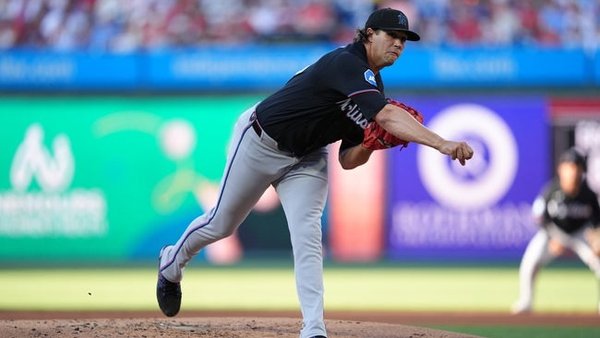
Payton Tolle’s 10.05 K/9 and a loanDepot park factor of 0.95 create a structural lean toward a low-scoring game — but the under at -105 versus the over at -115 is where the real friction lives. Both pitchers carry sub-3.70 ERAs, both offenses hover near .730 OPS, and Monday’s game in this same building ended at six total runs. The price gap tells you where the book sees exposure.
Payton Tolle vs Tyler Phillips: Boston Red Sox at Miami Marlins Betting Preview
After Monday night’s 4-2 Red Sox win in this same ballpark — a total of 6 runs, well under any reasonable expectation — we’re back at loanDepot park with two pitchers who profile more as run suppressors than run creators. The market has set the total at 7.5, and on paper, this feels about right. But “about right” isn’t where the bet lives — the bet lives in the 10-cent price gap between the over (-115) and the under (-105).
Payton Tolle is the story here. A 3.08 ERA, 1.08 WHIP, and 10.05 K/9 over 120 innings isn’t a hot streak or a small-sample illusion — that’s a legitimate top-of-rotation performance, sustained across a full workload. He’s pitching in a dome with a park factor of 0.95, against a Miami lineup that scores at a below-league-average clip. The pitcher-friendly environment amplifies what Tolle already does well.
Tyler Phillips carries a 3.67 ERA and a 3-6 record, a combination that signals he’s pitched better than his win total suggests. Neither the Red Sox nor the Marlins are run machines — both offenses carry similar OPS figures near .730, and both have been cold recently. The under at -105 isn’t a screaming edge, but in a game shaped like this one, you don’t need a screaming edge. You need the right side at the right price.
Game Info & Betting Lines
- Date/Time: Tuesday, August 25, 2026 | 6:40 PM ET
- Venue: loanDepot park (Domed, Park Factor: 0.95 — pitcher-friendly)
- Probable Starters: Payton Tolle (BOS, 8-6, 3.08 ERA) vs. Tyler Phillips (MIA, 3-6, 3.67 ERA)
- Moneyline: Boston Red Sox -161 / Miami Marlins +150
- Run Line: Boston Red Sox -1.5 (+104) / Miami Marlins +1.5 (-126)
- Total: 7.5 — Over -115 / Under -105
Why This Number Is Close
The market isn’t wrong to post 7.5 here. The numbers point to a combined 8.3 runs — just 0.8 above the posted total — which means the line is doing its job. Bookmakers have priced this as a modest, pitcher-controlled game, and the fundamentals support that read. Two starters with sub-3.70 ERAs, a dome that suppresses offense, and two lineups that rank among the league’s average-to-below-average run producers. This is exactly the type of game that should be set near 7.5.
The legitimate case for the over exists. Miami’s bullpen is shredded — Pete Fairbanks left Monday’s game with numbness and nerve irritation in his arm and is listed Day-To-Day (Hand) per the injury report, and Andrew Nardi, Anthony Bender, and William Kempner are all on the IL. A bullpen implosion in the late innings could push this over easily. That’s a real risk, not a throwaway concern.
But here’s where the market is slightly miscalibrated: the over costs -115 and the under costs -105. Both sides have roughly equivalent probability signals from the data, but you’re paying a meaningful premium to take the over. That 10-cent price difference, layered on top of a pitcher matchup that leans toward the under and a park that historically suppresses run scoring, is enough to create genuine positive expected value on the under at -105. The market is balancing risk on both sides, but it’s charging you more for the over in a game that should favor pitching.
What Separates the Pitching
The gap between these two arms is real, and it matters for the total even if it doesn’t necessarily swing the game’s outcome.
Payton Tolle operates with a four-seam fastball sitting at 96.2 mph that he throws 45.3% of the time and holds hitters to a .254 xwOBA against — a well above-average suppression rate for a primary pitch. His cutter at 88.6 mph generates a 27.1% whiff rate with a .244 xwOBA, and his curveball — thrown 9.5% of the time — posts a staggering 44.0% whiff rate and .148 xwOBA. That curveball is a legitimate put-away weapon that elevates his strikeout profile from good to elite. The 10.05 K/9 over 120 innings isn’t happening by accident — hitters are genuinely having trouble making contact.
Against Miami’s lineup, the matchup is more nuanced. Kyle Stowers carries a .442 xwOBA overall and a .479 xwOBA versus righties, making him Tolle’s most dangerous at-bat in the middle of the order. Griffin Conine’s .509 xwOBA is elite — he’s the kind of hitter who can turn one Tolle mistake into a multi-run swing. And Heriberto Hernández posts a .445 xwOBA overall with a 31.7% whiff rate that suggests he can be punched out but also carries real damage potential. Tolle won’t cruise through this lineup uncontested.
Tyler Phillips at 3.67 ERA doesn’t profile as a dominant arm, but his peripherals suggest he limits hard contact often enough to keep Boston’s projected total at 4.2 runs. Willson Contreras — with a .458 xwOBA and 26 home runs — is Phillips’ most dangerous matchup. Contreras’ .453 xwOBA versus righties means Phillips cannot afford to miss over the inner half with him. Wilyer Abreu (.424 xwOBA vs. RHP) also profiles as a threat. But Boston’s lineup drops off sharply beyond those two, and Phillips has demonstrated enough ability to work around damage in the middle innings.
The combined profile: Tolle suppresses at a higher rate and punches out more hitters; Phillips limits damage without dominating. Together, they create a pitching environment that, absent a major bullpen meltdown, keeps this game in the 7-8 run range more often than not.
Run Environment & Game Shape
loanDepot park’s dome eliminates weather as a variable entirely — no wind, no humidity swings, no late-August heat distortion. The 0.95 park factor means the building itself plays slightly pitcher-friendly, shaving roughly half a run off a neutral-site expectation. When you combine a suppressive park with two starters who both carry sub-3.70 ERAs and a pair of offenses hovering around .730 OPS, the structural lean is toward the under.
Monday’s game in this same park went 4-2 — six runs total. That’s one data point, not a trend, but it reinforces the environment. The Marlins were 2-for-18 with runners in scoring position that night. Boston’s four runs came primarily via a ninth-inning rally against a depleted bullpen. Neither team manufactured offense in a clean, sustained way. Tuesday figures to look similar: Tolle sets down Miami’s lineup at a high rate through five or six innings, Phillips navigates Contreras and Abreu without surrendering a crooked number, and the late innings determine whether this lands at six runs or nine.
The Fairbanks situation is the legitimate swing factor. If he can’t go, Miami’s bullpen management gets complicated in a hurry. But even accounting for that risk, the price on the under is too cheap to pass up. A compromised closer doesn’t automatically translate to a blowout — Boston’s offense has to actually capitalize, and this Red Sox lineup has shown it can strand runners as easily as it can score them.
I considered the Red Sox moneyline at -161 and passed — that juice exceeds my ceiling for a game with this much pitching uncertainty and a projection edge of just 0.1 runs in Boston’s favor. The run line at -1.5 (+104) offers insufficient margin given how close the projection sits. The total under at -105 is where the value concentrates: the right side, the right price, and a game structure that supports it.
The market expects something in the range of 7-9 combined runs — a reasonable window given the pitching and park context. But the under at -105 gives you a meaningful price advantage over the over, and the structural evidence from both starters’ arsenals and the offensive profiles on each side supports taking it. The play is Under 7.5 at -105, 2 units, moderate confidence.