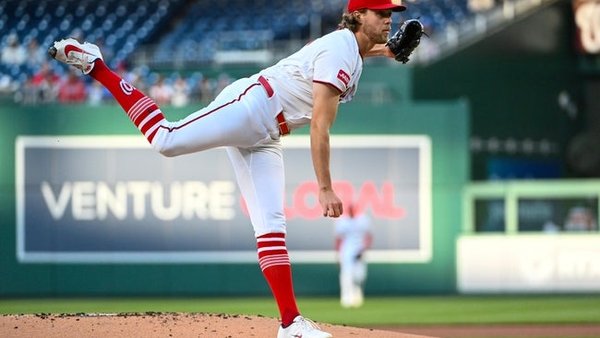
Gabriel Hughes carries a 6.54 ERA and no wins into a matchup the market is pricing at -119 — barely a lean toward the home side. The Nationals’ pitching depth holds a full run of separation over Colorado’s at the team level, and Irvin’s curveball-changeup combination gives Washington a legitimate strikeout path that Hughes simply cannot match. The number is close, but the starting pitcher gap is not.
Gabriel Hughes vs. Jake Irvin: Colorado Rockies at Washington Nationals Betting Preview
Yesterday’s 13-1 Colorado rout is loud. It’s the kind of result that makes you want to fade Washington hard and follow the momentum. But momentum in baseball lasts exactly one lineup turn, and the pitcher on the mound today for Colorado — Gabriel Hughes — is a different story than Tanner Gordon’s seven innings of one-run ball Wednesday night. Hughes is 0-5 with a 6.54 ERA in 42.2 innings this season. That’s not a narrative. That’s a track record of consistent damage.
Meanwhile, Jake Irvin takes the hill for Washington at a 5.82 ERA — hardly inspiring, but a full run better than Hughes. His 2-8 record is misleading in the worst way: Washington’s offense hasn’t supported him, not his execution. With a -119 price tag on the Nationals at home, the market is pricing this as a near coin-flip between two bad teams. The numbers say that understates the pitching gap by enough to make the price worth taking.
This isn’t a bet on Washington being good. It’s a bet on Washington being less bad in the right places, at a price that still offers value.
Game Info & Betting Lines
- Date/Time: Thursday, August 27, 2026 | 1:05 PM ET
- Venue: Nationals Park | Park Factor: 0.98 (slight pitcher’s lean)
- Probable Starters: Gabriel Hughes (COL) vs. Jake Irvin (WSH)
- Moneyline: Colorado Rockies +111 / Washington Nationals -119
- Run Line: Washington Nationals -1.5 (+159) / Colorado Rockies +1.5 (-194)
- Total: 9.5 (Over -106 / Under -114)
Why This Number Is Close But Slightly Off
The market is doing something reasonable here. It’s discounting Washington’s 2-8 run over the last 10 games, pricing in the recency of Colorado’s 13-1 blowout, and acknowledging that both these teams sit near the bottom of their respective divisions. The Rockies are 52-81; the Nationals are 62-73. Neither inspires confidence. At +111, Colorado isn’t being disrespected — the market sees a live dog.
But here’s where I think the line is slightly off: it treats yesterday’s result as signal when it’s mostly noise. Gordon threw a gem. Hughes has not thrown a gem all season. The Nationals carry a team ERA of 4.72 against Colorado’s 5.52 — a full run of separation in overall pitching depth that doesn’t evaporate because one Colorado starter had a career night. Washington’s lineup also holds a genuine edge: 186 home runs and a .753 OPS versus Colorado’s 151 HRs and .741 OPS, and their bats match up favorably against a right-handed starter with a 6.54 ERA.
The -119 price clears the juice ceiling comfortably for a one-unit lean. The market is balancing real concerns about Washington’s form against real structural advantages — and landing just a tick too close to even money given who’s starting for Colorado today.
What Separates the Pitching
The gap between Hughes and Irvin is real, and the Statcast data sharpens it beyond the ERA surface.
Hughes leans heavily on a four-seam fastball at 55% usage — sitting 92.3 mph with a 14.6% whiff rate and an xwOBA-against of .288. That’s a survivable pitch. The problem is his sweeper (7% usage) generates a .402 xwOBA-against, and his changeup (10.3%) is at .386 — two secondary offerings that Washington’s right-handed-heavy lineup can damage. His curveball and slider show better suppression (.199 and .205 xwOBA respectively), but those are roughly 20% combined usage. When Hughes needs outs against premium contact hitters, he doesn’t have a consistent out-pitch.
Irvin’s arsenal tells a different story in one key area: his curveball. At 22.9% usage, it generates a 36.9% whiff rate and a .230 xwOBA-against — a genuine swing-and-miss weapon at nearly a quarter of his pitches. His changeup (.192 xwOBA, 30.2% whiff) is equally dangerous in two-strike counts. Yes, his sinker (.478 xwOBA) and four-seamer (.387 xwOBA) get punished when hitters sit on them, but the secondary weapons give him a realistic path to generating strikeouts. His K/9 of 8.84 versus Hughes’ 7.38 reflects that difference concretely.
The matchup-level data reinforces Washington’s side. Andrew Pinckney sits at a .474 xwOBA overall with a .508 mark against right-handed pitching and a 9.1% barrel rate — Hughes’ sweeper and changeup are precisely the pitches that profile as danger zones. CJ Abrams carries a .417 xwOBA against right-handers this season. And Andrés Chaparro — who already went deep off Colorado pitching on Wednesday — carries a .424 xwOBA overall and a .391 mark specifically against right-handers like Hughes. That vsRHP split is the more relevant number here, and even at .391 it represents genuine hard-contact ability against the pitch mix Hughes is working with. He doesn’t have the put-away stuff to navigate that middle of the order cleanly through multiple times.
The Pushback
Colorado just demolished Washington 13-1. That’s not nothing, and dismissing it entirely would be intellectually dishonest. The Rockies’ lineup — specifically Hunter Goodman (.465 xwOBA, 36 HRs), Jake McCarthy (.294 AVG), and Connor Norby, who’s now riding an 11-game hit streak and five RBI last night — is capable of doing real damage. Goodman’s .455 xwOBA against right-handers means Irvin can’t just pound him with fastballs and expect weak contact. And Irvin’s sinker, sitting at a .478 xwOBA-against, is a pitch that can backfire badly if Colorado’s hitters get into counts where they can sit on it.
The bigger structural concern is Washington’s recent form. A 2-8 stretch over the last 10 games isn’t just a cold streak — it suggests something is broken in the lineup’s ability to produce consistently, even against inferior pitching. Colorado has won two of the first three games in this series. The Rockies are playing with more confidence right now, even if their overall record is worse.
I’m not ignoring those flags. They’re why this is a lean at one unit and not a hammer.
Park, Run Environment, and the Total
Nationals Park plays at a 0.98 park factor — a slight suppressor of runs in a game where the total is already set at 9.5. The projected run environment is high enough that both pitchers’ vulnerabilities will likely show up, but the slight pitcher’s lean at this venue nudges the advantage further toward the starter with the better secondary arsenal. Irvin’s curveball and changeup play well in a park that doesn’t juice fly-ball damage the way Coors does.
On the total: with both starters carrying ERAs north of 5.50 and bullpens that have been taxed, the over looks tempting. But I’m not chasing a secondary market when the primary edge is on the moneyline. The run line at +159 for Washington -1.5 is interesting given the home edge, but the juice on Colorado +1.5 at -194 tells you the market doesn’t see a blowout repeat — in either direction. The moneyline is the clean play.
The Bet
Washington is a bad team having a bad stretch against a slightly worse team with a significantly worse starting pitcher today. The -119 price accounts for the noise from Wednesday’s blowout without fully accounting for the structural pitching gap between Hughes and Irvin. At a park factor that leans neutral-to-pitcher-friendly, with Washington’s lineup featuring legitimate hard-contact threats against a starter who lacks an out-pitch, the Nationals clear the value threshold at this number.
One unit. Lean. Eyes open on Goodman and the sinker.
Bet: Washington Nationals Moneyline (-119) — 1 unit
If you’re looking for more MLB picks and betting analysis, check out our latest breakdowns covering today’s full slate of games.