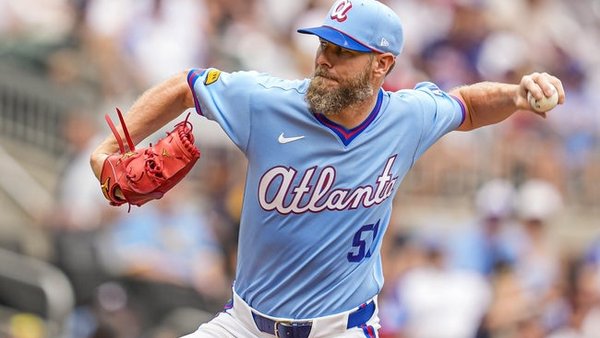
Two sub-2.70 ERA starters take the mound at a neutral Truist Park, yet the under is still available at positive money. Sale’s 11.07 K/9 and Yamamoto’s 0.90 WHIP point toward a game where innings stay short and traffic stays light — the total at 6.5 hasn’t fully accounted for what happens when this caliber of arm actually takes the ball.
Yoshinobu Yamamoto vs Chris Sale: Los Angeles Dodgers at Atlanta Braves Betting Preview
The first two games of this series featured AJ Smith-Shawver and a returning Tyler Glasnow on the mound — not exactly the top of anyone’s rotation. The results reflected that: a 4-3 Braves win Tuesday, a 6-5 Braves walk-off Wednesday. Back-and-forth affairs with bullpen exposure on both sides. Thursday changes everything.
When Yoshinobu Yamamoto and Chris Sale are the starters, this becomes a structurally different game. The market has set the total at 6.5, and the under is priced at +104 — positive money on a pitching duel that features two of the better starters in the National League. That price inefficiency is the entry point.
Two sub-2.70 ERA starters, a neutral park factor of 1.01, and positive juice on the under. The structural case for low run scoring is sound. The question is whether the bullpen situations on both sides erase it — and that’s where the real handicapping begins.
Game Info & Betting Lines
- Date/Time: Thursday, August 27, 2026 | 7:15 PM ET
- Venue: Truist Park | Park Factor: 1.01 (essentially neutral)
- TV: MLB.TV, FS1, SportsNet LA, BravesVision
- Probable Starters: Yoshinobu Yamamoto (LAD) vs Chris Sale (ATL)
- Moneyline: Los Angeles Dodgers -105 / Atlanta Braves -114
- Run Line: Atlanta Braves +1.5 (-213) / Los Angeles Dodgers -1.5 (+174)
- Total: 6.5 (Over -125 / Under +104)
Why This Number Is Close — But Still Beatable
The market hasn’t missed this matchup. A 6.5 total with Sale and Yamamoto on the hill is a sharp number — the books have done their homework. The over is priced at -125, which tells you they’re accounting for bullpen vulnerability and the natural variance of mid-season breakdowns. The under, priced at +104, is where they’ve left a fraction of value on the table.
Here’s where the market is slightly wrong: it’s weighting the bullpen uncertainty more heavily than the starter quality warrants. Both Yamamoto (151.2 IP) and Sale (135.0 IP) have demonstrated the durability to absorb six to seven innings, reducing meaningful high-leverage bullpen exposure. The book is pricing in a scenario where both starters exit early. That scenario is less likely with these two than with the Smith-Shawvers and Glasnows of the world.
The case for the over is real: Matt Olson has 37 home runs and Shohei Ohtani sits at 30 — one swing changes the game shape entirely. Depleted bullpens on both sides create late-inning run-scoring windows. The over at -125 is a legitimate play. But paying -125 juice on a game with two elite starters is a structural disadvantage. Getting +104 on the under is getting paid to trust the arms — and I’ll take that price every time the talent supports it.
What Separates the Pitching
The gap between these two starters and the rest of baseball is what makes this total compelling — and it’s worth being precise about where each pitcher creates a different kind of inning.
Chris Sale is the strikeout engine. His 11.07 K/9 leads this matchup by a significant margin, and the Statcast arsenal reveals why: his slider runs at a 39.3% usage rate, sitting 79.4 mph with a 36.1% whiff rate and an xwOBA-against of just .225. He pairs it with a 95.9 mph four-seamer that generates a 22.8% whiff rate. For a Dodgers lineup that has posted a .762 OPS on the season, Sale’s whiff-heavy profile is a direct suppressor. Max Muncy (xwOBA .430, barrel 7.1%) has gone 0-for-5 with 4 strikeouts in limited career exposure to Sale — that’s the kind of BvP sample that reinforces what the arsenal data already suggests. Sale has allowed only 8 home runs in 135 innings, making him a poor target for a Dodgers team that relies on the long ball.
Yoshinobu Yamamoto attacks differently. His split-finger is the most dangerous weapon in his arsenal — 26.9% usage, 91.4 mph, generating a 31.2% whiff rate and holding hitters to an xwOBA of just .211. His four-seamer sits at 96.0 mph and adds another dimension. What makes Yamamoto elite isn’t pure swing-and-miss — it’s his extraordinary command. 35 walks in 151.2 innings (a 0.90 WHIP) means he’s not giving the Braves lineup a runway. Matt Olson (xwOBA .450) is 0-for-4 with a strikeout in limited BvP against Yamamoto. Even Michael Harris II, who hits right-handers at a .443 xwOBA clip, has gone 1-for-4 with no extra bases against Yamamoto’s arsenal.
The combined effect: Sale creates short, punch-out innings against a Dodgers lineup that can generate power but will chase his slider. Yamamoto creates weak contact and grounders against a Braves lineup built for run-scoring. Neither pitcher creates the kind of high-traffic innings that inflate totals.
The Pushback
The concern is straightforward: both bullpens are genuinely compromised. The Dodgers are missing Edwin Diaz, Blake Treinen, and Will Klein — that’s real late-inning exposure. The Braves have Robert Suarez and Reynaldo Lopez on the IL. After two high-leverage series games where both bullpens were pressed for multiple innings, the relief corps on both sides are running thin entering Thursday.
The individual threats are equally real. Shohei Ohtani’s xwOBA sits at .506 — he’s the most dangerous hitter in baseball right now, and his .519 xwOBA against right-handers means Sale’s four-seamer will be tested. Ohtani is 2-for-9 in limited career BvP against Sale with 2 strikeouts — manageable, but not dismissible. Olson’s 37 home runs against Yamamoto’s left-handed profile is also a genuine variable. One Olson laser or one Ohtani no-doubter doesn’t just score a run — it reframes the entire game.
I’ll also be honest about where the numbers point: the combined run projections — Braves 4.5, Dodgers 4.3 — actually clear the 6.5 total, which is a legitimate tension point. That figure reflects real offensive quality from both lineups and accounts for bullpen exposure. The structural Under thesis doesn’t live in aggregate run-scoring projections; it lives in the ERA, the K rates, the whiff data, and the command profile of two starters who consistently outperform what lineup quality alone would suggest. Sale’s 2.20 ERA and Yamamoto’s 2.61 ERA aren’t flukes — they’re the product of arsenal depth that batted-ball models can underweight when quantifying true run prevention. That’s the friction I’m comfortable living with.
Run Environment & Game Shape
Truist Park’s 1.01 park factor is as close to neutral as it gets — no wind tunnel, no Crawford Boxes, no quirks that juice run scoring in either direction. The environment itself doesn’t tip the scale.
Both teams have the offensive capability to produce runs in bunches — the Dodgers rank among the league’s best with 168 home runs and a .762 OPS, and the Braves have matched that power with 170 home runs of their own. But both teams have also faced elite starting pitching before, and both lineups carry enough strikeout vulnerability to be contained. The Dodgers have fanned 1,043 times on the season; the Braves, 1,077. Against two starters generating whiff rates north of 30% on their primary out-pitches, those numbers matter.
The game shape I’m expecting: Sale punches out six or seven Dodgers through five to six innings, keeping Los Angeles off the board or limiting them to a single run. Yamamoto works efficiently with his splitter and command, holding Atlanta’s lineup to isolated threats rather than sustained traffic. Both starters exit with the game in the 2-1 or 3-2 range. The late innings are where it gets dicey — but with both offenses already worn down from two consecutive one-run games and depleted bullpens that have been leaned on heavily, I’m not expecting a late-game eruption. I’m expecting a pitcher’s finish to a pitcher’s game.
The Pick
Two elite starters. A neutral park. Positive juice on the under. The bullpen risk is real, the power threats are real, and the numbers lean over in aggregate — but this bet isn’t about aggregate. It’s about trusting Sale’s 2.20 ERA and Yamamoto’s 0.90 WHIP to do what elite starters do: keep the game low and make the market pay for undervaluing them.
The under at +104 is a bet that these two arms are better than a 6.5 ceiling implies. I think they are.
Bet: Under 6.5 (+104) — 2 units — Moderate confidence.