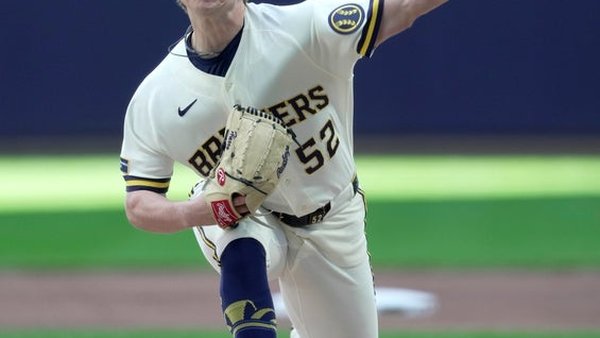
Kyle Harrison’s 11.06 K/9 and 2.79 ERA across 103.1 innings sit across from a sinker-heavy Holmes profile surrendering a .367 xwOBA on his primary pitch — yet the Brewers, the better team by record, run differential, and starter quality, are still available at even money. The number is treating this like a coin flip the pitching profiles do not support.
Kyle Harrison vs. Clay Holmes: Milwaukee Brewers at Chicago Cubs Betting Preview
The Cubs come into this series opener at -108, a modest favorite on their home field against a Brewers team that has a better record, a better run differential, and — most critically — a better starting pitcher on the mound tonight. The market noise here is understandable: Wrigley Field carries a slight hitter-friendly tilt, the Cubs have genuine power in their lineup, and Clay Holmes’ 2.26 ERA reads like an elite number. But the line is doing something the underlying data doesn’t support — it’s pricing Chicago as the preferred side in a game where Milwaukee has the pitching edge, the form edge, and the value edge simultaneously.
The Brewers arrive having lost Sunday to Texas but following a four-game winning streak before that. They’re 7-3 over their last 10. The Cubs, fresh off a wild series against Cincinnati that included a 17-5 blowout win sandwiched around two losses, are just 3-7 in their last 10. The form gap is real. Add in Milwaukee’s +177 run differential against Chicago’s +127, and the picture of which club is actually better becomes clearer.
The thesis is straightforward: better team, better starter, plus money. That’s the argument.
Game Info & Betting Lines
- Date/Time: Monday, August 31, 2026 | 7:40 PM ET
- Venue: Wrigley Field | Park Factor: 1.02 (slight hitter-friendly)
- TV: MLB.TV, Marquee Sports Net, Brewers.TV
- Probable Starters: Kyle Harrison (MIL) vs. Clay Holmes (CHC)
- Moneyline: Milwaukee Brewers +100 / Chicago Cubs -108
- Run Line: Milwaukee Brewers -1.5 (+149) / Chicago Cubs +1.5 (-181)
- Total: 9.5 (Over -107 / Under -113)
Why This Number Is Off
There’s a legitimate reason the Cubs are favored. Holmes’ 2.26 ERA across 75.2 innings is genuinely impressive. The market isn’t asleep — it sees a pitcher who manages contact efficiently, limits walks (25 on the season), and has allowed only 4 home runs. Wrigley’s 1.02 park factor is negligible, but it’s a tick in Chicago’s direction. Home field adds something, even if it’s only about 0.3 runs in MLB. The Cubs also feature Pete Crow-Armstrong, who is in the middle of an MVP-caliber season, and a lineup that has slugged 187 home runs — 61 more than Milwaukee’s 126.
But here’s the problem: the market is pricing this based on Holmes’ surface ERA while underweighting what Harrison brings to the mound. A 10-3 record and 2.79 ERA across 103.1 innings — nearly 28 more than Holmes has thrown — reflects sustained dominance, not a hot stretch. The Brewers are also the clearly superior team by every aggregate measure, yet they’re getting plus money. When the better team with the better starter is available at even money, that’s where value lives. The market has set this line to attract Chicago action. I’d rather be on the other side of that.
What Separates the Pitching
The gap between these two starters is wider than the ERA difference suggests, and the Statcast data makes it explicit. Harrison’s four-seam fastball sits at 94.8 mph and generates a 27.0% whiff rate, holding opposing hitters to a .292 xwOBA. His slurve — thrown 30.0% of the time at 82.1 mph — is his true swing-and-miss weapon, producing a 30.5% whiff rate and a microscopic .222 xwOBA against. That two-pitch combination gives Harrison a legitimate put-away arsenal. His 11.06 K/9 isn’t a fluke — it’s the natural result of throwing pitches hitters simply cannot make consistent contact with.
Holmes operates from an entirely different profile. His approach is built on his sinker, which he throws nearly 50% of the time at 93.4 mph. The problem: that sinker generates only a 9.7% whiff rate and holds a .367 xwOBA against. His best swing-and-miss pitch is his cutter at 32.8% whiff rate, but he throws it only 10.1% of the time. Holmes’ 6.54 K/9 is not a pitch-to-contact philosophy that neutralizes elite lineups — it’s a contact-management approach that works until it doesn’t. Against Milwaukee’s top of the order — Bauers (.452 xwOBA), Mitchell (.466 xwOBA, .483 vs. right-handers), and Chourio (.421 xwOBA) — a sinker-heavy profile invites hard contact from hitters with real barrel rates and quality of contact metrics.
The gap is most visible in innings-shaping. Harrison creates strikeout innings — fewer baserunners, less sequencing risk, more ability to get through six or seven cleanly. Holmes creates contact innings. Against a depleted Cubs bullpen, Harrison’s ability to go deep into games is a meaningful secondary advantage tonight.
The Pushback
The strongest case against this play starts with Holmes’ WHIP. At 1.06, it’s actually better than Harrison’s 1.12 — a reminder that Holmes is keeping runners off the bases even if his strikeout rate lags. That matters in a park that plays even slightly hitter-friendly. The Cubs’ bullpen depth is also a legitimate concern: with Porter Hodge, Ben Brown, Riley Martin, Hunter Harvey, and Phil Maton all on the IL, Chicago’s relief corps is running thin, and a short Holmes outing could expose that vulnerability in ways that work against a clean Milwaukee win.
Then there’s Crow-Armstrong. He’s not just having a good season — he’s having an MVP-caliber one, with 38 home runs, a .954 OPS, and an xwOBA of .452 that matches Jake Bauers as the best mark on either roster. He’s also been scorching lately: four home runs in his last seven at-bats entering this game. The BvP numbers against Harrison show 0-for-5 with four strikeouts in five plate appearances, but five PA is not a meaningful sample — it’s noise, not signal. A hitter this dangerous has to be accounted for regardless of any thin matchup history.
Chicago also has a real power advantage at the lineup level. Their 187 team home runs against Milwaukee’s 126 is a 61-homer gap. Their team OPS of .767 beats Milwaukee’s .735. In a game where the run total is posted at 9.5, there are enough offensive ingredients on Chicago’s side to make this genuinely competitive. I’m not dismissing those factors. I’m just saying that at +100, Milwaukee’s advantages in pitching, form, and overall team quality more than offset them.
Run Line and Total: Why I’m Staying on the Moneyline
The run line at -1.5 (+149) is tempting on paper. But the numbers project Milwaukee winning by roughly 0.2 runs — a margin so thin that it makes no sense to take on the extra half-run of risk for the plus money. Win probability is one thing; winning by two or more is a different ask entirely in a game this close. I’ll take the cleaner line.
On the total, the posted 9.5 sits just above where the run environment math lands when you factor in both starters and the park. That 0.2-run gap between the posted number and what the situation suggests doesn’t give me enough to act on either side. Pass.
The Play
Milwaukee is the better team, Harrison is the better pitcher, and +100 is a mispriced number. This is a moderate play — not a lock, not a fade-the-public spot — just a well-supported situation where the value and the quality of the bet are pointing in the same direction.
Bet: Milwaukee Brewers Moneyline (+100) — 2 units