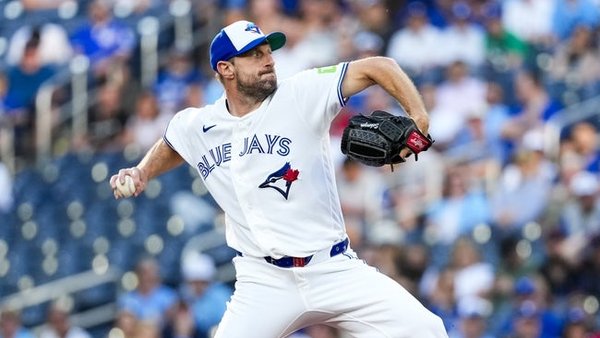
Kauffman Stadium’s run-suppressing park factor meets two ERA-damaged starters — Scherzer at a bloated 6.16 and Lugo at 5.03 — yet the market has posted a 9.5 total off last night’s nine-run blowout. The structural signals for tonight point meaningfully lower than the number the sportsbook is carrying into first pitch.
Max Scherzer vs. Seth Lugo: Toronto Blue Jays at Kansas City Royals Betting Preview
After Toronto’s 9-2 demolition of Kansas City on Friday night, the market has reset with a 9.5 total — and that number feels a half-run too generous. The Blue Jays scored in bunches with four in the first inning, Alejandro Kirk and Ernie Clement doing the damage against a struggling Daniel Lynch. Tonight, the pitching matchup shifts significantly, and neither arm inspires confidence on paper. But the structure of this game — a mild pitcher’s park, two mediocre offenses, and a Scherzer start that almost guarantees a short leash — points toward a quieter evening than the market is pricing.
The core thesis here isn’t that these starters are good. They aren’t. Max Scherzer carries a bloated 6.16 ERA in just 57.0 innings. Seth Lugo has logged 154 innings but posted a 5.03 ERA and a 1.42 WHIP. The market knows both arms are compromised — that’s why the 9.5 total exists. The question is whether the combination of park suppression, mediocre lineups, and Scherzer’s near-certain early exit creates a game that stays under that number. The numbers say yes.
Both rosters carry elevated strikeout rates — Toronto has recorded 1,025 strikeouts and Kansas City 1,107. High-K lineups don’t generate crooked numbers consistently. That’s the structural lean toward the Under, and the under is available at -108, meaning there’s no vig penalty to stomach on this side.
Game Info & Betting Lines
- Date/Time: Saturday, September 5, 2026 | 7:10 PM ET
- Venue: Kauffman Stadium | Park Factor: 0.95 (run-suppressing)
- TV: MLB.TV, Royals.TV, Sportsnet, TVA
- Probable Starters: Max Scherzer (TOR) vs. Seth Lugo (KC)
- Moneyline: Toronto Blue Jays -108 / Kansas City Royals -111
- Run Line: Kansas City Royals +1.5 (-178) / Toronto Blue Jays -1.5 (+146)
- Total: 9.5 (Over -112 / Under -108)
Why This Number Is Off
The market is doing something rational here. It’s pricing in two ERA-damaged starters, a Toronto lineup that just put up nine runs, and the general chaos of September roster games. That’s why 9.5 exists — the sportsbook is leaning into last night’s offensive explosion and the perception that neither pitcher can stop a crooked number.
But the legitimate case for the Over rests on Scherzer’s volatility, not the overall game environment. Strip that out and what’s left? Toronto’s OPS sits at .691 — not a lineup that consistently beats up on pitching. Kansas City’s OPS is .719, marginally better, but the Royals are 63-79 with a -92 run differential. They score in clusters and then go quiet for stretches. This is not a reliable Over engine regardless of who’s pitching.
Kauffman Stadium’s 0.95 park factor adds a layer of suppression — nothing dramatic, but a nudge in the right direction. The bigger driver is the gap between what the numbers project and what the market has posted: a combined run total of 8.8 projected runs against a 9.5 posted total. That 0.7-run margin is meaningful when the juice is -108, not -130. The market has set the number for the drama of last night; the structural signals point lower.
What Separates the Pitching
Comparing these two arms honestly: Lugo is the more reliable bet to give you length, and Scherzer is the more dangerous liability in this specific spot. That gap matters for how the game shapes up.
Seth Lugo is working with a diverse nine-pitch arsenal and 154 innings of workload, meaning he’s not going to be on a strict count tonight. His sinker sits at 91.5 mph and is his primary offering at 19.6% usage, though it carries a punishing .397 xwOBA against. His 4-seam fastball (.396 xwOBA) gets hit similarly hard. Where Lugo finds his edge is his cutter (21.5% whiff rate, .345 xwOBA) and his curveball (19.3% whiff rate, .286 xwOBA). His slow curve, used just 2.5% of the time, is actually his sharpest put-away weapon at 33.3% whiff and a microscopic .106 xwOBA. Lugo’s profile is not a strikeout arm — his 6.9 K/9 reflects a pitch-to-contact approach — but the cutter and curveball combination limits the kind of damage that inflates totals. Kazuma Okamoto, Toronto’s most dangerous hitter by xwOBA (.414), carries a 30.9% whiff rate. Lugo’s curveball is a natural weapon against him.
Max Scherzer is a different story. His four-seamer sits at 93.3 mph at 47.9% usage and holds a .345 xwOBA against with only a 15.3% whiff rate — a number that signals hitters are making contact consistently. His curveball at 31.3% whiff and .288 xwOBA is still his best swing-and-miss pitch. The concern is Jac Caglianone batting third for KC: he carries a .463 xwOBA and 34.8% hard-hit rate against right-handed pitching with a .492 xwOBA vs. RHP. Scherzer’s flat fastball is exactly the pitch Caglianone is built to punish. With just 57.0 innings logged this season, Scherzer is almost certainly on a 60-70 pitch limit. That means a quick exit — and a funnel into Toronto’s bullpen. The Blue Jays carry a staff ERA of 3.91, and their relievers handled seven solid innings in last night’s win, so the backend isn’t a disaster. But the structural problem is that Scherzer’s early exit compresses the game into higher-leverage, higher-variance situations.
Pushback: The Case Against the Under
The honest case for the Over isn’t frivolous. Caglianone against Scherzer’s flattening fastball is a genuine threat — a .492 xwOBA vs. RHP and 34.8% hard-hit rate means one mis-located four-seamer could turn into a multi-run inning in a hurry. Lugo’s 1.42 WHIP is also a real concern: he generates a lot of base traffic, and a cluster of singles against a high-K Toronto lineup could manufacture runs even without Lugo getting hit hard. And Toronto’s bullpen, while generally effective, is operating with a depleted roster. The injuries to Jose Berrios, Shane Bieber, Jameson Taillon, and Patrick Corbin mean the backend carries real volatility on a back-to-back. If Scherzer exits by the fourth inning, the Blue Jays could be burning through arms in a game that suddenly escalates. These are legitimate concerns, and I’m not dismissing them.
Angles Considered and Passed
Two other markets got a hard look here and didn’t survive the cut. The Kansas City run line at -1.5 (-178) is priced like a near-lock for a team that is 63-79 with a -92 run differential — that’s far too much to pay for a club that scores in clusters and fades. I don’t lay -178 on a below-.500 team regardless of the structural matchup. The Toronto moneyline at -108 is more tempting on paper, but Scherzer’s volatility is a ceiling-capper: one bad inning against Caglianone or Witt Jr. and the game flips. The moneyline needs the starter to hold, and holding is exactly what Scherzer has struggled to do this season. Both angles were considered; both were set aside in favor of the total.
Run Environment & Game Shape
The broader run environment here supports a contained game. Kauffman Stadium’s 0.95 park factor shades run totals modestly downward. Toronto’s .691 OPS ranks them among the game’s quieter offenses, and while their last two series produced big numbers, those came against Cleveland’s rotation depth and a struggling Lynch — not against a veteran pitcher working with nine pitches and 154 innings of stamina behind him. Kansas City’s lineup, despite Caglianone and Witt Jr., still belongs to a 63-79 team with a -92 run differential. The underlying quality isn’t there to consistently push totals past 9.5 against any functional pitching.
The game shape leans toward a moderate-scoring contest that stays in the 8-9 run range. Lugo pitches deep into the game on no count restrictions. Scherzer likely exits by the fourth or fifth inning, handing off to a Toronto bullpen that, injuries and all, still carries a 3.91 staff ERA. That’s not a sieve. The path to the Over requires Scherzer to implode early, the bullpen to pile on, and Lugo’s base traffic to turn into multiple crooked innings — a lot of things going wrong simultaneously in the same direction. The path to the Under is simply that two mediocre offenses, one solid long-inning pitcher, and a mild suppression park combine to produce what they usually produce: a game in the 8-9 run range.
The Pick
The Under at 9.5 requires a convergence of suppression factors rather than a single dominant edge — and that’s exactly what this game offers. The 8.8 combined run projection sits 0.7 runs below the posted total, Kauffman’s park factor nudges the environment downward, and neither offense is capable of consistently generating the kind of sustained attack needed to push past 9.5. At -108, there’s no vig tax for being right.
Bet: Under 9.5 (-108) | 1 unit | Lean — the projection gap, park suppression, and two mediocre offenses combine to make 9.5 a half-run too many for this environment.