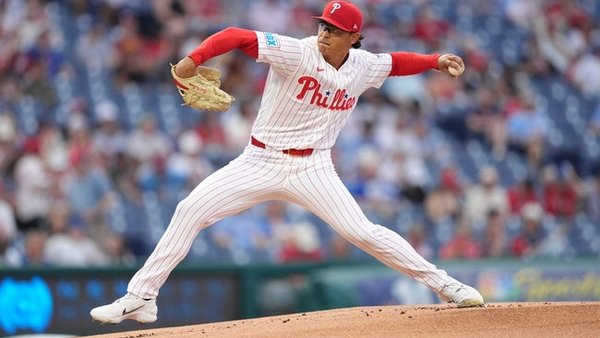
Jesus Luzardo’s 44.8% whiff-rate sweeper and 11.09 K/9 represent a different tier of pitching than what Grant Holmes brings to the mound — yet the total of 8.0 sits at flat juice as though these two starters are interchangeable. The asymmetry between a traffic-limiting ace and a contact-management arm shapes a run environment the number has not fully accounted for.
Grant Holmes vs Jesus Luzardo: Atlanta Braves at Philadelphia Phillies Betting Preview
After Atlanta’s eighth-inning rally stole a 5-4 win on Sunday, this four-game series finale shifts the spotlight to two starters who tell very different stories. The Phillies went to bed last night having wasted an Aaron Nola gem, and now they send their ace to close the series. The market has priced this game with a total of 8.0 runs — a number that looks almost mechanically correct — but the pitching gap between these two arms is significant enough to push outcomes below that line more often than not.
The core thesis here is straightforward: Jesus Luzardo is one of the best starters in the National League, and his presence in this game fundamentally compresses the expected run environment. The 8.0 total is already cautious by Citizens Bank Park standards, but when you account for Luzardo’s elite strikeout rate, Atlanta’s lineup cooling off, and a Philadelphia offense that doesn’t overwhelm anyone, the under at flat juice is the right expression of this pitching matchup.
The noise around this series — Atlanta extending their NL East lead to five games, Acuña’s 1,000th career hit — is irrelevant to the bet. What matters is who’s taking the ball Monday and what the price is asking us to believe about run production.
Game Info & Betting Lines
- Date/Time: Monday, September 7, 2026 | 1:05 PM ET
- Venue: Citizens Bank Park | Park Factor: 1.02 (near-neutral)
- TV: MLB.TV, BravesVision, NBC 10
- Away Starter: Grant Holmes (9-5, 3.62 ERA, 1.31 WHIP, 131.2 IP)
- Home Starter: Jesus Luzardo (13-5, 3.02 ERA, 1.12 WHIP, 169.2 IP)
- Moneyline: Atlanta Braves +139 / Philadelphia Phillies -168
- Run Line: Philadelphia Phillies -1.5 (+128) / Atlanta Braves +1.5 (-154)
- Total: 8.0 (Over -110 / Under -110)
Why This Number Is Close — But Slightly Off
The market has landed on 8.0 runs for good reason. Citizens Bank Park is essentially neutral at a 1.02 park factor — not a suppression environment like Oracle, not an inflation chamber like Coors. Both offenses are legitimate: Atlanta carries a .725 OPS and has averaged 4.65 runs per game this season, while Philadelphia sits at .712 OPS with 4.48 runs per game. On a straight-line calculation, 8.0 to 8.5 is exactly where this total should be.
The legitimate case for the over is real. Holmes has allowed 19 home runs on the season — a rate that exposes him to the Phillies’ power core. Kyle Schwarber (42 HR, xwOBA .505) and Bryce Harper (.891 OPS) can go deep in a single swing, and Acuña’s 100.5-mph blast on Sunday is a reminder that Atlanta isn’t without pop either. The market isn’t wrong to price this at 8.0.
But here’s where I think the number is slightly off: it doesn’t fully weight the asymmetry between the two starters. Luzardo’s strikeout profile and elite WHIP don’t just limit runs — they create a specific type of inning that keeps pressure off both benches. When one starter is generating 11-plus punchouts per nine innings and the other is posting 7.11, the run environment doesn’t split evenly. The numbers project 9.1 combined, which technically sits over — but that’s the raw output before you apply the variance compression that an ace-level arm provides.
What Separates the Pitching
The gap between these two starters is the argument for the under, and it starts with Luzardo’s arsenal. His sweeper is the best pitch in this game: 37.5% usage, 86.0 mph, 44.8% whiff rate, and a .181 xwOBA against — that’s a genuine swing-and-miss weapon that makes even disciplined hitters uncomfortable. He backs it with a 96.8 mph four-seam fastball (25.4% usage, .316 xwOBA against) and an 86.0 mph changeup generating 36.8% whiff rate. Three of his four primary pitches produce xwOBA marks below .325. Against Atlanta’s lineup, the matchups favor him: Matt Olson is hitting .185 in 27 plate appearances against Luzardo with 8 strikeouts, and Michael Harris II has fanned 7 times in just 15 plate appearances. Luzardo’s 11.09 K/9 isn’t a fluke — the underlying stuff backs every strikeout total he posts.
Holmes is a different animal. His best offering is a slider running 39.5% whiff rate at just .296 xwOBA against, and his curveball posts a .241 xwOBA — genuine quality in the breaking-ball department. But his four-seam fastball at 94.1 mph yields a .381 xwOBA against, and his sinker and cutter both sit above .400 xwOBA against. That’s a profile of a pitcher who sequences well and limits damage but doesn’t rack up empty at-bats. His 7.11 K/9 confirms it — he pitches to contact, which means the Phillies’ power bats stay in play. Schwarber’s .512 xwOBA against left-handed pitching and Harper’s .487 xwOBA against righties show this lineup doesn’t go quietly when the matchups break their way.
The type of innings each pitcher creates matters here. Luzardo generates three-pitch strikeouts and weak contact — low-stress, low-traffic innings that keep pitch counts manageable and prevent crooked numbers. Holmes generates outs but invites baserunners at a higher rate (1.31 WHIP vs. Luzardo’s 1.12). In a game where one starter is actively suppressing traffic and the other is managing it, the combined scoring profile skews lower than the raw total implies.
Bullpen & Injury Context
Both bullpens enter Monday with some attrition. Atlanta is without Robert Suarez (60-day IL, elbow), Spencer Strider (60-day IL, elbow), Joey Wentz (60-day IL, knee), and Reynaldo Lopez (15-day IL, knee) — a significant chunk of unavailable arms that could shorten Holmes’s leash if he runs into trouble. Philadelphia is missing Tanner Banks, Brad Keller, and Caleb Kilian from the relief corps, which limits their own depth options late. Neither bullpen is at full strength, but the injury attrition roughly balances out and doesn’t dramatically shift the run environment in either direction.
Run Environment & Game Shape
Here’s how I see this game playing out: Luzardo goes six or seven innings, posts eight-plus strikeouts, and holds Atlanta to two runs or fewer. Holmes is the variable — he’s capable of navigating five or six innings cleanly, but Schwarber and Harper represent genuine single-swing danger. If Holmes escapes the first three innings without giving up a crooked number, this game shapes up as a 3-2 or 4-3 final. If he catches bad luck against the top of the Phillies’ order, you might see a 5-2 finish — still under 8.0.
The market is pricing this as a pitcher’s duel between two solid starters, and that framing is mostly correct. What it doesn’t fully account for is the degree to which Luzardo’s elite profile pulls the ceiling down on Atlanta’s half of the ledger. With a .185 average against him in 27 plate appearances from Olson, 7 strikeouts in 15 PA from Harris, and Acuña hitting .267 in 18 PA with 4 strikeouts, the heart of this Atlanta lineup has a documented history of struggling against Luzardo’s arsenal. That’s the edge — not a dramatic market inefficiency, but a consistent lean toward a final score that clears the under at 8.0.
At flat juice on both sides, there’s no premium to pay. This is a clean, moderate-confidence play on the pitching matchup doing what the numbers suggest it should.
Bet: Under 8.0 (flat juice, -110)
Units: 2u
Confidence: Moderate