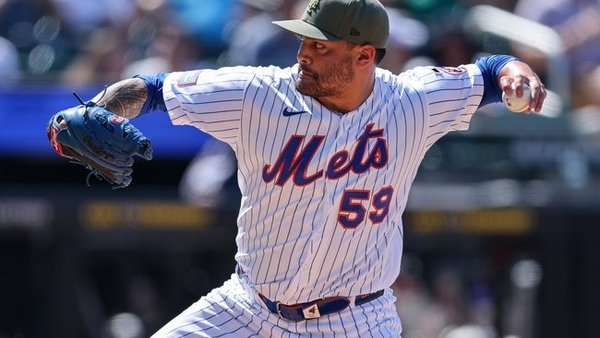
Sandy Alcantara’s sinker and arsenal profile represent a legitimate step up from what the Mets saw yesterday, but the market has already priced most of that gap into a -136 number. Miami’s depleted bullpen — four relievers unavailable — and a projected scoring margin of just 0.3 runs keep this from being anything more than a cautious lean.
Sean Manaea vs. Sandy Alcantara: New York Mets at Miami Marlins Betting Preview
After yesterday’s 9-4 Mets blowout — fueled by 16 hits off a shaky Eury Pérez — the series finale brings a dramatically different pitching matchup. The market has responded accordingly, installing Sandy Alcantara as a -136 favorite. The arm advantage is legitimate. But -136 on a lean is not the same as -136 on a conviction play, and the distinction matters here.
The core thesis is straightforward: Alcantara is an ace-caliber arm facing a Mets rotation piece whose numbers have been quietly damaging all season. That gap should translate to a Miami edge. The question is whether the price tag accurately reflects that edge — or whether the market has already closed most of it, leaving bettors with thinner margin than the name recognition suggests.
Miami’s lineup carries a legitimate offensive advantage over New York’s group (.725 OPS vs. .699), and the home environment at loanDepot park — a slight run-suppressing dome — amplifies the value of the better starting pitcher. That’s the scaffolding. But the -136 juice demands scrutiny before any money moves.
Game Info & Betting Lines
- Date/Time: Tuesday, September 8, 2026 — 6:40 PM ET
- Venue: loanDepot park (Dome) | Park Factor: 0.95 (slight run suppressor)
- TV: MLB.TV, Marlins.TV, SNY
- Probable Starters: Sean Manaea (NYM) vs. Sandy Alcantara (MIA)
- Moneyline: New York Mets +113 / Miami Marlins -136
- Run Line: Miami Marlins -1.5 (+152) / New York Mets +1.5 (-184)
- Total: 8.0 (Over -111 / Under -109)
Why This Number Is Close
The market is doing something sensible here. Alcantara’s 3.54 ERA and 1.19 WHIP over 195.2 innings represent a legitimate workload ace, and the books have priced that accordingly. On paper, -136 doesn’t look outrageous for a starter of his caliber against a Mets team sitting at 66-78 with a .699 OPS.
But here’s the problem: the numbers project this as a near-coin-flip in actual run output — Miami 4.5, New York 4.2. That’s a 0.3-run projected margin. When the gap between projected scores is that thin, paying -136 on the moneyline means you’re absorbing significant juice on a game the numbers say could go either way. The market’s pricing of the pitching gap is reasonable — it’s not egregiously wrong. It’s just priced tight enough that the edge disappears into the juice.
The legitimate case for Miami at -136 is Alcantara vs. Manaea. That’s a real qualitative difference. But the Mets offense, led by Juan Soto’s .922 OPS and his .436 xwOBA, is capable of making any starter uncomfortable on a given night. The market knows this. -136 is the price of that knowledge — and it’s close to where I’d stop paying.
What Separates the Pitching
The gap between these two arms is real, but it shows up differently than the raw ERA difference suggests. Sandy Alcantara operates with a sinker that sits at 97.3 mph and generates a .294 xwOBA against — a pitch that induces ground balls and keeps the ball in the park. His changeup at 90.8 mph is a legitimate swing-and-miss weapon, posting a 25.5% whiff rate that drives its .270 xwOBA. His slider is particularly brutal: a .199 xwOBA against with 25.0% whiff. Alcantara creates soft contact and weak swings at a rate that keeps run totals suppressed.
Sean Manaea is a different profile entirely — and critically, he’s a left-handed pitcher, which reshapes how you evaluate Miami’s lineup against him. His four-seam fastball sits at 91.1 mph — nearly six full ticks below Alcantara’s sinker — and his sweeper at 75.7 mph generates a 30.2% whiff rate, which is his best weapon. But his sinker carries a .398 xwOBA against, and his cutter isn’t much better at .388. The exposure to hard contact is real.
The most telling number is Manaea’s HR rate: 21 home runs allowed in just 128.1 innings, a 1.47 HR/9 that is genuinely alarming. But the handedness split matters here. Against a left-handed pitcher, Kyle Stowers‘ xwOBA drops sharply to .348 (vs. .487 against right-handers) — he’s actually one of the least threatening bats in this lineup tonight. The real danger is Heriberto Hernández, whose vsLHP xwOBA of .496 makes him the hitter Manaea has to fear most. Hernández has the barrel rate (7.7%) and 24 home runs to back it up, and lefties genuinely do not quiet him down. Griffin Conine sits in between at .414 vsLHP — a moderate threat who can still punish a mistake, but meaningfully less dangerous than Hernández in this specific matchup. The short version: don’t lump all three together as equal threats against a lefty arm. Hernández is the problem. Stowers is the soft spot.
Alcantara creating early contact outs and Manaea leaking barrels: that’s the shape of the gap. It’s not a dominant vs. replacement-level mismatch, but it’s meaningful in a dome environment that already suppresses scoring.
The Pushback
The concern here is layered. First, Miami’s bullpen is carrying significant injury damage — Andrew Nardi, Pete Fairbanks, Anthony Bender, and William Kempner are all unavailable. That’s four relievers stripped from the backend of a bullpen that needs to protect a lead. If Alcantara exits early or loses the zone mid-game, the bridge options are thin.
Second, the Mets just scored nine runs on 16 hits yesterday. That’s not a cold offense — that’s a team that can string contact together. Juan Soto’s .436 xwOBA is the kind of number that doesn’t disappear overnight, and his BvP against Alcantara (40 PA, .257, 1 HR) suggests some familiarity with the arsenal. The bullpen exposure and a functional Mets lineup are the two reasons this isn’t a comfortable -136 play.
Why the Run Line Was Dismissed
The run line at Miami -1.5 (+152) drew a look. The plus-money price is attractive on paper, and there’s genuine model interest given the starter gap. But the projected margin here is 0.3 runs — Miami 4.5, New York 4.2. A bet that requires a multi-run victory to cash is hard to justify when the numbers barely project a single-run edge. The juice on the moneyline is already a problem; committing to a spread on a coin-flip margin is compounding the mistake. The run line gets filed away and not touched.
Joe Jensen’s Pick
I like the side. I don’t love the price. The -136 tag pushes this past the threshold where I’m comfortable committing standalone units — my ceiling on a lean is -130, and this clears that by six cents. That’s not a massive overage, but it’s enough to keep real money off the table. The edge survives the scrutiny — barely — but surviving isn’t the same as thriving at this price.
If you’re building a parlay and need a home-side leg for tonight’s slate, Miami is a reasonable inclusion at -136 — the Alcantara-vs.-Manaea gap is real, the dome suppresses variance, and Hernández is a genuine threat to put a ball in the seats against a leaky left-hander. But as a standalone bet? The juice doesn’t cooperate. Treat this as beer money or fold it into a multi-leg ticket — not a spot to load up.
Bet: Miami Marlins Moneyline | 0 Units (Parlay Leg / Beer Money Only)