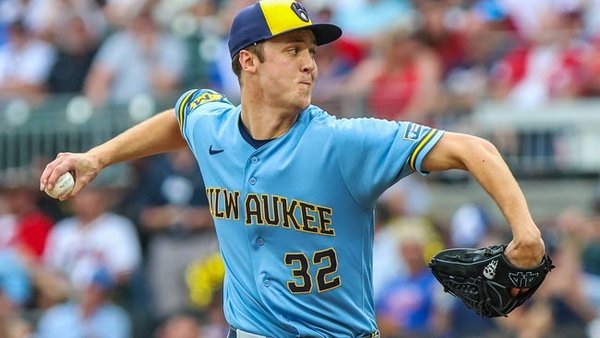
David Peterson’s 5.39 ERA and 1.56 WHIP point one direction — Jacob Misiorowski’s 1.97 ERA across 155 innings points another. The total sits at 7.5 with the Under priced at -120, and the entire case hinges on whether one historically dominant arm can suppress a combined run environment that raw projections have clearing 9.
David Peterson vs. Jacob Misiorowski: Chicago Cubs at Milwaukee Brewers Betting Preview
After Jackson Chourio’s two-run single broke open a tight eighth inning and gave the Brewers a 4-3 win Monday night, this series shifts dramatically on the mound. Matthew Boyd held Milwaukee quiet for seven innings in Game 1. Tonight, the Cubs send David Peterson — a pitcher with a 5.39 ERA and 1.56 WHIP — against arguably the best starter in baseball this season. That mismatch is the entire conversation.
The total is set at 7.5 with the Under priced at -120. The market already leans Under, and that’s not an accident. The question isn’t whether the market is wrong — it’s whether Jacob Misiorowski‘s dominance is large enough to pull the combined run environment below a number that Peterson’s track record seems designed to inflate. I think it is, and the Cubs’ injury situation amplifies that lean.
Milwaukee’s moneyline sits at -219, which eliminates that bet entirely. At that price, you’re paying too much for a result that should happen. The Under at -120 is the only clean vehicle for expressing the pitching edge here, and the case for it is built almost entirely on one arm.
Game Info & Betting Lines
- Date/Time: Tuesday, September 8, 2026 | 7:40 PM ET
- Venue: American Family Field (Park Factor: 1.00 — neutral run environment, dome)
- Probable Starters: David Peterson (CHC) vs. Jacob Misiorowski (MIL)
- Moneyline: Cubs +179 / Brewers -219
- Run Line: Brewers -1.5 (+101) / Cubs +1.5 (-122)
- Total: 7.5 (Over +100 / Under -120)
Why This Number Is Close — But Leans Under
The market is balancing two competing forces. On one side, Peterson’s 5.39 ERA suggests the Brewers’ half of the ledger could easily reach four or five runs on its own. On the other, Misiorowski’s 1.97 ERA over 155 innings is the kind of number that structurally suppresses an opponent’s run total regardless of lineup quality. The 7.5 total reflects that tension — it’s not a naive number.
The legitimate case for the Over is straightforward: Peterson has been consistently hittable all season, the Cubs’ bullpen is decimated with six relievers on the injured list, and a blowup inning is a real possibility. Jackson Chourio (.455, 2 HR in 12 plate appearances against Peterson) and Jake Bauers (.452 xwOBA, 8.1% barrel rate) represent genuine damage threats. A combined projected total north of 9 runs would cash the Over comfortably.
But here’s where I part ways with that lean: the 9.1 projected figure assumes the Cubs score roughly 4.1 runs. Against Misiorowski, who has held opposing lineups to a 1.97 ERA across 155 innings this season, 4.1 feels like a ceiling, not an expectation. Strip away the Cubs’ half, and you need Milwaukee to contribute five or more against Peterson alone to push past 7.5 — possible, but not the base case given Milwaukee’s .738 team OPS.
What Separates the Pitching
The gap between these two starters is as wide as any you’ll see in a regular-season game this late in September. Misiorowski’s four-seam fastball sits at 100.4 mph and generates a 36.0% whiff rate — deployed on 61.8% of his pitches — holding hitters to a .234 xwOBA. His curveball is the secondary equalizer: 87.6 mph with a staggering 43.5% whiff rate and a .155 xwOBA against. When a pitcher can pair a triple-digit heater with a breaking ball that hitters miss nearly half the time they swing, lineup quality becomes secondary. His 13.18 K/9 (227 strikeouts in 155 IP) projects to seven or eight punchouts in a standard outing, which means the Cubs will burn through a significant chunk of their at-bats without reaching base.
The BvP data is telling: Pete Crow-Armstrong, the Cubs’ most dangerous hitter with 41 home runs and a .953 OPS, is 0-for-15 with 10 strikeouts against Misiorowski in 15 plate appearances. Ian Happ’s BvP line shows .125 with 9 strikeouts in 18 PA. These aren’t small samples anymore — they’re a pattern.
Peterson operates in a completely different run environment. His sinker (30.6% usage, 92.0 mph) carries a .427 xwOBA against — an invitation for hard contact. His slider is his best pitch (.254 xwOBA, 28.0% whiff rate), but it accounts for only 22.2% of his arsenal. Chourio and Bauers both post elevated xwOBA figures against left-handed pitching, and Peterson doesn’t miss enough bats to compensate for command issues — his 1.56 WHIP confirms the baserunner volume. The innings these two pitchers create are fundamentally different: Misiorowski generates quick outs and strikeouts; Peterson generates traffic and contact.
The Pushback
The most honest concern here is that the numbers this game generates disagree with this bet. A combined projection of 9.1 runs doesn’t just clear 7.5 — it obliterates it. When the raw edge is pointing this hard at the Over, the burden of proof falls on the Under thesis.
The Cubs’ bullpen situation is the specific wildcard that makes me hesitate. With Porter Hodge, Hunter Harvey, Ben Brown, Riley Martin, Phil Maton, and Gavin Hollowell all on the IL, Chicago’s relief depth is thin. If Peterson exits early — and his 5.39 ERA suggests that’s more likely than not — the Cubs could be turning to their deepest available arms in high-leverage spots. That’s how Over tickets get cashed in a hurry.
But there’s a counter to that concern: even if Peterson implodes and Milwaukee runs up five or six runs in a blowup inning, Misiorowski is still on the other side limiting Chicago’s response. The Over in this game requires both halves of the ledger to contribute. The Cubs going 0-for-15 with 10 strikeouts from their best hitter alone suggests that’s a tall order. Peterson’s volatility is real, but one team’s bullpen collapse doesn’t automatically create a high-scoring game when the opposing starter is this dominant.
Angles I Rejected
The Brewers moneyline at -219 was a non-starter. That’s not value — that’s paying a premium for inevitability. Even if Milwaukee wins 83% of the time in this spot, the price doesn’t compensate you adequately for the 17% scenario where Peterson catches lightning in a bottle and the Cubs steal one. I don’t buy chalk at those prices on principle.
The run line at Brewers -1.5 (+101) is more interesting, and I understand the appeal. Milwaukee wins by two or more often enough that the plus-money price looks attractive. But Peterson’s volatility cuts both ways here. He’s capable of a short, ugly start that hands Milwaukee a five-run blowout, and he’s equally capable of grinding through five innings in a 2-1 game. That unpredictability makes the run line harder to trust than the total, where Misiorowski’s floor does most of the structural work regardless of how Peterson performs.
Game Shape: How the Under Cashes
The Under doesn’t need a pitching duel. It just needs Misiorowski to be Misiorowski. Here are the score combinations that get there:
- Milwaukee 4, Chicago 2 — Peterson allows three to four runs through five innings, Misiorowski limits the Cubs to two with six or seven strikeouts. This is the base case.
- Milwaukee 5, Chicago 2 — Peterson gets touched for a blowup inning, exits early, but Misiorowski holds the Cubs to two runs or fewer. Total still lands at 7.
- Milwaukee 3, Chicago 1 — Both starters are sharp, Peterson catches a clean lineup, Misiorowski deals a gem. Lower-probability but firmly in play given his 1.97 ERA.
- Milwaukee 6, Chicago 1 — Peterson gets knocked around but Misiorowski is dominant. The math still works at 7.
The common thread: Misiorowski’s floor keeps the Cubs’ run contribution capped. Even in the scenarios where Peterson struggles, the Under survives as long as Chicago can’t answer back. Given the 0-for-15 and .125 BvP lines from the top two spots in their order, the Cubs answering back is the hard part.
The Bet
The gap between these two starters is real, measurable, and directly reflected in the xwOBA and whiff rate data. Misiorowski’s 43.5% curveball whiff rate and .155 xwOBA against on that pitch alone tells you what the Cubs are dealing with. Peterson’s .427 xwOBA against on his primary pitch tells you what Milwaukee is getting. The Under at -120 is a two-unit play that doesn’t require the market to be wrong — it just requires Misiorowski to be who he’s been all season.
Bet: Total Under 7.5 (-120) — 2 Units — Moderate Confidence