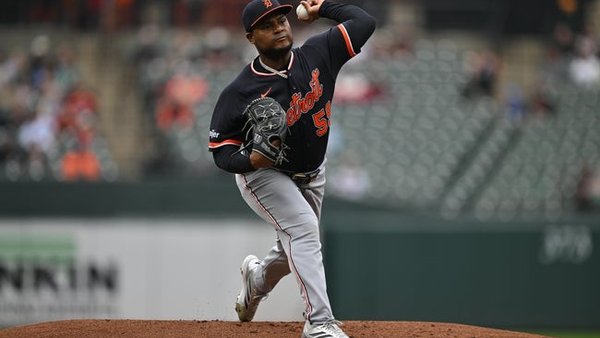
Framber Valdez’s curveball (30.3% whiff rate) and slider (41% whiff rate, .147 xwOBA-against) are built for exactly the lineup he faces — Washington ranks among the highest strikeout teams in baseball at 1,319 on the season. The total sits at 8.0, but the run environment shaped by Valdez’s ground-ball profile and Comerica’s neutral park factor tells a different story than the market is fully pricing.
Richard Lovelady vs Framber Valdez: Washington Nationals at Detroit Tigers Betting Preview
After CJ Abrams went yard twice in Tuesday night’s 3-1 Nationals win — including a go-ahead two-run shot in the seventh — the series finale shifts the pitching picture entirely. Washington used an opener format and got four innings from Jackson Kent. Today, it’s Framber Valdez anchoring the Detroit side against a Washington lineup that punishes pitchers who make mistakes, but also strikes out at a staggering rate.
The posted total is 8.0 — reasonable on the surface. But once you examine what Valdez actually does to contact-challenged lineups, and how little punch Detroit’s cold offense is generating in late September, that number starts to look like a market concession to reputation rather than a reflection of today’s game shape.
The Detroit moneyline is priced at -180, which immediately kills that avenue. The run lines don’t offer a clean directional read either. The cleanest market here is the total — and specifically, the Under.
Game Info & Betting Lines
- Date/Time: Wednesday, September 23, 2026 | 1:10 PM ET
- Venue: Comerica Park | Park Factor: 0.99 (neutral)
- Away Starter: Richard Lovelady (3-4, 3.86 ERA, 32.2 IP)
- Home Starter: Framber Valdez (10-11, 4.06 ERA, 168.2 IP)
- Moneyline: Washington Nationals +148 / Detroit Tigers -180
- Run Line: Detroit Tigers -1.5 (+123) / Washington Nationals +1.5 (-148)
- Total: 8.0 (Over -108 / Under -112)
Why This Number Is Close — But Slightly Off
The market is doing something sensible here. It sees a neutral park (0.99 factor), a quality starter in Valdez, and an opener-type on the Washington side who won’t last deep. That logic produces an 8.0 total — not low, not high, just balanced. The case for the Over is legitimate: Lovelady’s 1.84 WHIP in only 32.2 innings signals he’s a short leash arm whose early exit hands things over to middle relief, and Detroit’s bullpen has been uneven enough to allow crooked numbers.
But here’s where I think the market slightly miscalibrates. Washington’s lineup strikes out at an enormous rate — 1,319 team strikeouts on the season, among the highest marks in baseball and exactly the kind of opponent profile that plays into Valdez’s hands. That’s not the highest total of the two teams in this game — Detroit’s lineup has actually racked up 1,372 strikeouts this year — but Washington’s rate is still elite K-exposure territory and the side that matters most when Valdez is on the mound. That profile doesn’t generate the multi-baserunner, grind-it-out innings that push totals over. And Valdez’s ground-ball style doesn’t create the fly-ball run environments this total needs to clear. Comerica’s neutral factor means there’s no park-driven inflation to bail out the Over.
The under at -112 is a modest price for a game anchored by one of the most reliable innings-eaters in the American League. The cushion is thin — 0.6 projected runs against the posted line — but the direction is right.
What Separates the Pitching
The gap between these two arms is real, and it starts with volume and command. Framber Valdez has logged 168.2 innings this season with a 1.36 WHIP and only 16 home runs allowed — one per roughly 10.5 innings. His arsenal is built for exactly this type of opponent. His sinker sits at 93.8 mph and accounts for 44.3% of his pitches, generating a 9.1% whiff rate. It’s worth noting the sinker carries a .381 xwOBA-against — not an elite suppression number, making it more of a ground-ball inducer than a true swing-and-miss offering. The heavy lifting on the strikeout side comes from his secondary weapons. His curveball — 29.3% usage, 78.4 mph, 30.3% whiff rate, .258 xwOBA-against — is a genuine put-away pitch. His changeup adds an 18.3% usage share with a .319 xwOBA-against. And then there’s the slider: used sparingly at 4.5% of pitches, but Valdez’s sharpest weapon by the numbers — a 41% whiff rate and a .147 xwOBA-against that is genuinely elite. Against Washington’s high-strikeout lineup, that combination of slow curve and late-breaking slider creates exactly the kind of empty swings and weak contact that suppresses scoring.
James Wood, Washington’s most dangerous bat with an xwOBA of .539 and a 9.9% barrel rate, is a legitimate threat — but he’s also carrying a 29.0% strikeout rate and a 28.8% whiff rate that Valdez’s curveball and slider were designed to exploit. CJ Abrams (who torched Detroit last night) has only 8 PA against Valdez with one homer, but his .377 xwOBA vs. lefties suggests he’s the primary danger in this lineup.
Richard Lovelady is a different animal — a 32.2-inning opener with a 1.84 WHIP and 21 walks in limited work. His sweeper is his best offering — 43.9% usage, 24.6% whiff rate, xwOBA-against of .293. But his sinker is getting punished (.429 xwOBA-against), and his slider is essentially unusable (.625 xwOBA-against in small usage). Detroit’s lineup — led by Eduardo Valencia (.449 xwOBA, .477 vs. lefties) and Riley Greene (.472 xwOBA) — will see Lovelady early and stress his command immediately. The innings gap here is stark: Valdez is a 6-inning engine; Lovelady is a 2-3 inning opener at best.
The Pushback
Here’s where this bet almost falls apart. The numbers project a combined 9.4 runs — that’s 1.4 runs above the posted total of 8.0. If you trust that output, you’re technically betting against it. The Under requires Valdez to outperform the projection, not confirm it.
I’m comfortable with that tension for two reasons. First, late-September games between two 74-84 teams carry real variance in effort and roster management — Detroit may not push Valdez deep if the game gets out of hand early, but a motivated Valdez on a home mound in a series finale is a different animal than the average start that fed the seasonal averages behind that projection. Second, the structural advantages here — Valdez’s elite secondary weapons against a lineup built to strike out, versus Lovelady’s command issues against a Detroit lineup that can get deep counts — still point toward a suppressed scoring environment that the projection may not fully weight.
Rejected Angles
The Detroit -180 moneyline is dead on arrival. Even granting a healthy win probability advantage for the Tigers, paying -180 in a game where the away team’s ace (Abrams) just went deep twice 24 hours ago is not how you build a sustainable betting edge. The price demands too much juice for too little cushion against a Washington club that’s 7-3 in its last 10.
The run line similarly fails the value test. Detroit -1.5 at +123 is an interesting number, but it requires Valdez to both dominate and get run support — two separate conditions, both of which have to hit. With Lovelady’s command problems making the Detroit offense capable of early noise, the run line outcome is too dependent on variables stacking perfectly. The Under captures the pitching edge without needing Detroit to run away with it.
Joe Jensen’s Pick
This is a Framber Valdez game. His curveball (.258 xwOBA-against, 30.3% whiff) and slider (.147 xwOBA-against, 41% whiff) give him two legitimate put-away weapons against a Washington lineup that posts 1,319 team strikeouts — among the highest in baseball. Lovelady’s 1.84 WHIP means Detroit will have chances to score, but scoring early and often enough to push a combined total past 8.0 against a ground-ball workhorse is a different task. The neutral park (0.99) removes any inflation cushion.
Projected score: Detroit Tigers 4.9, Washington Nationals 4.5.
Bet: Under 8.0 — 2 units, moderate confidence. Valdez’s secondary arsenal profiles well against Washington’s strikeout-heavy lineup, and the pitching gap between a 168-inning workhorse and a 32-inning opener is wide enough to cap this game below the market’s number even with Lovelady running into trouble early.